Trial Key to Pacific Northwest Lepiota and Allies
Prepared for the Pacific Northwest Key Council
Richard E. Sieger, Puget Sound Mycological Society
Copyright © January 17, 2007
Photo copyright held by each photographer
Do not copy photos without permission
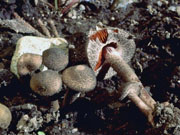
1a. Spore print is olive green to reddish brown, untouched fresh gills are red
................................................................................Melanophyllum haematospermum
Melanophyllum haematospermum (Bulliard ex Persoon: Fries) Kreisel
CAP 1–3.5 cm wide, conic becoming convex and finally plane, scratched flesh staining red then fading; disc with a knob flattening in age, dark grayish brown, covered with pointed scales becoming granular or powdery with age; margin surface like the disc but paler, persistently incurved, the edge hung with deciduous scraps. GILLS bright brick red becoming brownish gray in age, free or slightly attached, close. SPORE PRINT olive green soon drying reddish brown. STALK 3–7 cm long, top 1–3 mm thick, hollow, base bulbous, reddish or brown, covered with deciduous powder, scratched flesh staining red then fading. RING absent. ODOR pungent of cucumber. TASTE not remarkable. HABIT solitary to gregarious. HABITAT moist rich soil, woody debris, gardens. EDIBILITY not noted. MICROSCOPIC FEATURES spores 5–7 × 2.5–3 µm, elliptical to cylindrical, with obscure spines (focus on upper surface), hyaline to brown, inamyloid; cheilocystidia absent; pleurocystidia absent; cap cuticle an epithelium of brown sphaerocysts on an interwoven layer. NOTES This Flying Dutchman species sails the stormy seas of taxonomy; various authors have placed it in Agaricus, Chlorosperma, Cystoderma, Inocybe, Lepiota, Melanophyllum, Naucoria, Pratella, Psalliota, Psathyra, Pilosace, and Stropharia. It is synonymous with Melanophyllum echinatum (Roth: Fries) Singer. | Melanophyllum haematospermum
Andrew Parker |
1b. Spore print is white, cream, pale yellow, or pale pink; untouched fresh gills are pallid, never red (see Short Cut)
................................................................................2
2a. (1) Mushroom grows indoors
................................................................................3
2b. Mushroom grows outdoors
................................................................................4
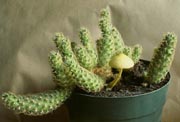
3a. (2) Cap is yellow
................................................................................Leucocoprinus birnbaumii
Leucocoprinus birnbaumii (Corda) Singer
CAP 1–6 cm wide, conic with incurved margin at first, aging in a day to flat with a central knob and finally sagging; disc with almost powdery, sometimes upturned, fibrous scales, bright yellow fading with age; margin striate, colored like the like the disc, with the scales becoming scattered to absent. GILLS free, pale yellow, close, in one to three tiers, edges even to finely fringed. SPORE PRINT white. STALK 2.5–8 cm long, top 1.5–6 mm thick, base enlarged, stuffed becoming hollow, bright yellow, covered with yellow
powder, fading in age. RING cottony fibrous, yellow, perhaps movable, not persistent. ODOR not remarkable. TASTE mild with a bitter aftertaste. HABIT scattered to clustered. HABITAT flower pots, greenhouses.
EDIBILITY poisonous—at least for some people. MICROSCOPIC
FEATURES spores 8–11 × 5–7 µm, oval-elliptical, with a germ pore,
dextrinoid; cheilocystidia clavate to ventricose; pleurocystidia absent; cap cuticle cellular, shape irregular, often in upright chains but not forming a trichodermium. NOTES Lepiota lutea (Bolton) Godfrin is synonymous with L. birnbaumii. | Leucocoprinus birnbaumii
John Dennis |
3b. Cap is violet brown
................................................................................Leucocoprinus lilacinogranulosus
Leucocoprinus lilacinogranulosus (Hennings) Locquin
CAP 1.5–4.5 cm wide, long oval becoming flattened conic and sagging when old; disc unbroken, violet brown; margin grooved, with minute granular scales the color of the disc or lighter, flesh buff, not changing. GILLS free, crowded, becoming wrinkled, whitish aging to pale flesh. SPORE PRINT color not noted. STALK 4–5 cm long, top 2.5–4.0 mm thick; even, base bulbous, growing from a 1 mm white woolly sclerotium; whitish, darker at the base, not changing when bruised. RING central or near the base, membranous, persists. ODOR not remarkable. TASTE not remarkable. HABIT several or solitary. HABITAT greenhouses. EDIBILITY not noted. MICROSCOPIC FEATURES spores 7.5–11.0 × 5.0–7.5 µm, ovate, with a germ pore, light to dark in Melzer’s; cheilocystidia clavate; pleurocystidia absent; cap cuticle several layers of mutually compressed inflated cells with staggered elongated terminal cells not in a palisade. NOTES fruits regularly in cactus pots in the University of Washington greenhouse.
4a. (2) Thorn-like warts are present on some part of the mushroom (check the disc)
................................................................................5
4b. Thorn-like warts are absent from the mushroom (loose grains may be present)
................................................................................6
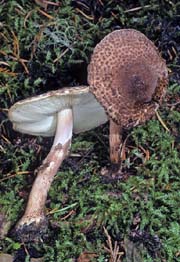
5a. (4) Warts are dark brown; mushroom is large—top of stalk is 8–12 mm thick
................................................................................Lepiota acutesquamosa
Lepiota acutesquamosa (Weinmann) Kummer
CAP 3–11 cm wide, at first convex, becoming plane, sometimes with a central knob; disc with brown fibrous scales and dark pointed warts, warts deciduous and tufts of dark fibers remain in their scars; margin like the disc. GILLS free, white, crowded, sometimes forked, edges usually eroded. SPORE PRINT white. STALK 6–11 cm long, top 8–12 mm thick; slightly club-shaped or bulbous; stuffed or hollow; silky smooth above, brown fibrous below; sometimes with dark pointed warts at the base. RING membranous to cobwebby; usually persistent when membranous, not movable, sometimes with dark pointed warts at the margin. ODOR pungent or not remarkable. TASTE not remarkable. HABIT solitary to scattered. HABITAT rich soil, humus, forest debris. EDIBILITY edible with caution; when eaten with wine, has caused a rash on skin exposed to sunlight; may be confused with an unidentified species (see notes). MICROSCOPIC FEATURES spores 6.5–9 (11) × 2–3.5 µm, oblong, without a germ pore, hyaline to pale yellow in Melzer’s; cheilocystidia clavate; pleurocystidia absent; cap cuticle short cylindric to globose cells in a mass of filamentous hyphae. NOTES L. acutesquamosa is part of a Lepiota aspera complex and may be synonymous with Lepiota aspera (Persoon: Fries) Quélet. I have examined several collections of a western Washington Lepiota (sp. #1) in the section Ovisporae that has persistent dark pointed scales. Its cap is 4 cm wide and has dark brown fibrous scales; the stalk is 6 cm long and expanded toward the base; the spores are 5.5–7.5 × 3.5–5 µm, oval to long oval, thick walled, lacking a germ pore, and medium to dark brown in Melzer’s. Section Ovisporae includes lethal species that have amanitins. | Lepiota acutesquamosa
Kit Scates Barnhart |
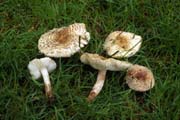
5b. Warts are reddish or vinaceous; mushroom is small—top of stalk is 2–4 mm thick
................................................................................Lepiota subincarnata
Lepiota subincarnata Lange
CAP 1–3 cm wide, elliptical with a central knob, flattening with age; disc with erect, pointed, fibrous scales that are reddish, cut flesh slightly red; margin at first with veil remnants, may have small flattened vinaceous scales. GILLS free, white, aging cream, close, broad, in 2 or 3 tiers. SPORE PRINT white. STALK 3–6 cm long, top 2–4 mm thick, equal, solid or stuffed, pale aging brownish, at first with pale shaggy fibrous patches below and silky above. RING not persistent. ODOR slightly fragrant. TASTE not remarkable. HABIT not noted. HABITAT woods, lawns. EDIBILITY lethal–has amanitins. MICROSCOPIC FEATURES spores 5–6 × 3 µm, elliptical, thick walled, without a germ pore, pale brown in Melzer’s; cheilocystidia with constricted midpoints or shaped like basidia; pleurocystidia absent; cap cuticle partially appressed pileocystidia that are long, slender, thick walled, brownish. NOTES L. subincarnata from a lawn caused a fatal poisoning in Vancouver, B.C. | Lepiota subincarnata
Steve Trudell |
6a. (4) Lightly stroked cap flashes bright red or orange (may fade to brown)
................................................................................7
6b. Lightly stroked cap doesn’t stain or undramatically stains yellow, orange, brown, or dark red (Make this choice when in doubt.)
................................................................................8
7a. (6) Stroked gills flash bright red or orange (may fade)
................................................................................Lepiota roseifolia
Lepiota roseifolia Murrill
CAP 2.0–6.8 cm wide, convex becoming plane and sometimes slightly depressed; disc raised, finely fibrous, medium brown to blackish; margin incurved becoming flat, with finely fibrous scales colored like the cap on a white background, rubbed surface instantly stains orange to red and slowly fades to brown. GILLS free, white, instantly stain red or orange when rubbed and quickly fade to white, edges minutely fringed, in one to three tiers, sometimes forked or with cross walls. SPORE PRINT white. STALK 4–8 cm long, top 5–8 (12) mm thick; club shaped; stuffed becoming hollow; white; staining like the cap margin. RING persistent; flared up and folded down; white with a brown lower margin. ODOR not remarkable. TASTE not remarkable. HABIT solitary to scattered. HABITAT under trees, especially near Pacific beaches. EDIBILITY not noted. MICROSCOPIC FEATURES spores 6.3–8.7 (9.5) × (3.4) 3.9–4.7 (5.5) µm, elliptical, apiculate, thick walled, without a germ pore, orange to dark reddish brown in Melzer's; cheilocystidia abundant, club shaped and sometimes beaked; pleurocystidia absent; cap cuticle trichoderm of upright hyphae and pileocystidia on an interwoven layer.
7b. Stroked gills don’t stain
................................................................................Lepiota flammeatincta
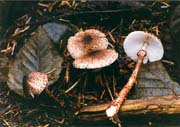
Lepiota flammeatincta Kauffman
CAP 1.2–4.5 cm wide, convex becoming plane and then uplifted; disc at least slightly raised, smooth, medium brown, rubbed surface suddenly staining red to orange and slowly fading to brown; margin downturned to flat, developing fibrous scales colored like the disc, staining like the disc. GILLS free, white, close, edges minutely fringed, in one or two tiers, not changing color when rubbed. SPORE PRINT not noted. STALK 4.0–9.5 cm long, top 1.5–6 mm thick; even or slightly club shaped; stuffed becoming hollow; white above, brown below, staining below the ring like the cap. RING persistent; flaring up and hanging down; upper surface white, lower surface brown. ODOR not remarkable. TASTE unpleasant, sometimes bitter. HABIT solitary to scattered. HABITAT in forests, especially near Pacific beaches. EDIBILITY not noted. MICROSCOPIC FEATURES spores 6.3–7.9 (9.5) × 3.9–4.7 µm, elliptical, apiculate, thick walled, without a germ pore, pale to dark reddish brown in Melzer's; cheilocystidia abundant, clavate to cylindrical, sometimes irregular or branched or capitate; pleurocystidia absent; cap cuticle interwoven, lacking a trichodermium but with many upright hyphae that are often in bundles near the margin. | Lepiota flammeatincta
Buck McAdoo |
8a. (6) Cap pattern is radial—streaks of color radiate from the disc into the margin
................................................................................9
8b. Cap pattern is circular, random, or absent
................................................................................10
9a. (8) Stature is sturdy; disc is light pink brown or light cinnamon brown; taste is mild (Don’t swallow!)
................................................................................Leucoagaricus rubrotinctus
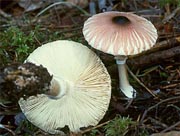
Leucoagaricus rubrotinctus (Peck) Singer
CAP 3–8 cm wide, briefly cylindric becoming conic, convex, plane, and finally uplifted; disc flat or raised, silky, moist, reddish pink to brown; margin incurved becoming flat and splitting radially at the edge, cuticle colored like the disc, tearing radially to expose white flesh. GILLS free, white, close, edges finely fringed, in one or two tiers, often forked, may have cross walls, attached to a collar. SPORE PRINT white. STALK 4–17 cm long, top 4–10 mm thick; enlarged toward the base; stuffed becoming hollow; white, bruising yellowish to brown. RING thin, movable, flaring up and hanging down. TASTE not remarkable. ODOR not remarkable. HABIT solitary to scattered. HABITAT under trees. EDIBILITY not noted. MICROSCOPIC FEATURES spores 6.3–9.5 (10) × 3.9–4.7 (5.5) µm, elliptical, tapered at the apex, side profile asymmetrical, prominently apiculate, thick walled, without a germ pore, pale to dark reddish brown in Melzer's; cheilocystidia abundant, long clavate; pleurocystidia absent; cap cuticle trichodermium of packed upright hyphae and pileocystidia on tightly interwoven hyphae, radially arranged NOTES Northwestern collections often lack rosy tints in the cap. Lepiota rubrotincta Peck is synonymous with Leucoagaricus rubrotinctus.
| Leucoagaricus rubrotinctus
Boleslaw Kuznik |
9b. Stature is delicate; disc is dark red brown or dark vinaceous brown; taste is bitter (Don’t swallow!)
................................................................................Lepiota glabridisca
Lepiota glabridisca Sundberg
CAP 1.5–4.2 cm wide, convex becoming plane; disc usually raised, cuticle unbroken, dark reddish brown or dark vinaceous brown; margin uplifted with radial splits in age, cuticle ruptured radially, the color of the disc or paler, background white. GILLS free, whitish, in one or two tiers, with forks or cross walls or both near the stalk, close, edges minutely fringed. SPORE PRINT white. STALK 3.0–8.5 cm long, top 2–5 mm thick; club-shaped, stuffed becoming hollow, smooth, white and sometimes pale yellowish at the base, darkening when bruised. RING persistent, movable, flaring or collapsed, white with a dark lower margin. ODOR not remarkable. TASTE bitter. HABIT gregarious to solitary. HABITAT conifer forests. EDIBILITY not noted. MICROSCOPIC FEATURES spores (6.3) 7.0–9.5 (10.3) × 4–4.8 (5.5) µm, ellipsoid and often tapered, thick walled, without a germ pore, pale to dark reddish brown in Melzer’s; cheilocystidia abundant, clavate; pleurocystidia absent; cap cuticle radially interwoven lower layer of elongate cells that are usually encrusted, and an upper layer of patches of loosely interwoven thinner cells that are often gelatinous. NOTES L. glabridisca was ubiquitous in the forested river banks near Willapa Bay, Washington, in early November 2000.
10a. (8) Blue, lavender, lavender-pink, purple, or dark vinaceous colors are on some part of the mushroom—on the cap, on the stalk, or in the stalk
................................................................................11
10b. No blue, lavender, lavender-pink, purple, or dark vinaceous colors are on any part of the mushroom
................................................................................15
11a. (10) Stalk is shaggy or has bands of flattened scales
................................................................................12
11b. Stalk is bald, powdery, or granular
................................................................................13
12a. Scales on the cap are medium brown
................................................................................Lepiota helveola
12b. Scales on the cap are dark vinaceous
................................................................................Lepiota fuscovinacea
Lepiota fuscovinacea Möller & J. Lange
CAP 2.5–6 cm wide; convex; disc soon with a knob, smooth or with small pointed scales, dark vinaceous brown to purple black; margin incurved, finally becoming flattened and sometimes wavy, breaking into concentric appressed fibrous scales colored like the disc, flesh between the scales pale. GILLS free, white becoming cream, edges sometimes browning, edges wavy and finely fringed, attached to a collar around the stalk. SPORE PRINT pale cream. STALK 3–6 cm long, top 3–8 mm thick, even or enlarged at the base, becoming hollow, interior pale vinaceous, surface whitish to pale vinaceous, covered below with a dark vinaceous boot that breaks into bands of fibrous scales. RING fibrous-wooly zone, pale, persistent . ODOR unpleasant, of Scleroderma. TASTE not remarkable. HABIT solitary to gregarious. HABITAT in or near deciduous and coniferous forests, often in openings, often on bare soil. EDIBILITY not noted. MICROSCOPIC FEATURES spores (4) 4.5–5.5 (6.5) × 2–3 µm, oval to somewhat truncate with a lateral apiculus, thick walled, without a germ pore, dextrinoid; cheilocystidia clavate; pleurocystidia absent; cap cuticle erect multi-septate hyphae rising from interwoven hyphae.
13a. (12) A ring is absent; odor is pungent
................................................................................Cystolepiota bucknallii
Cystolepiota bucknallii (Berkeley & Broome) Singer & Clémençon
CAP 2.5–4.5 cm wide, bell shaped; disc may develop a knob, covered with lilac to lavender powder that may fade in age; margin at first powdery and colored like the disc, aging paler, deciduous membranous veil material hanging from the edge. GILLS free, pale yellow, crowded. SPORE PRINT white. STALK 4–10 cm long, top 2–4 mm thick; even; hollow; covered below with lavender powder that does not persist; interior flesh at the base becoming dark violet. RING not persistent. ODOR pungent, of coal tar. TASTE not remarkable. HABIT gregarious to scattered. HABITAT humus in hardwood, conifer forests. EDIBILITY not noted. MICROSCOPIC FEATURES spores 6–7.5 × 2.8–3 µm, subfusiform, some with an almost truncate basal end, without a germ pore, pale yellow in Melzer’s; cheilocystidia absent; pleurocystidia absent; cap cuticle chains of globose cells interwoven with narrow hyphae. NOTES rare in the Northwest.
13b. A ring is present; odor is not remarkable
................................................................................14
14a. (13) Disc is velvety; disc is lavender pink; dried mushroom is faded
................................................................................Lepiota decorata
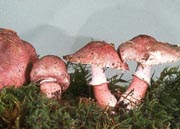
Lepiota decorata Zeller
CAP 2.5–5.5 cm wide, conic to convex becoming plane; disc raised or sometimes depressed, hairy or velvety, lavender; margin incurved becoming upturned and sometimes eroded, velvety becoming scaly, colored like the disc. GILLS free, white, close, edges even. SPORE PRINT white. STALK 4.5–8 cm long, top 5–10 mm thick; wider at the base; stuffed or hollow; smooth, with white mycelium at the base; lavender to whitish. RING persistent; whitish above, color of the cap below. ODOR not remarkable. TASTE not remarkable. HABIT scattered. HABITAT conifer duff. EDIBILITY not noted. MICROSCOPIC FEATURES spores 6.3–7.1 (9.5) × 3.6–4.7 µm, oval to elliptical, apiculate, thick walled, light to dark reddish brown in Melzer’s; cheilocystidia abundant, long clavate to ventricose; pleurocystidia absent; cap cuticle trichodermium of elongate, frequently ventricose, sometimes encrusted pileocystidia supported by interwoven, sometimes encrusted hyphae. NOTES Seldom seen in the Northwest, the species was encountered frequently in Washington's Deception Pass State Park and in the Sequim, Washington, area in November 2001.
| Lepiota decorata
Ben Woo |
14b. Disc is smooth or obscurely fibrous; disc is purple; dried mushroom retains its color
................................................................................Lepiota roseilivida
Lepiota roseilivida Murrill
CAP 1–4 cm wide, convex becoming flat; disc raised, smooth or obscurely fibrous, purple; margin incurved becoming flat, with flattened fibrous scales, purple on a white background. GILLS free, white, close, edges obscurely to obviously fringed, in one or two tiers. SPORE PRINT not noted. STALK 3–7.5 cm long, top 2–6 mm thick; enlarged toward the base; stuffed becoming hollow; white above, tinged pink with purple fibers below, bruising light olive. RING persistent, flares up or hangs down, white or tinged pink. ODOR not remarkable. TASTE not remarkable. HABIT solitary to gregarious. HABITAT under trees. EDIBILITY not noted. MICROSCOPIC FEATURES spores 6.3–9 × 4–5 µm, oval to short elliptical, side profile asymmetrical, apiculate, thick walled, with an obscure germ pore, dark reddish brown in Melzer's; cheilocystidia clavate to cylindrical, many with long narrow bases, often twisted; pleurocystidia absent; cap cuticle trichoderm of loose upright hyphae on an interwoven layer.
| Lepiota roseolivida
.jpg)
Fred Stevens (MykoWeb) |
15a. (10) Bottom of stalk is a flat-topped bulb
................................................................................16
15b. Bottom of stalk is not a flat-topped bulb but may be a rounded bulb
................................................................................17
16a. (15) Veil is membranous; ring is persistent
................................................................................Macrolepiota rachodes var. hortensis
Macrolepiota rachodes var. hortensis (Pilát) Wasser
STALK base has a marginate bulb—a flat-topped bulb that usually has a ridged perimeter. NOTES It is otherwise the same as Macrolepiota rachodes var. bohemica. The spelling "rhacodes" is correct for this variety but not for the other two varieties in this key. [See What's Become of Macrolepiota rachodes? for the new name for what is described here, Chlorophyllum brunneum.]
See 35a for a description of Macrolepiota rachodes var. bohemica.
| Chlorophyllum brunneum
.jpg)
Michael Wood (MykoWeb) |
16b. Veil is cobwebby; ring is not persistent
................................................................................Lepiota cortinarius
Lepiota cortinarius Lange
CAP 3–10 cm wide, convex becoming plane; disc brown, unbroken; margin becoming wavy and splitting radially, covered with small tawny fibrous scales, usually with white flesh showing between scales. GILLS free, white with yellow stains in age, sometimes attached to a collar, crowded when young, edges even, in two tiers; at first covered by a cobwebby (cortinate) partial veil. SPORE PRINT not noted. STALK 3–9 cm long, top 7–20 mm thick, smooth above, with tawny fibers or scales below, the base having a small flat-topped bulb that usually has a ridged perimeter. RING a cortinate zone, not persistent. ODOR not remarkable. TASTE not remarkable. HABIT not noted. HABITAT conifer needles. EDIBILITY not noted. MICROSCOPIC FEATURES spores 7.5–10 × 3–4 µm, oval to oblong, truncate, dark brown in Melzer’s; cheilocystidia present; pleurocystidia few and scarcely projecting; cap cuticle thick walled brown pileocystidia, erect or appressed and appearing interwoven.
17a. (15) Stalk has ornamentation—scales of any color or patches of
fibers darker than the background
................................................................................18
17b. Stalk lacks scales or patches of dark fibers but may have grains, uniformly distributed dark fibers, or a ring
................................................................................24
18a. (17) Shaggy, woolly scales are dense on lower stalk (may be dislodged by careless handling)
................................................................................19
18b. Scales or fibrous patches are scattered on lower stalk
................................................................................20
19a. (18)Species is uncommon; midpoint of spore bulges on one side (like fat Egyptian mummy); hilar appendage is hooked (like a short beak)
................................................................................Lepiota magnispora
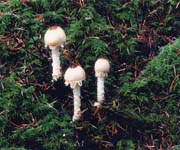
Lepiota magnispora Murrill
CAP 2.5–5.5 cm wide; convex; disc unbroken, fibrous, dark brown, becoming at least slightly raised; margin breaking into overlapping pinkish tinged brown fibrous scales on a light brown background, yellow (?) felty remains of the ring hanging from the edge; flesh whitish. GILLS free, whitish; crowded. SPORE PRINT pale cream. STALK 6–10.5 cm long; top 5–12 mm thick; slightly narrow above; hollow; pale and smooth above the ring, shaggy below with woolly yellowish or pinkish brown scales and sometimes with brown spiral bands. RING yellowish or pinkish brown; cottony; not persistent. ODOR not remarkable. TASTE not remarkable. HABIT scattered. HABITAT under fir. EDIBILITY "edible" in some European field guides; a look-alike may be lethal. MICROSCOPIC FEATURES spores 13–20.8 × 4–5 µm, bulging on one side and with a dent-like depression at the base of the hilar appendage, without a germ pore, reddish brown in Melzer’s; cheilocystidia ovate; pleurocystidia absent; cap cuticle long cylindric hairs connected with clamps to a supporting layer of brown septate hyphae. NOTES This species is synonymous with Lepiota ventriosospora Reid. Two collections, perhaps the first reported in the Northwest, were made near the Cascade crest in Jefferson County, Oregon, in November 1990 and are now in WTU. They were identified by the shape of the spores using drawings made for me by Dr. Walter J. Sundberg. Macroscopically, they looked just like nearby L. clypeolaria. European field guides use the yellow color of the veil and lower stalk of L. magnispora to distinguish it from L. clypeolaria but Reid says this is not a reliable characteristic and it was not observed in the Oregon collections. | Lepiota magnispora
Buck McAdoo |
19b. Species is common; midpoint of spore does not bulge on one side; hilar appendage is not hooked
................................................................................Lepiota clypeolaria
Lepiota clypeolaria (Bulliard ex Fries) Kummer
CAP 1.8–6 cm wide; conical becoming convex and then flattened; disc unbroken, fibrous, dark chestnut brown to cinnamon brown, raised in age; margin like the disc but soon breaking into loose deciduous woolly scales, buff or light brown to bright yellowish, incurved becoming upturned and torn or eroded in age; exposed flesh white or pallid yellow. GILLS free, buff to cream color; close; edges finely fringed; in one to three tiers. SPORE PRINT pale cream. STALK 3.5–14.5 cm long, top 4–10 mm thick; equal or somewhat expanded below; hollow; pale silky fibrous above the ring, shaggy below with woolly scales the color and texture of those on the cap margin. RING whitish to bright yellowish; woolly; sometimes flaring like a skirt; often breaking up into woolly scales. ODOR not remarkable. TASTE not remarkable. HABIT usually gregarious but may be solitary. HABITAT forest floors. EDIBILITY "poisonous" in some American field guides and "edible" in some European field guides; a look-alike may be lethal. MICROSCOPIC FEATURES spores (12.7) 14.3–19 × 3.5–4.7 µm, distinctively fusiform, smooth, without a germ pore, pale to dark reddish brown in Melzer’s; cheilocystidia more or less clavate; pleurocystidia absent; cap cuticle interwoven layer supporting erect brown pileocystidia, often like a trichodermium. NOTES According to Singer, the species is synonymous with Lepiota colubrina (Persoon ex) S. F. Gray, the type species.
20a. (18) Lower stalk has scales with a crusty cuticle (use a lens)
................................................................................21
20b. Lower stalk has scales without a crusty cuticle
................................................................................22
21a. (20) Perimeter of disc has a ring of upturned scales; odor is fragrant; bruised stalk darkens
................................................................................Lepiota helveola
Lepiota helveola Bresadola sensu Josserand
CAP 1.5–3 cm wide, convex to flat; disc often flat, may be raised, fibrous, with a ring of small upturned scales on the perimeter, ruddy medium brown occasionally tinged pink to vinaceous; margin downturned to flat or undulating, with fibrous scales the color of the disc on a white background. GILLS free, white, aging to cream-buff, close, edges finely fringed, attached to an obscure collar around the stalk, in one or two tiers. SPORE PRINT white. STALK 2–4 cm long, top 3–7 mm thick; equal; stuffed becoming hollow; white or pink-tinged; bruising brown; with bands of appressed fibrous brown scales some of which have a crusty cuticle, with white rhizomorphs at base. RING may not persist, similar to the scales on the stalk. HABIT solitary to scattered. HABITAT soil, humus, in gardens, under trees. ODOR very mildly fungoid with a slight fragrance, may be absent. TASTE fungoid, becoming metallic. EDIBILITY potentially lethal–has amanitins. MICROSCOPIC FEATURES spores 5.8–8 × 3–4.6 µm, oval to elliptical, apiculate, thick walled, without a germ pore, pale reddish brown to dark reddish brown in Melzer's; cheilocystidia club shaped or sac like; pleurocystidia absent; cap cuticle long clavate pileocystidia on a loosely interwoven region. NOTES L. fuscosquamea has darker cap colors and a more coarsely tomentose cap cuticle than L. helveola. Synonymous with Lepiota josserandii Bon & Boiffard.
21b. Perimeter of disc lacks a ring of upturned scales, odor is not remarkable; bruised stalk is unchanged
................................................................................Lepiota fuscosquamea
Lepiota fuscosquamea (Peck) Saccardo
CAP 3–6 (8) cm wide, convex becoming flattened; disc with a central knob, unbroken, fibrous, chestnut brown becoming paler with age; margin with concentric rings of fibrous or floccose scales colored like the disc, edge with veil material at first, often splitting radially with age. GILLS free, white, often with brown spots in age, close, narrow, edges finely fringed. SPORE PRINT white. STALK 6–9 (12) cm long, top 4–15 mm thick, base tapering to a slight bulb, hollow, whitish, lower stalk with patches and zones of brown scales that have a crusty cuticle. RING partly covered with a cuticle, may not persist. ODOR mildly grain like (farinaceous). TASTE mildly grain like (farinaceous). HABIT solitary to gregarious. HABITAT swamps, humus under conifer. EDIBILITY not noted. MICROSCOPIC FEATURES spores 6–8 × 3.5–4 µm, elliptical, apiculate, walls somewhat thick, without a germ pore, rusty brown in Melzer’s; cheilocystidia clavate; pleurocystidia absent; cap cuticle trichodermium of pileocystidia supported by frequently encrusted interwoven hyphae.
22a. (20) Stalk has a wide membranous ring that hangs like a skirt
................................................................................Lepiota pseudohelveola var. pseudohelveola
Lepiota pseudohelveola var. pseudohelveola Kühner ex Hora
CAP (1) 2–5 cm wide, conical becoming plane; disc with a knob, pink tinged medium gray brown, smooth; margin concentric bands of flattened scales the color of the disc alternating with concentric bands of white flesh. GILLS white becoming cream. SPORE PRINT white. STALK 3–6 cm long, top 2–5 mm thick, cylindrical, expanded at the base, pale pinkish above the ring, darker below, with scattered fibrous scales the color of the disc, darkens when scratched near the base. RING persistent, membranous, wide, hangs like a skirt, upper surface pale pinkish, lower surface brown with a raised pattern. ODOR fruity or absent. TASTE not noted. HABIT solitary. HABITAT near broadleaf and needle bearing trees, river flats, forests, sand dunes, grass. EDIBILITY potentially lethal—has amanitins. MICROSCOPIC FEATURES spores 7–10 (11.5) × 4.0–4.7 (6.5) µm, elliptic to oval, without a germ pore, dextrinoid; cheilocystidia ventricose or club shaped; pleurocystidia absent; cap cuticle interwoven thick walled brown hyphae supporting a layer of short club shaped hyaline cells with clamps from which project long erect cylindric hyaline cells with clamps (not a trichodermium). NOTES L. pseudohelveola var. subulosa Bon is not known to occur in the Northwest; its cap lacks concentric white bands and its stalk has uniformly scattered dark fibers below the ring.
22b. Stalk has no ring or has a band of tissue that may have scales
................................................................................23
23a. (22) Bottom of stalk has an orange wash; top of stalk is 1–3 mm thick; stature is delicate
................................................................................Lepiota castanea
Lepiota castanea Quélet
CAP 1–3 cm wide, acutely conical becoming bell shaped and finally depressed; disc raised, velvety or with fibrous scales, cinnamon brown; margin incurved often becoming undulated and uplifted, at first with membrane hanging from the margin, colored like the disc, with fibrous scales; flesh white, often becoming rusty in age or when bruised. GILLS free, white or buff, often becoming rusty in age or when bruised, close, edges even, in one to three tiers, often not reaching the margin. SPORE PRINT not noted. STALK 2.8–6.5 cm long, top 1–3 mm thick; wider at the base; stuffed becoming hollow; above fibrous, white; below with scattered fibrous or woolly cinnamon brown scales; white with an orange wash at the base and sometimes between the scales; becoming rusty when bruised. RING not persistent. ODOR sweet, unpleasant, or not remarkable. TASTE not remarkable. HABIT scattered or solitary. HABITAT humus under conifer. EDIBILITY potentially lethal–has amanitins. MICROSCOPIC FEATURES spores 8.7–11.1 (12.7) × (3.1) 4.3–4.8 µm, truncate and spurred (bullet shaped), without a germ pore, pale or dark in Melzer’s; cheilocystidia clavate or cylindric, base narrow, apex often narrow; pleurocystidia absent; cap cuticle loosely interwoven layer supporting a trichodermium of hyphae and pileocystidia, separating in age. NOTES Similar species have slightly different microscopic features—spores, cystidia, or cap cuticles. | Lepiota castanea
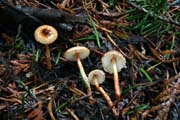
A and O Ceska |
23b. Bottom of stalk lacks an orange wash; top of stalk is 4–9 mm thick; stature is sturdy
................................................................................Lepiota clypeolarioides
Lepiota clypeolarioides Rea
CAP 2.5–5 cm wide, cylindrical becoming conical, convex, flattened, and finally depressed; disc with a blunt knob, dark reddish brown,
fibrous; margin concentric bands of small fibrous scales the color of the disc, background tan with a rusty tinge, some white flesh showing in cracks in age. GILLS free, white aging yellowish, crowded. SPORE PRINT white. STALK 4–10 cm long, top 4–9 mm thick, cylindrical or slightly enlarged toward the base, white aging reddish brown, smooth above, with bands or patches of reddish brown scales below. RING a raised fibrous zone, white, may have dark brown scales, may be absent. ODOR not noted. TASTE not noted. HABIT scattered to gregarious. HABITAT under conifers. EDIBILITY potentially deadly—has amanitins. MICROSCOPIC FEATURES spores (5.5) 6–8.4 × 3-4 (5.6) µm, elliptic to ovoid, profile asymmetric, thick walled, without a germ pore, yellowish in Melzer’s; cheilocystidia clavate to ventricose; pleurocystidia absent; cap cuticle interwoven hyphae supporting pileocystidia, similar to a trichoderm. | Lepiota clypeolarioides
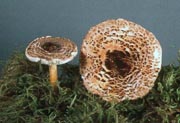
Ben Woo |
24a. (17) Entire cap is pallid—white, cream, buff, pale pink, peach, light gray, light gray brown
................................................................................25
24b. At least part of cap is darker than peanut butter—brown or blackish
................................................................................35
25a. (24) Mushroom is robust, large—top of stalk is more than 5 mm thick
................................................................................26
25b. Mushroom is delicate, small—top of stalk is less than 4 mm thick
................................................................................29
26a. (25) Cap has a broad central bulge; stalk never has a ring
................................................................................Lepiota petasiformis
26b. Cap is evenly rounded or flattened; stalk usually has a ring
................................................................................27
27a. (26) Disc is pinkish buff or reddish; stalk usually has a medial bulge (like a bowling pin); old injuries are dark reddish
................................................................................Lepiota americana
27b. Disc is whitish, light gray, or light gray brown; stalk is even, club shaped, or has an expanded base; old injuries are unchanged, brown, or dingy
................................................................................28
28a. (27) Mushroom grows on lawns, roadsides; stalk is usually longer than cap diameter; dried gills are dark
................................................................................Leucoagaricus naucinus
Leucoagaricus naucinus (Fries) Singer
CAP 3–10 cm wide, convex aging to plane and uplifted; with a suede-like feel; disc not raised, either light gray or whitish, smooth; margin incurved becoming plane, eroded in age, colored like the disc, smooth or occasionally with small appressed scales that may reveal white flesh in age. GILLS free, whitish or pale pink becoming dark when dried; close; edges even or minutely fringed; in one to three tiers; occasionally branched, with cross walls, or both near the stalk. SPORE PRINT white, sometimes pale pink. STALK 4.5–14.0 cm long, top 5–20 mm thick; usually club shaped with the base enlarged, rarely even; white, slowly darkening or staining yellow with handling; smooth, the base often with cottony fibers; stuffed becoming hollow. RING whitish, underside brown near the margin; thick; persists; becomes movable; upper part flares like a collar, lower part hangs like a skirt; edge frayed; lower surface may have patches. ODOR not remarkable. TASTE not remarkable. HABIT Solitary to scattered. HABITAT lawns, roadsides, always in the open. EDIBILITY delicious; edible for most people but some eventually become sensitive, exhibiting flu-like symptoms; the gray form is more frequently troublesome than the white; poisonous white mushrooms frequent the same habitat—compare with Clitocybe spp. and Amanita spp. MICROSCOPIC FEATURES spores 7.9–10.3 (12.7) × 5.5–6.3 µm, ovoid and asymmetric in side view, thick walled with a germ pore, pale to dark reddish brown in Melzer’s; cheilocystidia clavate to ventricose; pleurocystidia absent; cap cuticle short upright hyphae with elongate tip cells arising from an interwoven layer. NOTES The species is synonymous with Lepiota naucina (Fries) Kummer, Lepiota naucinoides Peck, Lepiota leucothites (Vittadini) P. D. Orton, Leucoagaricus leucothites (Vittadini) Wasser, and 'round and around and around ….
| Leucoagaricus leucothites
.jpg)
Leucoagaricus leucothites 1 Fred Stevens (MykoWeb) |
28b. Mushroom grows on tilled land and compost; stalk is usually shorter than cap diameter; dried gills are pale
................................................................................Leucoagaricus barssi
Leucoagaricus barssi (Zeller) Vellinga
CAP 7–15 cm wide; at first oval becoming convex to expanded; disc raised, light gray or light gray brown, fibrous or broken into fine fibrous scales; margin like the disc but paler, flesh whitish becoming grayish, the edge sometimes radially split. GILLS free, close, edges even, white becoming straw colored and remaining so when the mushroom is dried. SPORE PRINT white. STALK 8–12 cm long, top 8–18 mm thick; may be slightly expanded at the base; stuffed then hollow; smooth or silky; white bruising brownish, becoming dingy. RING double, collar-like, movable at maturity. ODOR not remarkable. TASTE not remarkable. HABIT gregarious to clustered. HABITAT tilled land, straw, manure. EDIBILITY edible; choice. MICROSCOPIC FEATURES spores (8) 10–12 × 6.5–9 µm, ellipsoid to subovoid, with thickened wall, with a germ pore, reddish brown in Melzer’s; cheilocystidia abundant and clavate, broadly ventricose, or cylindric; pleurocystidia absent; cap cuticle tangled turf of tubular hyphae. NOTES L. barssii was abundant in Oregon’s Willamette Valley in 1934 and was a market mushroom in Portland in the 40’s. Although field guides still report its abundance in the Willamette Valley, it fruits there in only occasional years, and is largely unfamiliar to central Oregon mushroomers. It has appeared in Seattle and Olympia gardens. It is synonymous with Lepiota barssii Zeller.
| Leucoagaricus barssii
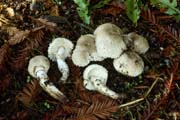
Steve Trudell |
29a. (25) Cut flesh slowly stains reddish
................................................................................Cystolepiota hetieri
Cystolepiota hetieri (Boudier) Singer
CAP 1.5–2.5 cm wide; conic to convex; disc whitish, cream, or pale pink becoming reddish with age, slowly bruising red, covered with deciduous powder or grains; margin like the disc with tissue hanging from the edge when young. GILLS free, close, broad, white, often with reddish edges, in 3 tiers. SPORE PRINT white. STALK 2–4 cm long, top 1.5–4 mm thick, enlarged somewhat at the base, covered with powder at first, colored and staining like the cap. RING not persistent. ODOR not remarkable. TASTE bitter or not remarkable. HABIT scattered. HABITAT under deciduous and coniferous trees, especially in river flats. EDIBILITY potentially lethal-has aminitis. MICROSCOPIC FEATURES spores 4.4–5.1 (6.6) × 2.5–2.9 µm, ellipsoid, thin walled, without a germ pore, colorless in Melzer’s; cheilocystidia ventricose with narrowed tips often strangulated, obscured by the basidia; pleurocystidia absent; cap cuticle cellular with ellipsoid or pointed globose cells and cylindric hyphae. NOTES Lepiota rufescens (Berkeley & Broome) Lange is synonymous with C. hetieri. The strangulated tips on the cheilocystidia are distinctive.
29b. Cut flesh stains yellowish or remains unchanged
................................................................................30
30a. (29) Disc is pale pink, pale pinkish buff, or peach; ring doesn't persist
................................................................................31
30b. Disc is white, cream, or buff; ring persists
................................................................................33
31a. (30) Cap has a broad central bulge; cap is wider than 3.5 cm; top of stalk is at least 4 mm thick
................................................................................Lepiota petasiformis
Lepiota petasiformis Murrill
CAP 3.6–4 cm wide; convex, flesh white and unchanging; disc a distinct broad knob, thickly covered with loose pale pinkish buff powder; margin thin, powdery like the disc, powder often breaking into warts or scales. GILLS free, crowded, remain white, in 3 tiers. SPORE PRINT color not noted. STALK 2–6 cm long, top 4–5 mm thick, equal or smaller at the top, covered with powder like the cap. RING absent. ODOR of grain (farinaceous). TASTE of grain (farinaceous). HABIT not noted. HABITAT on humus in woods. EDIBILITY not noted. MICROSCOPIC FEATURES spores 3.5–5 × 2.5–3 µm, broad oval to cylindric, thick walled, without a germ pore, pale yellow to pale rusty brown in Melzer's; cheilocystidia clavate, rare; pleurocystidia absent; cap cuticle thin walled globose cells. NOTES The mushroom is similar to Cystolepiota hetieri but it doesn't stain red. Murrill collected the type for L. petasiformis "in woods near Seattle" in late October 1911, and Zeller collected it "in the same region." Now, the species seems to be as rare as woods near Seattle. Have you seen any of those lately?
31b. Cap is evenly rounded or has a small central bump; cap is less than 3 cm wide; top of stalk is less than 3 mm thick
................................................................................32
32a. Disc is peach; gills may have rusty stains
................................................................................Lepiota oregonensis
Lepiota oregonensis H. V. Smith
CAP 0.8–2.5 cm wide, rounded becoming almost plane; disc with a central knob in age, peach colored, covered with grains or granular warts; margin incurved becoming uplifted with radial splits, with veil material hanging from the edge at first, colored like the disc but paler and aging to the disc color, covered with grains smaller than those on the disc, flesh white and sometimes darkening when bruised. GILLS free, whitish, sometimes with rusty stains; edges even; close. SPORE PRINT not noted. STALK 1.5–9 cm long, top 1.5–3 mm thick; sometimes expanded at the base; whitish above, peach below, darkening when bruised; covered with grains or warts; hollow, stuffed in places. RING not persistent. ODOR not remarkable. TASTE mildly grain-like. HABIT clustered to gregarious. HABITAT soil and litter under conifer and alder. EDIBILITY not noted. MICROSCOPIC FEATURES spores 4–4.8 × 2–2.4 µm, ellipsoid, without a germ pore, hyaline to pallid rusty brown in Melzer’s; cheilocystidia clavate, sometimes with a smaller apex; pleurocystidia absent; cap cuticle thin-walled spherical layer.
32b. Disc is pink; gills never have rusty stains
................................................................................Cystolepiota seminuda
Cystolepiota seminuda (Lasch) Kummer
CAP 1–2.5 (3) cm wide; convex to plane; covered with deciduous powder; disc pale pink; margin whitish with deciduous membrane hanging from the edge. GILLS free, close, middle wide, white or pale pink, unchanging, edges even, in 1 tier. SPORE PRINT white. STALK 2–4 cm long, top 1.5–3 (4) mm thick, hollow, equal above and swollen at the base, upper part white, lower part pale pink covered with deciduous powder that in age becomes glistening flakes. RING not persistent. ODOR not remarkable. TASTE like grain (farinaceous) or not remarkable. HABIT scattered to gregarious. HABITAT on soil usually in woods. EDIBILITY not noted. MICROSCOPIC FEATURES spores 4–5 × 2.5–3 µm, elliptical, without a germ pore, pale brown or colorless in Melzer’s; cheilocystidia absent; pleurocystidia absent; cap cuticle globose cells with thin walls. NOTES The small powdery Cystolepiota species of the Northwest are not well documented. The presence or absence of cheilocystidia and pleurocystidia may help resolve ambiguities in this key. Lepiota cristatella Peck, L. hemispherica Murrill, and C. sistrata (Fries sensu Huijsman) Singer may be synonymous with C. seminuda.
33a. (30) Mushroom grows along rivers near alder flats; taste is biting (don’t swallow!)
................................................................................Lepiota pulcherrima
Lepiota pulcherrima Graff sensu Kauffman
CAP 1–4 cm wide, bell-shaped becoming flat; disc flat or raised, smooth, moist, white aging to pale brown; margin flaring becoming flat, silky cuticle rupturing into small upturned powder-like scales, colored like the disc. GILLS free, white, crowded, edges even. SPORE PRINT white. STALK 3–9 cm long, top 1.5–4 mm thick; enlarged below; stuffed becoming hollow; silky to fibrous; white aging brownish. RING persistent, flaring, margin torn, margin often pale rose. ODOR not remarkable. TASTE biting acidic, bitter. HABIT solitary to clustered. HABITAT gravel in alder flats along rivers and in nearby needle duff. EDIBILITY not noted. MICROSCOPIC FEATURES spores 5–7 (7.5) × 3–4 µm, oval to elliptical, smooth, pale brown in Melzer's; cheilocystidia abundant, thinly cylindric; pleurocystidia absent; cap cuticle radial hyphae with bundles of upturned cells, the hyphae often pinched at the septa, often with globules that become rusty in Melzer's. NOTES After waiting for 15 years to see it, I found L. pulcherrima on November 1, 2000, on The Nature Conservancy land along the Naselle River in southwest Washington. It grew near alder in the needle duff of an ancient Sitka-spruce/hemlock forest, the last of its kind. The mushrooms, trees 300 to 600 years old, soft foggy rain, spawning salmon—memorable.
33b. Mushroom grows in gardens, forests; taste is mild (don’t swallow!)
................................................................................34
34a. (33) Margin of cap has minute powdery or granular scales; margin of expanded cap has radial furrows; mushroom grows in gardens
................................................................................Leucocoprinus cepistipes
Leucocoprinus cepistipes (Sowerby: Fries) Patouillard
CAP 2–8 cm wide, oval becoming convex; sometimes with a central knob; disc whitish becoming brown, unbroken or minutely hairy; margin striate in age, white, darkening when bruised, covered with loose white to dark brown scales that are minute and granular. GILLS free, crowded, frequently forked or with cross walls or both, edges minutely fringed, in one tier, white to pale vinaceous brown, sometimes staining yellowish to brown. SPORE PRINT white. STALK 3–13 cm long, top 2–6 mm thick; usually expanded toward the base (tapered like a baseball bat) and ending with a bulbous base that is sometimes pointed; smooth above and sometimes powdery, fibrous below and sometimes finely hairy; whitish and bruising brownish. RING persists or rarely adheres to the cap margin; flares like a skirt, with a torn margin, whitish. ODOR not remarkable. TASTE not remarkable. HABIT clustered, gregarious, or rarely solitary. HABITAT gardens, compost, mulch. EDIBILITY perhaps poisonous; "edible" in some field guides. MICROSCOPIC FEATURES spores 9–11 × 6.0–7.5 µm, ovate, thick walled, with a small germ pore, pale brown to dark reddish brown in Melzer’s; cheilocystidia abundant; pleurocystidia absent; cap cuticle mutually compressed globose cells supporting a trichodermium and fasciculate on the margin. | Leucocoprinus cepistipes
.jpg)
Fred Stevens (MykoWeb) |
34b. Margin of cap is smooth or has obscure fibrous scales; margin of expanded cap is even; mushroom grows in forests
................................................................................Lepiota sequoiarum
Lepiota sequoiarum Murrill
CAP 1–4 cm wide, conic becoming flat and upturned; disc usually raised, smooth, buff; margin incurved becoming flat, developing obscure
appressed fibrous scales; white. GILLS free, white, close, edges obscurely fringed, in one tier. SPORE PRINT not noted. STALK 4.5–10 cm long, top 1–4 mm thick; equal to enlarged at the base; stuffed becoming hollow; white, bruising or aging brown. RING persistent, may flare up, hangs down, white, margin may darken. ODOR not remarkable. TASTE not remarkable. HABIT solitary to scattered. HABITAT under trees. EDIBILITY not noted. MICROSCOPIC FEATURES spores (5.5) 6.7–9.5 (11.1) × 3.5–4.7 µm, elliptical, apex tapered, side profile asymmetrical, apiculate, without a germ pore, pale to dark reddish brown in Melzer's; cheilocystidia abundant, clavate to long cylindrical; pleurocystidia absent; cap cuticle two interwoven layers. NOTES L. sequoiarum is easily recognized by its long slender stalk combined with a buff disc on a small white cap. | Lepiota sequoiarum
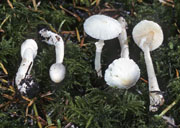
Michael Beug |
35a. (24) Scratched lower stalk stains yellow, orange, or red (may fade)
................................................................................36
35b. Scratched lower stalk stains buff, brown, pale vinaceous, sordid, dingy, or remains unchanged
................................................................................38
36a. (35) Stalk usually has a medial bulge (like a bowling pin); bottom end of stalk is often pointed; old injuries are dark reddish
................................................................................Lepiota americana
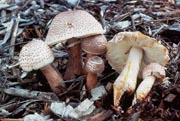
Lepiota americana (Peck) Redhead
CAP (3) 6–15 cm wide; egg shaped becoming bell-shaped or flat, sometimes with a central knob; disc unbroken, pinkish buff to reddish brown; margin with slightly upturned scales the color of the disc, pale flesh exposed between the scales; flesh bruising bright yellow fading to orange, orange red, and finally dull reddish brown to vinaceous brown, but older specimens may develop only the final colors; NH4OH stains the flesh dark grayish green. GILLS free, cream to pale yellow, close, edges finely fringed. SPORE PRINT pale cream. STALK (7) 8–12 cm long, (6) 12–22 (40) mm thick at the widest point; sometimes club-shaped or cylindrical but usually spindle-shaped and widest just below the midpoint, noticeably narrower above and below, and often pointed at the base; above whitish and smooth, below pale to brownish and smooth or slightly fibrous; flesh bruising like the cap; often with "roots" at the base. RING membranous; usually persistent; flaring like a collar when young; above whitish, lower margin colored and staining like the cap. ODOR not remarkable. TASTE not remarkable. HABIT clustered, rarely solitary. HABITAT near rotting wood. EDIBILITY edible for most people; reddens urine—an interesting effect in trough urinals. MICROSCOPIC FEATURES spores (7.9) 9–10.5 (12) × 6.3–7.5 (9) µm; elliptic to oval; with a small germ pore; colored in Melzer’s; cheilocystidia abundant; pleurocystidia absent; cap cuticle interwoven to ascending hyphae, many cells slightly inflated, upper cells often pale brown. NOTES Dried herbarium specimens are dark red. Further taxonomic work may reveal that this is a complex of similar species. Leucocoprinus americanus (Peck) Redhead is synonymous with Lepiota americana. [Leucoagaricus americanus (Peck) Vellinga is a newer name.] | Leucoagaricus americanus
Michael Beug |
36b. Stalk never has a medial bulge; bottom end of stalk is thick or bulbous; old injuries are brown
................................................................................37
37a. (36) Scales on the cap are smooth; scales are cinnamon brown on a white background; stalk length approximately equals cap diameter
................................................................................Macrolepiota rachodes var. bohemica
Macrolepiota rachodes var. bohemica (Wichansky) Bellu & Lanzoni
CAP 10–20 cm wide, convex becoming flat in age; disc cinnamon brown, smooth; margin colored like the disc, smooth at first, soon breaking up into smooth upturned scales with white, fibrous flesh showing between the scales. GILLS free, white, rarely tinged pale green, becoming red or brown when bruised, darkening in age, close, edges finely fringed, in two or three tiers. SPORE PRINT white. STALK 10–20 cm long—about equal to the diameter of the cap, top 10–25 mm thick, club shaped, often swollen at the base, stuffed, smooth, white, the surface darkening when bruised, the cut flesh staining reddish or saffron. RING thick, persistent, membranous, double, the edge fibrous and frayed, usually movable, white with the lower surface darkening in age. ODOR not remarkable. TASTE not remarkable. HABIT scattered to gregarious. HABITAT in compost piles, rich cultivated soil. EDIBILITY edible and choice but may sicken more than a few people, especially when undercooked; read notes. MICROSCOPIC FEATURES spores 8–10.5 × 5–6.5 µm, broadly oval, with a small germ pore, dark reddish brown in Melzer’s, contents become red when mounted in 3–5% KOH or NH4OH and stained with Congo red; cheilocystidia clavate, strangulated; pleurocystidia absent; cap cuticle compact cemented hymeniform layer of clavate to bulbous cells. NOTES One or more of the three Northwest Chlorophyllum species poisons some people; it’s uncertain which because until recently all three were known as Macrolepiota rachodes. Occasional groups of fruiting bodies have fused gills; examination of these sterile gills has not revealed a parasite, but consumption is discouraged. Occasional collections I've observed with green tinged gills have not been the poisonous Chlorophyllum molybdites (Meyer ex Fries) Massee that probably doesn't occur in the Pacific Northwest.; it frequents lawns and has a green spore deposit; its spore contents become gray when mounted in 3–5% KOH or NH4OH and stained with Congo red; its cap cuticle has some pear-shaped cells and, at the disc, tightly interwoven cells that may be upright but are not organized. [See What's Become of Macrolepiota rachodes? for the new name for what is described here, Chlorophyllum rachodes.]
37b. Scales on the cap are fibrous (like hemp rope); scales are grayish olive brown on a dingy background; stalk length is greater than cap diameter
................................................................................Macrolepiota rachodes var. rachodes
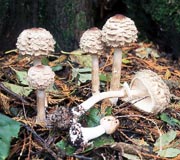
Macrolepiota rachodes (Vittadini) Singer var. rachodes
CAP 5–12 cm wide; convex becoming flat with a knob in age; disc grayish olive brown, smooth; margin colored like the disc, soon breaking up into coarsely fibrous scales on a dingy background. GILLS free, white, becoming red or brown when bruised, darkening in age, close, edges finely fringed, in two or three tiers. SPORE PRINT white. STALK 7–15 cm long—about 1½ times as long as the diameter of the cap, top 7–15 mm thick, equal with an abruptly bulbous base, stuffed, smooth, white, the surface darkening when bruised, the cut flesh staining reddish or saffron. RING thick, persistent, membranous, double, the edge fibrous and frayed, usually movable, white with the lower surface darkening in age. ODOR not remarkable. TASTE not remarkable. HABIT scattered to gregarious. HABITAT litter under deciduous trees. EDIBILITY edible and choice but may sicken some people. MICROSCOPIC FEATURES spores 8–10.5 × 5–6.5 µm, oval, with a small germ pore, dark reddish brown in Melzer’s; cheilocystidia clavate, not strangulated; pleurocystidia absent; cap cuticle compact hymeniform layer of clavate to bulbous cells that may have irregular projections. NOTES. Carlo Vittadini's Descrizione Dei Funghi Mangerecci Più Communi Dell'Italia, 1835, includes a picture of Agaricus rachodes (=Macrolepiota rachodes). It has a smooth cinnamon brown cap cuticle, a swollen stalk base, and looks like Macrolepiota rachodes var. bohemica. [See What's Become of Macrolepiota rachodes? for the new name for what is described here, Chlorophyllum olivieri.] | Chlorophyllum olivieri
Sharon Godkin |
Comparison of Varieties of Macrolepiota rachodes
| Characteristic |
var. rachodes |
var. bohemica |
var. hortensis |
| Scales |
coarsely fibrous |
smooth |
smooth |
| Cap colors |
grayish olive-brown on a dingy background |
cinnamon brown on a white background |
cinnamon brown on a white background |
| Ratio of stipe length to cap diameter |
stipe length 1½ times cap diameter |
stipe length equal to cap diameter |
stipe length equal to cap diameter |
| Stipe diameter |
7–15 mm |
10–25 mm |
10–25 mm |
| Stipe base |
abrupt bulb |
swollen |
marginate bulb |
| Habitat |
leaf litter under deciduous trees |
compost, rich cultivated soil |
compost, rich cultivated soil |
| Cultures |
can be grown in cultures |
seldom grows in cultures |
not observed |
| Spore profile |
oval |
broadly oval |
broadly oval |
| Cheilocystidia |
even |
strangulated |
strangulated |
| Spelling |
rachodes |
rachodes |
rhacodes |
38a. (35) Mushroom is large—top of stalk is more than 8 mm thick
................................................................................39
38b. Mushroom is small—top of stalk is less than 7 mm thick
................................................................................40
39a. (38) Cap is gray brown; cap is smooth or has flattened scales
................................................................................Lepiota barssii
39b. Cap is brown; cap has tufts of brown fibers (use a lens)
................................................................................Lepiota acutesquamosa
40a. (38) Cap has loose grains or powder
................................................................................41
40b. Cap has scales or fibers
................................................................................42
41a. (40) Margin of expanded cap has radial grooves; ring usually persists; lower stalk is usually enlarged—tapered like a baseball bat
................................................................................Leucocoprinus cepistipes
41b. Margin of cap is even; ring doesn’t persist; lower stalk isn’t tapered like a baseball bat (base of stalk may be enlarged)
................................................................................Lepiota oregonensis
42a. (40) Disc is blackish; odor is not remarkable
................................................................................Lepiota atrodisca
Lepiota atrodisca Zeller
CAP 1–5 cm wide, at first convex then flattening and finally uplifted; disc raised, unbroken with flattened fibers, dark grayish brown to almost black; margin at first rolled under, becoming upturned and finally flat, slightly eroded in age, hairy or with flattened fibers or fibrous scales, the fibers
colored somewhat lighter than the disc, the flesh white and sometimes
becoming dingy in age but not staining when touched, the cuticle pulled back from the edge in age. GILLS free, whitish; close or somewhat distant; often with forks, cross walls, or both near the stalk; edges finely fringed, in two tiers. SPORE PRINT white. STALK 1–11.5 cm long, top 1–7 mm thick; the base enlarged; stuffed becoming hollow; smooth, rarely powdery; white, sometimes bruising brown. RING flares up like a collar and hangs down like a skirt; usually persists; pale above, light brown below, frequently with a blackish lower margin. ODOR not remarkable. TASTE not remarkable. HABIT gregarious to solitary. HABITAT coniferous forests on humus and rotten logs. EDIBILITY not noted. MICROSCOPIC FEATURES spores 6.3–7.9 × 3.1–4.7 (5.65) µm, ovoid to ellipsoid and tapered, thick walled, without a germ pore, pale brown or pale reddish in Melzer’s; cheilocystidia clavate, cylindric, or ventricose, sometimes encrusted; pleurocystidia absent; cap cuticle filamentous trichodermium, often tangled and appearing loosely interwoven and sometimes flattened, the cells septate and elliptic or cylindric with ends that may be constricted or Y shaped. NOTES Walter Sundberg found a Lepiota species (Sundberg 766) with brown cap colors that is otherwise like Lepiota atrodisca. He gave it the provisional name "Lepiota brunneodisca." Hardly anyone knew anything about it but the name was passed around. In the 1980s, any small brown Lepiota on a Northwest foray table that was unknown to the identifying hobbyist was destined to be called "Lepiota brunneodisca" no matter what it looked like. Some hobbyists shortened the catchall name to "Lepiota brunnea." | Lepiota atrodisca
.jpg)
Fred Stevens (MykoWeb) |
42b. Disc is warm brown; odor is often pungent
................................................................................43
43a. Odor (if present) is not of grain; cap diameter may be more than 3.5 cm; mushroom is common; spores are projectile shaped
................................................................................Lepiota cristata
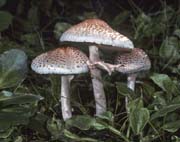
Lepiota cristata (Fries) Kummer
CAP 1–7 cm wide, convex becoming almost flat; disc knobbed, smooth, medium brown to reddish brown; margin incurved becoming flat or upturned, developing concentric rings of small scales, scales paler and rosier than the disc, exposed flesh white, deciduous membrane hangs from edge. GILLS free, white, may age buff, close or somewhat distant, edges even or obscurely wavy, in one to three tiers. SPORE PRINT white. STALK 3–12 cm long, top 2–6 mm thick; equal; stuffed becoming hollow; smooth to silky; white, often flesh-tinged below, bruising or aging brown; base woolly. RING usually not persistent, may be flaring or collapsed, white. ODOR spicy, dulled by refrigeration, sometimes absent; others say it is fragrant, agreeable, mild, strong, pungent, unpleasant, foul, repugnant, fishy, fruity but disgusting, radishy, fruity then rubbery like Scleroderma, like burned rubber, strongly fungusy, sweet and cinnamon-like, like boiled sweets! TASTE disagreeable or not remarkable. HABIT solitary to gregarious. HABITAT under trees on the ground or on rotten wood. EDIBILITY probably poisonous; similar species may be lethal. MICROSCOPIC FEATURES spores 6.3–7.9 × 3.1–4.7 µm, bicornute (bullet shaped), without a germ pore, pale to dark yellow in Melzer's; cheilocystidia abundant, inflated; pleurocystidia absent; cap cuticle hymeniform layer of clavate or pear shaped cells on an interwoven layer. NOTES Hey! Smell this! | Lepiota cristata
Kit Scates Barnhart |
43b. Odor (if present) is of grain; cap diameter is less than 3.5 cm; mushroom is uncommon; spores are egg shaped
................................................................................Lepiota castaneidisca
Lepiota castaneidisca Murrill
CAP 1.8–3 cm wide, convex becoming flattened; disc even or knobbed, smooth, warm buff to pinkish cinnamon; margin incurved becoming plane, breaking into scales, scales pale pinkish, exposed flesh white, at first with scraps hanging from the edge. GILLS free, white to pale pinkish, edges even, in three tiers. SPORE PRINT color not noted. STALK 3–6 cm long, top 2.5–5 mm thick, equal, stuffed becoming hollow, smooth, white, darkening in age or when bruised, base wooly. RING not persistent. ODOR like grain (farinaceous) or absent. TASTE disagreeable of grain (farinaceous) or not remarkable. HABIT scattered. HABITAT humus. EDIBILITY not noted, similar species may be lethal. MICROSCOPIC FEATURES spores 4.7–6.3 × 3.1–3.9 µm, ovoid, thin walled, without a germ pore, pale yellow in Melzer's; cheilocystidia rare, club shaped; pleurocystidia absent; cap cuticle irregular tightly packed clavate cells rising from an interwoven layer. NOTES This Lepiota cristata look-alike is a species of uncertain parentage. Three years after he published it as a new species, Murrill took it back and published it as a synonym of L. cristata. Helen Smith's examination of the type revealed wedge shaped spores although Murrill's original description says the spores are ovate. The type collection may be a mixture of L. castaneidisca and L. cristata. Regardless, West Coast collections of L. castaneidisca, ovate spores and all, are documented.
Come bide a wee,
And sit with me
Upon my tombstone long.
The key die lee,
Though it may be
I did but read it wrong.
- epitaph in north Scotland
Only five of the Lepiotaceae are common on Northwest foray tables. Experienced mushroomers may try to identify them with the following list of salient features. The list of features isn’t complete, it applies only to normal forms of each species, and other species may have the same features. If you think a mushroom is on the list, jump to the description in the key and compare it carefully with the mushroom in hand. Follow the key from the beginning to resolve doubts.
| In compost; big and coarse |
Macrolepiota rachodes var. bohemica (37a) |
| In grass; cap smooth |
Leucoagaricus naucinus (28a) |
| Woolly; yellow brown |
Lepiota clypeolaria (19b) |
| Cap has radial streaks |
Leucoagaricus rubrotinctus (9a) |
| Odorous; scales warm brown |
Lepiota cristata (43a) |
Discussion
This discussion applies to this key only and only to its species as they appear in the Northwest.
TAXONOMY
Modern taxonomy places all species in this key in Agaricaceae, a family that includes genera with dark spores. Because that idea may be jarring to the target audience for the key—intelligent people with limited mycological experience who don't have a microscope or unusual chemicals—a more traditional family name, Lepiotaceae, is used.
The following are segregate genera of Lepiotaceae briefly described.
Leucocoprinus are smaller mushrooms that have caps covered with fine scales or grains and have cap margins with radial furrows.
Cystolepiota are smaller mushrooms that have caps covered with fine grains and have cap margins without radial furrows.
Leucoagaricus are larger mushrooms with caps that have scarcely any scales, feel like suede, and are uniformly white or light gray.
Macrolepiota are big coarse mushrooms with big scales on the cap and a big, frayed, movable ring on the stalk.
Lepiota are small or big mushrooms with caps that have either a radially ruptured cuticle or smaller scales that are usually darker than the background color.
Lepiota petasiformis is closely allied to mushrooms in Cystolepiota and eventually may be placed in that genus.
CAP
A difference in cap colors may be the best way to separate one species from another, but the words used to describe colors are imperfect. Where key leads require a difficult decision about color, other features are included to help make the correct choice.
Disc
The disc of an older mushroom may show what the young cap looked like. It often remains entire while the rest of the cuticle ruptures.
Margin
Typically, the cuticle can't stretch enough to keep pace with an expanding cap so it ruptures, forming scales and exposing flesh.
GILLS
Some species have gills with unique staining reactions. Cortinate (cobwebby) veils covering the gills are unusual, but Lepiota cortinarius and Lepiota acutesquamosa may have them.
SPORE PRINT
Spore prints should be made on white paper. If black paper is used, pale spore prints of any color will look white.
STALK
Overall shape, ornamentation, and staining reactions of the cuticle and flesh are noteworthy diagnostic features.
RING
Traditionally, Lepiotaceae are supposed to have rings, but they don’t always.
ODOR
An odor may help identify a mushroom, but describing that odor is difficult. (See the description of the odor of Lepiota cristata, 43a)
TASTE
You may nibble a little flesh from the edge of the cap, but for goodness sake don't swallow anything. Spit, rinse, and spit.
HABIT
Habit is too variable to be much help in this key.
HABITAT
Lepiotaceae eat dead plants and are not known to be symbiotic with trees (mycorrhizal). High humidity encourages lepiotas to fruit.
EDIBILITY
Please don't eat little lepiotas!
Mycophagy isn't an exact science. Data on edibility depend on anecdotal evidence from people who have eaten wild mushrooms. Few species are eaten, few people eat them, and few of the people who do eat them are skilled identifiers. Mushrooms that are otherwise edible may cause illness unless they are fresh, thoroughly cooked, and eaten in reasonable quantities. A few people are sickened by them anyway because of unusual sensitivity. Some species in this key were tested chemically and were found to contain amanitins, the poisons that make some Amanita species lethal. A small meal of Lepiota subincarnata killed a man in Vancouver, B.C. Please don't eat little lepiotas!
MICROSCOPIC FEATURES
Microscopic features don't vary among Lepiotaceae of the same species nearly as much as macroscopic features do.
One must use a microscope to separate look-alike species at key leads 19 and 42. Otherwise, examination with the naked eye or a 10 power hand lens will do.
Spores
Lepiota cristata and Lepiota magnispora can be identified by spore profile alone, and spore characteristics can be most helpful in confirming identifications of other species.
Cheilocystidia
Most species have cheilocystidia, but the cells may be hard to find.
Pleurocystidia
Pleurocystidia are scarce in the few species that have them.
Cap cuticle
The organization of cells in the cap cuticle is an important diagnostic feature.
NOTES
Within a species, individual mushrooms differ from one another. A mushroom changes appearance as it ages. Environmental conditions such as rain and drought affect the way it looks. Nature doesn't care about keys. Some mushroom hunters don't care about keys either. They destroy features by careless handling. This key doesn't account for all variations, but an effort has been made to include the ones most likely to be encountered in the field and on the foray table.
When a path leads to a name, confirm it by comparing the mushroom in hand with the description in the key. Remember, the species may not be in the key at all.
Bibliography
Ammirati, Joseph F. & James A. Traquair & Paul A. Horgen. 1985. Poisonous Mushrooms of Canada. Markham, Ontario: Fitzhenry & Whiteside Limited
Benjamin, Denis R. 1995. Mushrooms: Poisons and Panaceas. New York: W. H. Freeman and Company
Berkeley, M. J. & C. E. Broome. 1936. Bulletin de la Société Mycologique de France Tome 52, p.4
Breitenbach, J. & F. Kränzlin. 1995. Fungi of Switzerland Volume 4. Luzern, Switzerland: Edition Mykologia
Bresadola, Giacoma. 1882. Fungi Tridentini 1 p.15
Bresadola, Giacoma. 1931. Bulletin de la Société Mycologique de France Tome 47, pp. 52–57
Candusso, M. & G. Lanzoni. 1990. Lepiota S.I., Fungi Europaei 4. Italy: G. Parini 5
Hansen, Lise & Henning Knudsen, editors. 1992. Nordic Macromycetes Vol. 2. Copenhagen: Nordsvamp
Kauffman, C. H. 1924. The Genus Lepiota in the United States. Papers of the Michigan Academy of Science, Arts and Letters Vol. 4
Kelly, Kenneth L. & Deane B. Judd. 1976. Color Universal Language and Dictionary of Names. Washington, D.C.: National Bureau of Standards Special Publication 440
Largent, David L. & Timothy J. Baroni. 1988. How to Identify Mushrooms to Genus VI: Modern Genera. Eureka, California: Mad River Press
Lincoff, Gary H. 1981: The Audubon Society Field Guide to North American Mushrooms. New York, Alfred A. Knopf
McKenny, Margaret & Daniel E Stuntz & Joseph F. Ammirati. 1987. The New Savory Wild Mushroom. Seattle: The University of Washington Press
Moser, Meinhard. 1978. Keys to Agarics and Boleti. Great Britain: Roger Phillips
Murrill, William A. 1912. The Agaricaceae of the Pacific Coast II. Mycologia Vol 4, No. 5, pp. 231–262.
Murrill, William A. 1912. The Fungus Flora of the Siskiyou Mountains in Southern Oregon. Mycologia 4, p.235.
Peck, C. H. 1873. Twenty-third Annual Report of the Regents of the University of the State of New York. Report of the Botanist
Reid, Derek A. 1958. New or Interesting Records of British Hymenomycetes. II. Transactions of the British Mycological Society. 41
Saccardo, P.A. 1902. Sylloge Fungorum Vol. 16
Singer, Rolf. 1986. The Agaricales in Modern Taxonomy. Federal Republic of Germany: Sven Koeltz Scientific Books
Smith, Alexander H. 1949. Mushrooms in Their Natural Habitats. Portland, Oregon: Sawyer's
Smith, Alexander H. & Helen V. Smith & Nancy S. Weber. 1979. How to Know the Gilled Mushrooms. Dubuque, Iowa: Wm. C. Brown
Smith, Helen V. & Nancy S. Weber. 1982. Selected Species of Leucocoprinus from the Southeastern United States. Contributions of the University of Michigan Herbarium Vol. 15 pp. 297–309
Smith, Helen V. & Nancy S. Weber. 1987. Observations on Lepiota Americana and Some Related Species. Contributions of the University of Michigan Herbarium Vol. 16 pp. 211–221
Smith, Helen V. 1954. A Revision of the Michigan Species of Lepiota. Lloydia Vol. 17 No. 4 pp.307–328
Smith, Helen V. 1966. Contributions Toward a Monograph on the Genus Lepiota, I. Type Studies in the Genus Lepiota. Mycopathologia et Mycologia Applicata Vol. 29
Smith, Helen V. & Walter J. Sundberg. 1979. Studies on the Lepiotaceae of the Pacific Coast Region. I. Two New Species. Mycotaxon Vol. 8 pp. 446-452
Snell, Walter H. & Esther A. Dick. 1971. A Glossary of Mycology. Cambridge, Massachusetts: Harvard University Press
Sundberg, Walter James. 1967. The Family Lepiotaceae in California. Master's thesis, San Francisco State College
Vellinga, Else C. 2000. Which Lepiotas are Toxic? Mushroom the Journal of Wild Mushrooming Issue 69 Vol. 18 No. 4 pp. 33–34
Weber, Nancy Smith & Alexander H. Smith. 1985. A Field Guide to Southern Mushrooms: Ann Arbor, The University of Michigan Press
Zeller, S. M. 1922. Contributions to Our Knowledge of Oregon Fungi. Mycologia Vol. 4 No. 4
Zeller, S. M. 1934. A New Species of Lepiota. Mycologia Vol. 26 p. 210
Zeller, S. M. 1938. New or Noteworthy Agarics from the Pacific Coast States. Mycologia
Vol. 30
Glossary
Amanita: a genus of gilled mushrooms
amanitins: toxins that may cause grave illness and death
ammonium hydroxide: see NH4OH
apex: (of a cell) the end farthest from the attachment; (of a stalk) the top
apiculate: pointed
apiculus: (of a spore) a pointed basal projection
cap: (in this key) the "umbrella" that bears gills and is supported by the stalk.
cheilocystidia: sterile cells that project from the edge of the gill
clamps (clamp connections): asymmetrical bulges where two cells join
clavate: club shaped
Clitocybe: a genus of gilled mushrooms
cm (centimeter): 0.3937 inch—about 3/8"; 21/2 cm is about 1", 10 cm is about 4"
Congo red: a stain used in microscopy to color fungal cell walls
cuticle: the layer of cells forming the skin of a cap or stalk
dextrinoid: (in microscopy) the red to red brown color that results when certain cells are mounted in Melzer's reagent
disc: (of a cap) the zone at the center
edge: (of a cap) the perimeter
epithelium: an outside layer of compressed cells on the cap or stalk
even: (of a gill edge) linear; (of a stalk) entirely cylindrical (of a cap) not grooved
farinaceous: an odor or taste reminiscent of fresh grain
fasciculate: having bundles of crowded cells
flesh: the inner tissue of a cap or stalk
floccose: shaggy
free: (of the gills) not meeting the stalk
fusiform: tapering in at both ends
germ pore: a small thin-walled zone on a spore's apex
gills: the thin radial blades on the underside of the cap
habit: the proximity of mushrooms to one another in one fruiting
habitat: (in this key) where the mushroom grows and what it grows on
hilar appendage: (of the spore) a basal projection that includes the apiculus
hyaline: (of cells viewed in the microscope) transparent
hymeniform: club shaped like the fertile cells on the gill
hyphae: strands of fungal cells
inamyloid: tissue or cells not stained by Melzer's reagent
KOH (potassium hydroxide): a solution of lye in water used in 3–5% concentration for mounting microscopic specimens; a reagent that stains certain mushroom tissue
margin: (of a cap) the zone between the disc and the edge
marginate bulb: an abrupt swelling with a flat top and often a ridged perimeter found at the base of a stalk
medial: away from both ends
Melzer's (Melzer's reagent): a solution of chloral hydrate, water, iodine, and potassium iodide that stains certain fungal tissue and cells various colors
mm (millimeter): 1/100 cm; about 1/32 inch
movable: (of a ring) easily slid along the stalk like a ring on a finger
mycelium: a mass of hyphae visible to the naked eye as fine cords
NH4OH (ammonium hydroxide): a solution of ammonia in water used in 3–5% concentration for mounting microscopic specimens; a regent that stains certain mushroom tissue
ovoid: egg shaped
palisade: (of the cap cuticle) an aligned row of erect cells
pileocystidia: sterile cells that project from the cap cuticle
pleurocystidia: sterile cells that project from the face of the gill
ring (annulus): a band of tissue encircling the stalk medially
scales: (in this key, of the cap and stalk) ruptured cuticle; small raised patches that differ from the underlying flesh in texture and often in color
Scleroderma: a genus of spherical underground fungi
sclerotium: a compact mass of fungal material from which a mushroom may grow
septate: (of cells) having cross walls
sp., spp. (pl.): species
sphaerocysts: (in this key) loose globular cells covering the cap or stalk
spore: (in this key) a mushroom's reproductive cell
spore print: the spores deposited when a cap is removed from the stalk and placed gills down on a flat surface
stalk (stipe): (in this key) the stem beneath the cap
strangulated: irregularly constricted
striate: (in this key, of the cap margin) hav-ing radial grooves, not just shadows of gills viewed through translucent flesh
subovoid: almost egg shaped
tiers: (of the gills) the concentric pattern of long gills interspersed with shorter ones
trichodermium: (of cap cuticles) an accumulation of erect hair-like cells
var., vars. (pl.): variety
veil (partial veil): a sheet of tissue extending from the edge of the cap to the stalk and covering the gills of an immature mushroom
ventricose: with a medial bulge
vinaceous: the purple red color of aged zinfandel
wine: (sensu Benjamin Franklin) a constant that God loves us and loves to see us happy
µm (micrometer, micron): one millionth of a meter; about 1/25,000 inch
Species Index
acutesquamosa, Lepiota, 5a
americana, Lepiota, 36a
americanus, Leucocoprinus, 36a
aspera, Lepiota, 5a
atrodisca, Lepiota, 42a
barssii, Leucoagaricus, 28b
birnbaumii, Leucocoprinus, 3a
bucknallii, Cystolepiota, 13a
castanea, Lepiota, 23a
castaneidisca, Lepiota, 43b
cepistipes, Leucocoprinus, 34a
clypeolaria, Lepiota, 19b
clypeolarioides, Lepiota, 23b
colubrina, Lepiota, 19b
cortinarius, Lepiota, 16b
cristata, Lepiota, 43a
cristatella, Lepiota, 32b
decorata, Lepiota, 14a
echinatum, Melanophyllum, 1a
flammeatincta, Lepiota, 7b
fuscosquamea, Lepiota, 21b
fuscovinacea, Lepiota, 12b
glabridisca, Lepiota, 9b
haematospermum, Melanophyllum, 1a
helveola, Lepiota, 21a
hemispherica, Lepiota, 32b
hetieri, Cystolepiota, 29a, 31a
leucothites, Lepiota, 28a
leucothites, Leucoagaricus, 28a
lilacinogranulosus, Leucocoprinus, 3b
lutea, Lepiota, 3a
magnispora, Lepiota, 19a
molybdites, Chlorophyllum, 37a
naucina, Lepiota, 28a
naucinoides, Lepiota, 28a
naucinus, Leucoagaricus, 28a
oregonensis, Lepiota, 32a
petasiformis, Lepiota, 31a
pseudohelveola, Lepiota, 22a
pulcherrima, Lepiota, 33a
rachodes var. bohemica, Macrolepiota, 37a
rachodes var. rachodes, Macrolepiota, 37b
rhacodes var. hortensis, Macrolepiota, 16a
roseifolia, Lepiota, 7a
roseilivida, Lepiota, 14b
rubrotincta, Lepiota, 9a
rufescens, Lepiota, 29a
seminuda, Cystolepiota, 32b
sequoiarum, Lepiota, 34b
sistrata, Cystolepiota, 32b
species #1, Lepiota, 5a
subincarnata, Lepiota, 5b
ventriosospora, Lepiota, 19a
- END -
