MatchMaker © Mike Beug
MatchMaker © Ben Woo
Three large gilled mushroom species in the Northwest are widespread and frequently eaten. One or more of them poison a few of the people who eat it, but we’re not sure which.
Decades ago we called some Northwest mushrooms "Lepiota rachodes" and later "Macrolepiota rachodes." We were comfortable with those names. The few publications and mycologists available to mushroom hobbyists assured us that we were correct. Then dozens of European and American mushroom books were published and they offer confusing concepts of what they call M. rachodes. Some describe a stately mushroom, some describe a robust mushroom, and some wed the two forms into a mushroom with features borrowed from both. A third form is scarcely mentioned. Even the name is spelled in two ways, "rhacodes" and "rachodes." So what, exactly, do we call them?
Elsa Vellinga to the rescue. She is a Dutch mycologist at UC Berkeley who decided that the three varieties of M. rachodes are quite different from one another and should be three species. Research convinced her that they are morphologically and genetically more closely related to the genus Chlorophyllum than they are to Macrolepiota. She published them as three species of Chlorophyllum: C. rachodes, C. brunneum, and C. olivieri. Molecular studies showed her that the sequestrate Endoptychum agaricoides is a Chlorophyllum also and its name is now C. agaricoides.
Chlorophyllum molybdites, notorious for poisoning careless mushroom hunters in the places where it grows, doesn’t seem to occur in the Northwest.
So we have four Northwest Chlorophyllum species and they’re not hard to identify. Here’s a key.
1a. Mushroom sequestrate; gills absent or contorted and enclosed
................................................................................C. agaricoides
1b. Mushroom not sequestrate; gills flat and soon exposed
................................................................................2
2a. Stalk length noticeably greater than cap diameter; cap scales fibrous (like hemp rope); cap scales grayish olive brown on a dingy background
................................................................................C. olivieri
2b. Stalk length approximately equal to cap diameter; cap scales smooth; cap scales cinnamon brown on a white background
................................................................................3
3a. Annulus with one edge; stalk base an abrupt bulb with a flattened top that may have a ridged perimeter
................................................................................C. brunneum
3b. Annulus with two edges—one turned up and one turned down; stalk base swollen or a bulb with a sloping top and no ridge
................................................................................C. rachodes
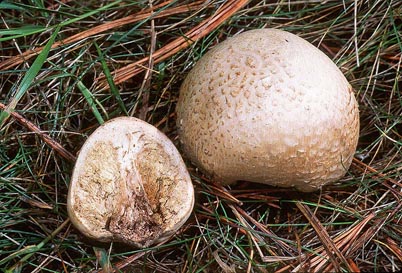
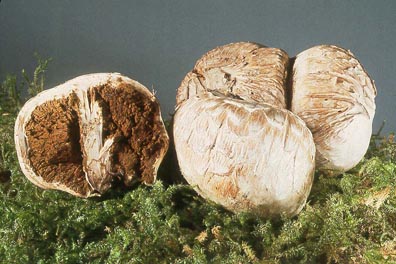
Chlorophyllum agaricoides (Czerniaier) Vellinga
CAP 1–7 cm wide × 2–10 cm high, spherical to egg shaped, often tapering upward to a blunt point, dry, white aging to dark brown, smooth with obscure fibrils, may develop appressed fibrous scales; disc the same; margin attached to the stalk. GILLS a gleba of contorted blades with cross connections and chambers, fleshy becoming friable, aging to a wind eroded powdery mass, white aging to yellow brown. SPORE PRINT not obtainable. STALK 0–3 cm long × 5–20 mm thick, extending from a columella, white becoming brown, with a cord at the base. RING absent. ODOR not remarkable when young, of cabbage when old. TASTE not remarkable. HABIT single to clustered. HABITAT cultivated land, grass, wasteland. EDIBILITY edible when young and white. SPORES 6.5–9.5 × 5–7 µm, globose to elliptic, green to yellow brown, germ pore indistinct, reddish brown in Melzer's. CHEILOCYSTIDIA absent. PLEUROCYSTIDIA absent. CAP CUTICLE not noted. NOTES Synonym It is synonymous with Endoptychum agaricoides Czerniaier. Drought resistance An enclosed hymenium protects it from desiccation. Evolution It is evolving from a gilled mushroom to a false truffle. Or perhaps it's the creation of an indecisive Intelligent Designer. Look-alike Endoptychum depressum Singer & A.H.Smith favors sylvan habitats and has a blackish interior when old; C. agaricoides is found in the open and has a yellow brown interior when old.
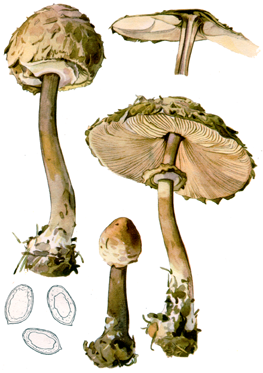
Chlorophyllum olivieri (Barla) Vellinga
CAP 5–12 cm wide, convex becoming flat with a knob in age; disc grayish olive brown, smooth; margin like the disc at first, soon breaking up concentrically into coarsely fibrous scales on a dingy background. GILLS free, white, becoming red or brown when bruised, darkening in age, close, edges finely fringed, in two or three tiers. SPORE PRINT white. STALK 7–15 cm long—about 1½ times as long as the diameter of the cap, top 7–15 mm thick, equal with an abrupt rounded bulb at the base, stuffed, smooth, white, surface darkening when bruised, cut flesh staining reddish or saffron. RING thick, persistent, membranous, double, the edge fibrous and frayed, white with the lower surface darkening in age; movable like a ring on a finger. ODOR not remarkable. TASTE not remarkable. HABIT scattered to gregarious. HABITAT litter under conifer or deciduous trees. EDIBILITY edible and choice but may sicken some people—see notes. SPORES 8.7–11 × 5.8–8 µm, oval, with a small germ pore, dark reddish brown in Melzer's. CHEILOCYSTIDIA globose to oval. PLEUROCYSTIDIA absent. CAP CUTICLE compact hymeniform layer of clavate to bulbous cells that may have irregular projections. NOTES Edibility Of the gilled Chlorophyllum species in the Northwest, one or more sicken some people; it is uncertain which because in the past all three were called “Macrolepiota rachodes.”
Chlorophyllum brunneum (Farlow & Burt) Vellinga
CAP 10–20 cm wide, convex becoming flat in age; disc cinnamon brown, smooth; margin colored like the disc, smooth at first, soon breaking up concentrically into smooth upturned scales with white fibrous flesh showing between the scales. GILLS free, white, becoming red or brown when bruised, darkening in age, close, edges finely fringed, in two or three tiers. SPORE PRINT white. STALK 10–20 cm long—about equal to the diameter of the cap, top 10–25 mm thick, club shaped, base with an abrupt bulb having a flattened top and often a ridged perimeter, stuffed, smooth, white, surface darkening when bruised, cut flesh staining reddish or saffron. RING thick, persistent, membranous, single edge, edge fibrous and frayed, movable like a ring on a finger, white above with a tough brown patch below. ODOR not remarkable. TASTE not remarkable. HABIT scattered to gregarious. HABITAT compost, rich soil, gardens. EDIBILITY edible and choice but may sicken some people—see notes. SPORES 10.0–13.2 × 6.9–8.6 µm, broadly oval, with a germ pore, dark reddish brown in Melzer's. CHEILOCYSTIDIA clavate, narrowing toward the base. PLEUROCYSTIDIA absent. CAP CUTICLE compact cemented hymeniform layer of clavate to bulbous cells. NOTES Salient features that distinguish C. brunneum from C. rachodes: C. brunneum has a ring with a single edge and its stalk base is an abrupt bulb with a flattened top that often has a ridged perimeter; C. rachodes has a double-edged ring and a stalk base that is either gradually swollen or is a bulb with a sloping top that never has a ridge. Edibility Of the gilled Chlorophyllum species in the Northwest, one or more sicken some people; it is uncertain which because in the past all three were called “Macrolepiota rachodes.”
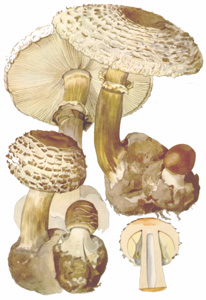
Chlorophyllum rachodes (Vittadini) Vellinga
CAP 10–20 cm wide, convex becoming flat in age; disc cinnamon brown, smooth; margin like the disc at first, soon breaking up concentrically into smooth upturned cinnamon brown scales with white fibrous flesh showing between the scales. GILLS free, white, rarely tinged pale green, becoming red or brown when bruised, darkening in age, close, edges finely fringed, in two or three tiers. SPORE PRINT white or cream. STALK 10–20 cm long—about equal to the diameter of the cap, top 10–20 mm thick, club shaped, gradually swollen at the base or with a rounded bulb having a sloping top and no ridge, stuffed, smooth, white, surface darkening when bruised, cut flesh staining reddish or saffron. RING thick, persistent, membranous, movable like a ring on a finger, with two edges—one turned up and one turned down, edges fibrous and tattered, above white, below with brown cuticle that darkens in age. ODOR not remarkable. TASTE not remarkable. HABIT scattered to gregarious. HABITAT compost, rich soil, gardens. EDIBILITY edible and choice but may sicken some people—see notes. SPORES 8.8–12.7 × 5.4–7.9 µm, globose to pyriform, with a small germ pore, dark reddish brown in Melzer's, contents become red when mounted in 3–5% KOH or NH4OH and stained with Congo red. CHEILOCYSTIDIA globose to pyriform. PLEUROCYSTIDIA absent. CAP CUTICLE compact interwoven hymeniform layer, cells irregularly constricted. NOTES Salient features that distinguish C. rachodes from C. brunneum: C. rachodes has double-edged ring and a stalk base that is either gradually swollen or is a bulb with a sloping top that never has a ridge; C. brunneum has a ring with a single edge and its stalk base is an abrupt bulb with a flattened top that often has a ridged perimeter. Cultures of C. rachodes rarely produce mushrooms. Edibility Of the gilled Chlorophyllum species in the Northwest, one or more sicken some people; it is uncertain which because in the past all three were called “Macrolepiota rachodes.” Occasional clusters have fused gills; examination of these sterile gills has not revealed a parasite, but consumption is discouraged. Look-alike The poisonous Chlorophyllum molybdites (Meyer ex Fries) Massee looks like C. rachodes but is not known to grow in the Pacific Northwest. C. molybdites produces a green spore print and has white gills that become green with age. C. rachodes sometimes has gills with a green cast but its spore print is always white. C. molybdites frequents lawns; its spore contents become gray when mounted in 3–5% KOH or NH4OH and stained with Congo red; its cap cuticle has some pear shaped cells and, at the disc, tightly interwoven cells that may be upright but are not organized.
| Chlorophyllum agaricoides | |
MatchMaker © Mike Beug |
MatchMaker © Ben Woo |
| Chlorophyllum olivieri | Chlorophyllum brunneum | |
 Mushrooms; Pilát & Ušák Spring Books, London; c.1938 |
 Mushrooms; Pilát & Ušák Spring Books, London; c.1938 |
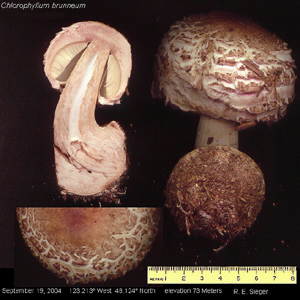 Dick Sieger |
| Chlorophyllum rachodes | ||
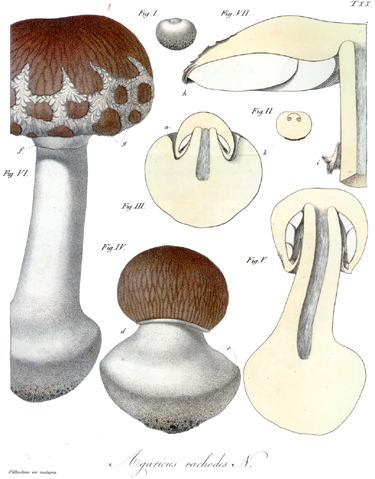 Carlo Vittadini; Descrizione dei Funghi Mangerecci Più Comuni dell'Italia; 1835 |
||
| Characteristic | C. rachodes | C. brunneum | C. olivieri |
|---|---|---|---|
| Ratio of stalk length to cap diameter | Stalk length equals cap diameter | Stalk length equals cap diameter | Stalk length 1½ times cap diameter |
| Cap colors | Cinnamon brown on a white background | Cinnamon brown on a white background | Grayish olive brown on a dingy background |
| Cap scales | Smooth | Smooth | Coarsely fibrous |
| Stalk diameter | 10–25 mm | 10–25 mm | 7–15 mm |
| Ring | Double edge | Single edge | Double edge |
| Base of stalk | Gradual swelling or a bulb with a sloping top | Abrupt bulb with a flattened top | Abrupt rounded bulb |
| Habitat | Compost, rich soil | Compost, rich soil | Litter under trees |
| Cheilocystidia | Broadly oval | Club shaped | Rounded |
| Cultures | Mushrooms rarely result | Not observed | Mushrooms often result |
| Name Used | Equivalent |
|---|---|
| Macrolepiota rachodes var. bohemica | Chlorophyllum rachodes |
| Macrolepiota rachodes var. rachodes | Chlorophyllum olivieri |
| Macrolepiota rachodes var. hortensis | Chlorophyllum brunneum |
- END -