Adolf Ceska
Key to Veined Fungi and Descriptions
The term Veined Fungi covers the genera Cantharellus, Craterellus, Gomphus, and Polyozellus, (the chanterelles), and some other species whose spore-bearing surface is wrinkled, veined or ridged, but not gill-like. We are fortunate to have a very good account of the chanterelles on the Internet that contains a "Key to Pacific Northwest Chanterelles, Chanterelle-Like Mushrooms, and Look-Alikes". It begins at page 30 of a publication called
Ecology and Management of Commercially Harvested Chanterelles,
by David Pilz, Lorelei Norvell, Eric Danell, and Randy Molina,
and may be found at
https://www.researchgate.net/publication/255711924_USDA-FS_PNW_Research_Station_-Ecology_and_Management_of_Commercially_Harvested_Chanterelle_Mushrooms
The chanterelles considered there are listed in the index and described in Chanterelles. (The name Cantharellus roseocanus is used in place of Cantharellus cibarius var. roseocanus.)
The Chanterelles key also has a description for a chanterelle more recently described from Oregon, and also found in California and Washington, Cantharellus cascadensis. That description is derived fromthe original 2003 description, with Further Notes from Siegel & Schwarz (2016). There are also three Polyozellus species added at the end of that key, newly described in 2017. All four of these species are illustrated in the Gallery below, along with the other chanterelles.
The other veined fungi included here are not likely to be confused with chanterelles. Most of them are small members of genera most of whose members have well-formed gills: Marasmius, Mycena, Hemimycena, and Arrhenia. Rimbachia has characteristics in common with gilled mushrooms as well. Stereopsis humphreyi is a distinctive small white species with a stem and gill-less cap. Cudonia circinans is in a genus traditionally associated with cup-fungi and is the only ascomycete considered here. Some of the so-called crust and parchment fungi have a vein-like surface, but many require microscopic identification or are seldom recorded. Four that are recognizable and fairly common are described here: Phlebia radiata, Phlebia tremellosa, Plicatura nivea, and Plicaturopsis crispa.
1a Upright fruitbodies with vein-like folds on the underside of a cap (usually running down onto the upper part of the stem) or on the outside of a funnel-like fruitbody, 5 cm or more tall when mature, generally growing on the ground (See the Chanterelles Key, mentioned in the introduction, and illustrations in a Gallery below)
................................................................................Chanterelles
1b Fruitbodies upright and less than 5 cm tall when mature, or fruitbody growing directly from moss plants, or attached laterally to wood, or growing flat on wood
................................................................................2
2a Fruitbody upright and less than 5 cm tall, or fruitbody growing directly from moss plants
................................................................................3
2b Fruitbody attached laterally to wood or growing flat on wood
................................................................................17
3a Fruitbody white
................................................................................4
3b Fruitbody some other color
................................................................................13
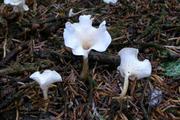
4a Cap 0.6-2.9 cm wide, kidney-shaped to funnel-shaped on 1-3 cm stem, cap in most fruitbodies cleft on one side to the stem
................................................................................Stereopsis humphreyi
| CAP single or rarely 2 or 3 per stem, 0.6-2.9 cm wide, becoming kidney-shaped to funnel-shaped, cleft on one side to the stem, often with markedly wavy margins, membranous and soft, dull white on upper surface, dry, silky when young, nearly smooth to wrinkled, later most becoming obscurely zoned-ridged and often minutely cottony-scaly or rough towards stem. UNDERSIDE decurrent, nearly smooth but sometimes when old with low radiating wrinkles or more prominent furrows, creamy white, demarcated from stem. STEM 1-3 cm long and 1-3 mm wide, stuffed to hollow, tough, pliant, white (but when old faintly cinnamon), velvety, a few bald except at base, base with hairs. FRUITING gregarious on mossy needle beds, cones, twigs, fern fronds, and mosses, in coniferous forest. SPORES 6.5-9 x 3.5-5.5 um, narrowly to broadly oval to elliptic, smooth, inamyloid. | Stereopsis humphreyi Adolf Ceska |
4b Not having these characters, cap less than 1.5 cm
................................................................................5
5a Fruitbody growing on Carex (sedge) or Scirpus under dense leaf cover in open marshes
................................................................................Marasmius caricis
CAP 0.2-0.75 cm, cushion-shaped becoming convex and sometimes slightly depressed on disc, tough and membranous, margin incurved when young, revolute (curled up) when old; pure white, dry, opaque, radially furrowed and wrinkled when old, slightly micaceous (with shiny particles) under low magnification. UNDERSIDE gills white, adnate, distant, moderately sized, fold-like to vein-like in larger caps, small subgills and anastomoses forming a submerulioid to poroid surface with a few dominant gills. STEM 1.5-3 mm x 0.1-2 mm, equal but often slightly swollen at base, solid, off-center, white, appearing inserted to the naked eye, actually arising from a base under the epidermis with a small pad at the point of emergence; dry, finely downy. FRUITING scattered on Carex (sedge) or Scirpus under dense leaf cover in open marshes. SPORES 13.2-16.0 x 5-6.4 um, inequilateral, narrowly oboval to elliptic or fusiform, smooth, inamyloid, colorless, often 1 to 2 droplets, with prominent blunt apiculus.
5b Fruitbody growing on some other substrate
................................................................................6
6a Fruitbody growing usually on fallen leaves especially Populus, but also other vegetation such as standing dead Equisetum stems, overwintered apple-skins, leaves and sticks of hardwood trees, or blackberry shoots
................................................................................Marasmius epiphyllus
CAP 0.1-1.5 cm across, convex to flat, rarely depressed, white or whitish when young, disc becoming pale yellow or yellowish orange when old, margin white; minutely pruinose (appearing powdery), dull, opaque, smooth or minutely wrinkled, margin obscurely striate when old. UNDERSIDE gills frequently adnate, sometimes attached to an adnate partial collar, distant, few or rarely lacking altogether, narrow and vein-like, 1-4 tiers of subgills (vein-like), interveined; white or pale yellowish white. STEM 5-40 mm x 0.2-1 mm, inserted, yellowish white when young, top remaining so but lower part becoming yellowish brown, reddish brown or dark brown; shiny, pruinose (appearing as if having yellowish white or reddish brown powder). FRUITING fallen leaves especially Populus, but also other vegetation such as standing dead Equisetum stems, overwintered apple-skins, leaves and sticks of hardwood trees, or blackberry shoots. SPORES 9.6-12.3(13.2) x 3.6-4.8(5.4) um, elongate-elliptic; basidia 4-spored. REMARKS An English name is "white pinwheel". Marasmius tremulae has cap under 0.4 cm, grows on aspen leaves, and has longer spores 11-14 x 2.8-4 um on 2-spored basidia.
6b Fruitbody growing on some other substrate
................................................................................7
7a Fruitbody growing on redwood twigs and needles, (cylindric spores)
................................................................................Mycena paucilamellata
CAP 0.1-0.15 cm across, conic - bell-shaped, shining white and opaque at all stages. UNDERSIDE smooth or 3-5 low ridges somewhat decurrent, whitish. STEM 1 cm long, thread-like, top usually slightly enlarged, base inserted; white; pruinose (appearing powdery) in upper part, base slightly downy. FRUITING growing on redwood twigs and needles. SPORES (8)9-11 x 3-3.5 um, cylindric to subaciculate (almost needle-like), tapered to a long point at base, smooth, amyloid, colorless.
7b Growing on some other substrate
................................................................................8
8a Fruitbody mycenoid (Mycena-like in having comparatively small conic or convex caps, cartilaginous stems, no ring, no volva) (Hemimycena)
................................................................................9
8b Fruitbody with off-center to lateral stem or no stem, usually growing on moss (Rimbachia)
................................................................................11
9a Known from gregarious growth on dripping wet gametophytes of moss in spray zone of a montane waterfall, cap convex to flat with prominent umbo, (spores 9.8-10.8 x 2.5-3.1 um)
................................................................................Hemimycena nebulophila
CAP 0.12-0.18 cm, convex to flat, with prominent pointed umbo; white, wrinkled, translucent, with uneven edges. UNDERSIDE smooth or as a few distant fold-like ridges. STEM 4-6 mm long and 0.1 mm wide, thread-like except for slightly swollen base; white, downy under hand lens. FRUITING gregarious on dripping wet gametophytes of moss in spray zone of a montane waterfall. SPORES 9.8-10.8 x 2.5-3.1 um, allantoid (curved sausage-shaped) to narrowly cylindric or narrowly pip-shaped, smooth, inamyloid, colorless, thin-walled; basidia (1)2-4-spored.
9b Not having these characters
................................................................................10
10a Restricted to growth on monocot debris in wet areas, cap downy centrally under hand lens, (spores 11-15 x 3.8-4.5 um)
................................................................................Hemimycena cyphelloides
CAP 0.05-0.2 cm, convex, sometimes depressed at center, becoming flat to cup-shaped or funnel-shaped; white, finely downy centrally with hand lens, sometimes radially grooved when folds present on underside. UNDERSIDE smooth or with folds not reaching margin, slightly decurrent. STEM 2-10 mm x 0.05-0.1 mm, thread-like, white, with minute fine hairs under hand lens, often more at base, inserted or with a slightly swollen pubescent base. FRUITING restricted to growth on monocot debris in wet areas. SPORES 11-15 x 3.8-4.5 um, elliptic to cylindric, smooth, inamyloid, thin-walled, with prominent apiculus; basidia (1)2 spored; clamp connections absent.
10b On woody or herbaceous debris including monocot litter, leaves, coniferous litter, Douglas-fir cones, all of which are damp, cap downy overall under hand lens, (spores 7-9 x 4.5-4.8 um)
................................................................................Hemimycena hirsuta
CAP 0.1-0.5 cm, obtusely conical to bell-shaped becoming flat and sometimes depressed centrally, variable in shape and may have conic umbo; white, translucent, finely downy under hand lens, edges uneven and sometimes crisped. UNDERSIDE smooth or with uneven folds not reaching margin, spore-bearing surface decurrent, folds distant; white. STEM 4-8 mm x 0.1-0.2 mm, thread-like, white, finely downy under hand lens, especially towards base. FRUITING on woody or herbaceous debris including monocot litter, leaves, coniferous litter, Douglas-fir cones, all of which are damp. SPORES 7-9 x 4.5-4.8 um, elliptic, smooth, inamyloid, colorless, with prominent apiculus, often with one droplet; basidia 2(3-4)-spored.
11a (8b) Underside with gill-like radiating folds
................................................................................Rimbachia bryophila
| CAP 0.1-0.7 cm, hanging, conchate (shell-shaped) to conic to cup-shaped, margin incurved, fragile; white; dry, bald near margins, sometimes slightly hairy near point of attachment. UNDERSIDE smooth when very young, soon becoming cantharelloid (with veins) and usually forming forked gill-like folds in larger fruit-bodies; colored as cap. STEM absent, or short pseudostem. FRUITING on various species of moss in humid places such as ravines in coastal coniferous forests. SPORES 5-7 x 4.5-7 um, nearly round to very broadly pip-shaped with very prominent apiculus, smooth, inamyloid, colorless, with thin to pronounced walls. | Rimbachia bryophila.jpg) Fred Stevens (MykoWeb) |
11b Underside smooth or only slightly wrinkled
................................................................................12
12a Spores round or nearly round 4-5(6) x 4-5 um
................................................................................Rimbachia arachnoidea
CAP 0.1-0.3 cm, cup-shaped, hanging with concave spore-bearing surface facing downward, margins incurved; white; finely fibrillose, margin silky. UNDERSIDE smooth to only slightly wrinkled; white with slight buff tint. STEM Cap is narrowly to broadly attached centrally or off-center. FRUITING occasionally somewhat confluent where crowded, more often among or associated with mycelial strands; on moss leaves, usually on undersides or along stems, and also on nearby substrate such as soil or decayed wood, in hardwood or mixed forests. SPORES 4-5(6) x 4-5 um, round or nearly round or broadly pip-shaped, smooth, inamyloid, colorless, with pronounced walls and apiculus.
12b Spores not round or nearly round, 8-10.5(12) x (4)5-6(7) um
................................................................................Rimbachia neckerae
CAP 0.08-1.2 cm, urceolate (having the shape of a pitcher, with a large body and small mouth) to bell-shaped or conchate, thin, very delicate, translucent, margin incurved becoming uneven; white; smooth or minutely tomentose, margin slightly fringed. UNDERSIDE smooth, becoming wrinkled only in the center; white. STEM absent or with off-center rudimentary pseudostem. FRUITING gregarious on algal fluxes and amongst mosses on soil or old wood. SPORES 8-10.5(12) x (4)5-6(7) um, pip-shaped to broadly elliptic or almond-shaped, smooth, inamyloid, thin-walled, with prominent apiculus.
13a (3b) Fruitbody 2-6 cm tall, buff to yellowish brown or pale brown, firm-fleshy to cartilaginous, cap sometimes convoluted, cap margin rolled under
................................................................................Cudonia circinans
| CAP 0.5-2 cm wide, convex, sometimes with a shallow central depression, sometimes convoluted; margin strongly rolled under, thin, and often wavy; cap color cream buff, pinkish buff, cinnamon buff, vinaceous buff, yellowish, pale brown, or darker, cap surface wrinkled or smooth, dry, UNDERSIDE sterile, often with veins that extend up from stem; STEM 1.5-7.0 cm long and 1.5-5 mm wide at top, 2-12 mm lower down, sometimes flattened, stuffed to hollow, brown (usually darker than cap), sometimes tinted with reddish brown or lilac, usually with fine particles, often longitudinally striate or ridged, sometimes rather flattened. FRUITING scattered to gregarious or clustered in humus or needle litter, on soil, or on rotting wood; under conifers or less often hardwoods; more common in fall. SPORES ascospores (28)32-40(46) x 2 um, needle-like. REMARKS It is likely that Cudonia monticola and Cudonia grisea may bear veins on the underside as well (see Key to Club Fungi). | Cudonia circinans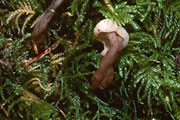 Michael Beug |
13b Not with these characters (Arrhenia)
................................................................................14
14a Only very young fruitbodies having veins on underside, mature fruitbodies with well-formed gills
................................................................................Arrhenia acerosa
| CAP 0.6-3.5 cm, oval to spatula-shaped, semicircular, kidney-shaped, rarely cup-shaped, somewhat membranous, the surface usually depressed, margins incurved at first; hygrophanous, grey brown to pale mouse gray, moist to dry, sometimes white-downy centrally, striate. UNDERSIDE ridges variable, often thick when young, suggesting Cantharellus, later thin and gill-like, adnate to decurrent, moderately spaced to subdistant, irregularly with 2 or 3 tiers of subgills; colored as cap or paler. STEM up to 1.8 cm long, 0.5 cm wide, generally shorter and lateral; whitish to grayish. FRUITING on various mosses, especially Dicranum species, or near mosses on ground or litter. SPORES 5-9 x 4.2-5.5 um, variable in shape, often predominantly nearly round or broadly obovoid, but also sometimes mostly elliptic, or with intermediate forms, smooth, inamyloid, colorless; clamp connections present. | Arrhenia acerosa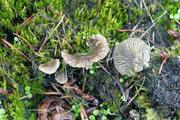 Ian Gibson |
14b Mature fruitbodies with veins on underside
................................................................................15
15a Fan-shaped to spoon-shaped on a distinct upright stem
................................................................................Arrhenia spathulata
CAP 0.2-1.1 cm, spoon-shaped to fan-shaped, occasionally more circular, margin incurved, at first even, later somewhat scalloped or vaguely lobed; light brown to nearly black; somewhat membranous, moist to dry. UNDERSIDE initially smooth, with age developing more or less radially arranged folds, with numerous interveined bridges or more irregular anastomoses and forks, often with puckered sides, colored as cap or paler, set off from stem by a raised ridge continuous with margin of cap. STEM 0.15-1.0 cm x 0.05-0.15 cm, varying from rudimentary to elongated, nearly lateral, colored as cap or whitish toward base from mycelium. FRUITING sandy or peaty soil with sparse low often pioneering moss cover, in recently deglaciated sites or burn sites as well as tundra or arctic alpine sites. SPORES 5-10 x 4.2-6 um, elliptic to oboval, oval, or almond-shaped, smooth, inamyloid, colorless. REMARKS Arrhenia auriscalpium has been recorded from 4 locations in Alberta near the BC border, also from Alaska, Northwest Territories, and Arizona, as well as Europe, probably occurs in the Pacific Northwest.
15b Various shapes, stem short or indistinct
................................................................................16
16a Old cap oboval to fan-shaped or kidney-shaped, usually lobed, cap base attached to moss or on ground near moss, cap color light gray brown to gray yellow brown or buff, (clamp connections present)
................................................................................Arrhenia lobata
CAP 0.5-4 cm, rarely round, more often oboval, fan-shaped or kidney-shaped, rarely funnel-shaped, membranous, margins incurved and remaining so, usually lobed, sometimes deeply incised, sometimes crisped (finely wavy) and scalloped; hygrophanous, light gray brown to gray yellow brown or buff, fading when partially dry, often blackening on exposed margins or when dry; surface moist. UNDERSIDE smooth when immature, soon with branched more or less radially arranged veins with numerous curving anastomosing lateral veins or more irregularly veined-wrinkled, often forking; colored as cap or paler. STEM not well formed, attachment off-center or lateral, base may be whitish or just paler than cap, attached by whitish mycelium. FRUITING single to clustered on moss in wet sites, alpine sites or bogs or fens often around the margins of pools. SPORES 5-10(15) x 4.2-8.5, more or less elliptic, smooth, inamyloid, colorless, with a conspicuous blunt apiculus; clamp connections present.
16b Old cap shaped like an inverted bowl, almost round or bilaterally symmetric, suspended at crown or off-center from moss; cap color whitish to brownish to gray to buff, (clamp connections absent)
................................................................................Arrhenia retiruga
| CAP 0.1-1.0 cm, like an inverted bowl suspended from its center or more often with off-center attachment and bilaterally symmetric, mostly hanging, usually shallow, sometimes nearly approaching a stemmed form but always with the spore-bearing surface demarcated by a sterile margin; margin incurved, usually becoming crisped (finely wavy) and uneven when old; whitish to brownish gray to buff; moist to dry, smooth to wrinkled in large specimens. UNDERSIDE smooth at first, often becoming only slightly wrinkled, either with radially disposed branched and forked veins with frequent anastomoses and intervenose branches, or more elaborately netted-poroid with less development in the marginal areas; colored as cap or slightly paler. STEM absent or slight sheathing pseudostipe. FRUITING on mosses, sometimes on twigs or leaves near mosses. SPORES 6-9(11) x 3.2-5 um, mostly short and cylindric to elliptic but varying to broadly elliptic or oboval, smooth, inamyloid, colorless, apiculus prominent; clamp connections absent. | Arrhenia retiruga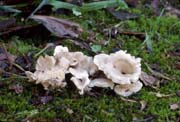 Steve Trudell |
17a (2b) Consistency gelatinous or somewhat gelatinous (waxy-soft)
................................................................................18
17b Consistency membranous or lax and soft
................................................................................19
18a Veins and convoluted pleats not forming pores but radiating; growing flat on wood
................................................................................Phlebia radiata
| FRUITBODY 1-4 cm wide growing flat on wood, circular at first but often confluent in sheets 10 cm or more across, up to 1 mm thick, attached firmly; the exposed spore-bearing surface reddish orange or pink, occasionally tan or pale orange or violet-gray, may be pruinose, often translucent, with narrow folds (ridges) interrupted, not forming pits but radiating, rarely branching, sometimes with convoluted pleats, also tuberculate (bumps) or verrucose (warty); hairy margin up to 3 mm wide and sometimes granulose, sometimes brighter or paler in color than the rest of the fruitbody; flesh waxy-soft, somewhat gelatinous, white to pallid. FRUITING on rotting wood of hardwoods and occasionally conifers, in fall, associated with a white rot. SPORES 3.5-7 x 1-2 um, cylindric, smooth, inamyloid, colorless; clamp connections present. | Phlebia radiata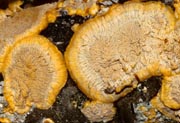 John Plischke |
18b Veins and convoluted pleats forming a network pattern (merudioid), may be bent outward to form shelf-like caps projecting up to 5 cm
................................................................................Phlebia tremellosa
| FRUITBODY growing flat or partly bent outward to form shelf-like caps, often imbricate (shingled), separable from the wood when fresh, often confluent, usually about 5 cm x 3 cm (but up to 25 cm x 10 cm), and 5 mm thick; if present caps projecting up to 5 cm, soft and cartilaginous, the upper surface white to pallid, tomentose to hirsute, not zoned or only slightly zoned; spore-bearing outer (or lower) surface translucent, waxy, soft, gelatinous, elastic, when young or fresh pale orange-yellow to deep orange-red, usually blood red when older or dried, the folds narrow, up to 1.5 mm deep, radiating, branching, pleated in network pattern (merulioid) with radial folds dominating, occasionally forming long, nearly rectangular pits, 1 or 2 per millimeter; margin of flat part up to 2 mm wide, waxy, fringed, pale yellow to orange-red, occasionally darker; flesh soft, gelatinous, white to pallid. FRUITING on hardwood and less often conifer wood, associated with a white rot, common in fall. SPORES 3.5-4.5 x 1-1.5(2) um, cylindric, smooth, inamyloid, colorless, often with two droplets; with clamp connections. REMARKS also known as Meruliopsis tremellosus. The somewhat similar Meruliopsis corium lacks clamp connections. Serpula species have dark spores. | Phlebia tremellosa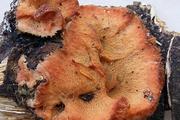 Bryce Kendrick |
19a (17b) Fan-shaped to inverted cup-shaped cap growing in overlapping clusters on hardwood, underside some-what gill-like, the veins in a radiating pattern with wavy edges
................................................................................Plicaturopsis crispa
| CAP 1-2.3 cm, semi-circular, fan-shaped, or inverted cup-shaped, growing shelf-like in overlapping clusters or groups, upper side white when young but soon yellow-brown to red-brown or tan, somewhat zoned with concentric undulations, finely tomentose; margin wavy, scalloped, often somewhat lobed, often lighter in color. UNDERSIDE somewhat gill-like, in a radiating pattern, with finely wavy edges, often forked and vein-like, often anastomosing, moderately distant, narrow, whitish to grayish. STEM short and lateral or occasionally central on inverted cup, sometimes absent. FRUITING in overlapping clusters or groups on branches and trunks of hardwoods. SPORES 3-4 x 1-1.5 um, sausage-shaped to elliptic, smooth, colorless, often containing 2 droplets. | Plicaturopsis crispa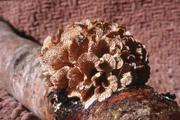 Andrew Parker |
19b Growing flat on alder or bent outward to form a shelf-like cap, underside bumpy or sparsely pleated-veined
................................................................................Plicatura nivea
| FRUITBODY growing flat on wood or bent outward to form a shelf-like cap, attached loosely, forming patches 0.05-0.1 cm thick, and several centimeters to decimeters across, caps extending up to 3 cm from the wood, upper cap surface dark cream to orange-brownish or grayish, undulating, somewhat zoned, finely velvety; margin sharp and somewhat lighter than cap surface. UNDERSIDE (or side facing outward where growing flat on wood) white (yellowish when old), bumpy or pleated-veined, not forming net-like pores. FRUITING principally on dead branches and small-diameter stems of alder, rarely on other hardwoods. SPORES 4-5 x 0.7-1 um, cylindric, slightly curved, smooth, amyloid, colorless. | Plicatura nivea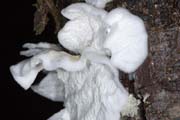 John Davis |
Cantharellus cascadensis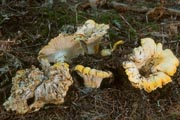 Michael Beug |
Cantharellus formosus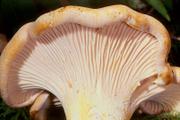 Michael Beug |
Cantharellus roseocanus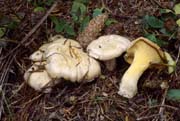 Steve Trudell |
Cantharellus subalbidus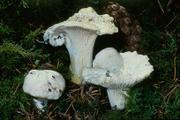 Michael Beug |
Craterellus cornucopioides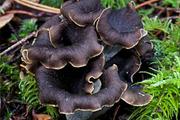 Boleslaw Kuznik |
Craterellus tubaeformis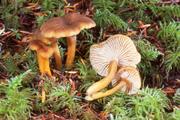 Michael Beug |
Gomphus clavatus.jpg
) Michael Wood (MykoWeb) |
Gomphus floccosus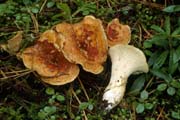 Steve Trudell |
Gomphus kauffmanii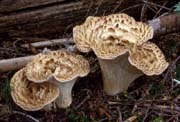 Steve Trudell |
Polyozellus atrolazulinus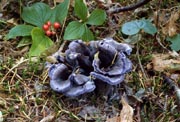 Steve Trudell |
Polyozellus marymargaretae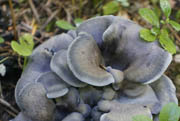 Michael Beug |
Polyozellus purpureoniger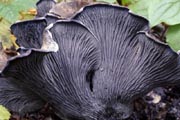 Steve Trudell |
| GENUS AND SPECIES | KEY ENTRIES |
| ARRHENIA Fr. | |
| A. acerosa (Fr.: Fr.) Kühner | 14a |
| = Leptoglossum acerosum (Fr.) M.M. Moser | |
| A. auriscalpium (Fr.) Fr. | 15a |
| A. lobata (Pers.: Fr.) Kühner & Lamoure ex Redhead | 16a |
| = Leptoglossum lobatum (Pers.) Ricken | |
| A. retiruga (Bull.: Fr.) Redhead | 16b |
| = Leptoglossum retirugum (Bull.) Ricken | |
| CANTHARELLUS Fr. | |
| C. cascadensis Dunham, O'Dell & R. Molina Pilz et al. | photos above and Chanterelles key |
| C. roseocanus (Redhead, Norvell & Danell) Redhead, Norvell & Moncalvo | Pilz. et al. |
| C. formosus Corner | Pilz. et al. |
| C. subalbidus A.H. Sm. & Morse | Pilz. et al. |
| CRATERELLUS Pers. | |
| C. cornucopioides (L.: Fr.) Pers. | Pilz. et al. |
| C. neotubaeformis nom. prov. | Pilz. et al. |
| CUDONIA Fr. | |
| C. circinans (Pers.) Fr. | 13a |
| GOMPHUS (Pers.) Pers. | |
| G. bonarii (Morse) Singer | Pilz. et al. |
| G. clavatus Gray | Pilz. et al. |
| G. floccosus (Schwein.) Singer | Pilz. et al. |
| G. kauffmanii (A.H. Sm.) R.H. Petersen | Pilz. et al. |
| HEMIMYCENA Singer | |
| H. cyphelloides (P.D. Orton) Maas Geest. | 10a |
| = Mycena cyphelloides P.D. Orton | |
| H. hirsuta (Tode: Fr.) Singer | 10b |
| = Hemimycena crispula (Quél.) Singer | |
| = Mycena crispula (Quél.) Kühner | |
| H. nebulophila (Redhead) Redhead | 9a |
| MARASMIUS Fr. | |
| M. caricis P. Karst. | 5a |
| M. epiphyllus (Pers. ex Fr.) Fr. | 6a |
| MYCENA (Pers.) Roussel | |
| M. paucilamellata A.H. Sm. | 7a |
| PHLEBIA Fr. | |
| P. radiata Fr. | 18a |
| P. tremellosa (Schrad.) Nakasone & Burds. | 18b |
| PLICATURA Peck | |
| P. nivea (Fr.) P. Karst. | 19b |
| PLICATUROPSIS D.A. Reid | |
| P. crispa (Fr.) D.A. Reid | 19a |
| POLYOZELLUS Murrill | |
| P. multiplex (Underw.) Murrill group | photos above and Chanterelle key |
| P. atrolazulinus Trudell & Kõljalg | photos above and Chanterelle key |
| P. marymargaretae Beug & I. Saar | photos above and Chanterelle key |
| P. purpureoniger Spirin & I. Saar | photos above and Chanterelle key |
| RIMBACHIA Pat. | |
| R. arachnoidea (Peck) Redhead | 12a |
| R. bryophila (Pers.) Redhead | 11a |
| R. neckerae (Fr.) Redhead | 12b |
| STEREOPSIS D.A. Reid | |
| S. humphreyi (Burt) Redhead & D.A. Reid | 4a |
| = Craterellus humphreyi Burt | |
- END -