Boleslaw Kuznik
The members of the traditional family Sarcosomataceae are characterized by dark colored (brown to black), tough-textured, shallow to deep cup-shaped apothecia (fruiting bodies) with or without stipes (stems), growing in the spring / early summer on rotting wood, humus or soil. The sterile tissue of the exterior underside is typically dark colored.
Plectania, Pseudoplectania, Strobiloscypha, Sarcosoma and Urnula remain in Sarcosomataceae along with Selenaspora (formerly in Otidiaceae). On the other hand, Desmazierella, Neournula, and Pseudosarcosoma were separated into Chorioactidaceae.
Three additional species found in adjacent areas, but not yet recorded from the Pacific Northwest, are included for comparative purposes as noted under the closest species: Sarcosoma globosum, Urnula craterium, and Nannfeldtiella guildeniae (the last may be in Pseudombrophila of Pyronemataceae).
Most of the larger cup fungi found are in the order Pezizales with Sarcosomataceae and Chorioactidaceae being two of several families that have cup-shaped fruiting bodies. In order to key out these genera and species from other genera within the order Pezizales, the reader is referred to Harold J. Larsen's "Key to Genera of Operculate Cup Fungi (Pezizales) of the Pacific Northwest and Rocky Mountain Region" included in the Pacific Northwest Key Council keys.
The species described here either have not been tested for edibility or are very small sized, and as a result fruitbodies from these families are generally not considered to be edible.
The 2017 update included consideration of Chorioactidiaceae, name changes for Sarcosoma mexicanum and Sarcosoma latahense, and the addition of Strobiloscypha keliae (described 1995) and Selenaspora guernisacii (formerly in Otidiaceae). Those species were placed at the end of the key to preserve as much of the original key structure as possible.
1a Fruiting body showing some obvious gelatinous tissue when cut, usually 2-8 cm broad; more or less top-shaped, at least when young
................................................................................2
1b Fruiting body lacking obvious gelatinous tissue when cut; mostly cup-shaped; size variable
................................................................................3
2a Fruiting body medium sized (up to 4 cm), lacks highly gelatinized interior, exterior with almost colorless to olive hairs
................................................................................Pseudosarcosoma latahense
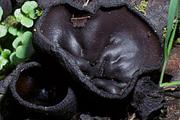
| FRUITING BODY top-shaped at first, then disc-shaped with short stem; texture gelatinous at first, becoming less so at maturity; upper surface purple-black to black, wavy; gray coloration of exterior surface resulting from relatively long, colorless to olive-brown hairs. HABIT and HABITAT saprophytic on decaying wood, litter and soil in coniferous forest, April through June. MICROSTRUCTURES spores 24-37 x 9-12 um, elliptical, without oil drops at maturity. REMARKS infrequent. | Pseudosarcosoma latahense Boleslaw Kuznik |
2b Fruiting body large (4-10 cm), highly gelatinized interior, exterior with dark hairs
................................................................................Urnula padeniana
| FRUITING BODY top-shaped at first, then becoming disc-shaped with thick, short gelatinous base; upper surface black; outside under-surface wrinkled and clothed with long, dark hairs, often roughened with dark brown granules. HABIT and HABITAT saprophytic on wood or duff, spring, summer and fall. MICROSTRUCTURES spores 23-24 x 10-14 um, elliptical with 1-3 oil drops -- with some mature specimens the presence or absence of oil drops may be the definitive characteristic in distinguishing between Urnula padeniana and Pseudosarcosoma latahense . REMARKS widely distributed but not abundant. | Urnula padeniana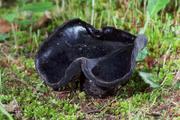 Michael Beug |
Note: Sarcosoma globosum, an eastern species not yet authoritatively identified from the western states, differs by being nearly globose when young, and subglobose to flattened globose when mature, 4-10 cm broad, watery-gelatinous with sac-like base, with spores 23-26 x 10-12 um, ellipsoid, guttulation unknown, and short brown, monilioid tomentum hyphae.
3a (1b) Fruiting body with orange granules along top edge on outside
................................................................................Plectania melastoma
| FRUITING BODY up to 3 cm wide, cup-shaped, usually with short stem; margin incurved and often split, but not lobed or stellate; inner surface black, smooth, glistening; exterior orange granules, which turn a wine purple color when placed in 3% KOH solution. HABIT and HABITAT saprophytic on conifer litter during spring, growing singly to clustered. MICROSTRUCTURES spores 21-24 x 8-10 um, ellipsoid-fusoid, smooth, with numerous oil drops at first, none at maturity; tomentum hyphae are encrusted with orange granules, no dark hyphae in medullary excipulum. REMARKS common. | Plectania melastoma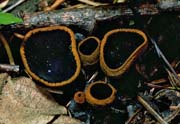 Michael Beug |
3b Fruiting body lacking encrustation of orange granules on outside edge
................................................................................4
4a Fruiting body small cup-shaped (1 to 2 cm wide, occasionally to 3 cm) with long, slender stem (2 to 6 cm long and 0.2-0.4cm wide)
................................................................................Plectania nannfeldtii
| FRUITING BODY small, up to 1.5cm, cup-shaped with incurved margin, inner surface black, smooth; exterior black with delicate hairy surface. HABIT and HABITAT usually attached to buried wood and can be found on conifer duff. MICROSTRUCTURES spores 22-30 x 10-14 um, elliptical, smooth, or faintly rough, no oil drops at maturity. REMARKS common in early spring; see also Pseudoplectania melaena (8b). | Plectania nannfeldtii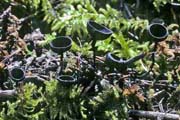 Kit Scates Barnhart |
4b Fruiting body without long slender stem
................................................................................5
5a Fruiting body cup-shaped or shallow urn-shaped with scalloped edge; inside surface pinkish brown and outside purplish brown with (buried) whitish base
................................................................................Neournula pouchetii
| FRUITING BODY up to 3 cm wide and 5 cm high, exterior pale tan to pale purple-brown with sparse, pale brown hairs on underside; stem up to 1 cm wide, usually buried. HABIT and HABITAT saprophytic on conifer duff (cedar, hemlock), spring and summer. MICROSTRUCTURES spores 23-32 x 8-10 um, oblong-elliptical, smooth at first, warty at maturity. REMARKS rare. [uncommon but recognized more often since original key written – Ian Gibson] | Neournula pouchetii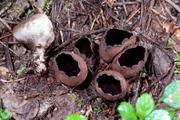 Michael Beug |
Note: Urnula craterium has not been authoritatively identified from the Pacific Northwest but is similar to Neournula pouchetii without the coloration. Fruiting body large (up to 10-12 cm long and 3-10 cm wide), dark brown becoming black at maturity; base up to 4 cm long; margin scalloped. Spores 25-35 x 12-14 um, narrowly elliptic, smooth. Common on fallen hardwood east of the Great Plains; however, its reported occurrence in the Pacific Northwest is highly doubtful. A similar species, U. hiemalis, is found in Alaska.
5b Fruiting body not fitting above description
................................................................................6
6a Fruiting body minute (up to 0.5 cm wide), upper surface whitish to slightly bluish-green, under (outer) surface brown with stiff dark brown hairs; habitat restricted to fallen Scotch Pine needles. Rare.
................................................................................Desmazierella acicola
FRUITING BODY up to 0.5 cm wide, saucer-shaped with flat or slightly convex disc; inner surface whitish to slightly bluish green; flesh thick, white; outer surface brown. MICROSTRUCTURES spores 15-17 x 8-10 um, elliptical, smooth with rounded colorless apiculi on each end, spores containing two oil drops; setae (hairs) extending above the hymenium with some paraphyses extended as dark bristles out from the hymenium. Paraphyses contain dark brown melanin-like pigment accounting for its classification in the Sarcosomataceae. HABIT and HABITAT on fallen Scotch Pine needles, winter to early spring. REMARKS extremely rare.
6b Fruiting body blackish and cup-shaped or disc-shaped
................................................................................7
7a Fruiting body with stellate (star-shaped) margin lacking obvious brown hairs. Rare.
................................................................................Plectania milleri
| FRUITING BODY up to 4 cm wide, cup-shaped to disc-shaped, usually lacking any stem; interior surface purple-brown, black when dry; exterior black with black hairs on underside not conspicuous on margin. HABIT and HABITAT saprophytic on conifer duff during late spring. MICROSTRUCTURES spores 21-26 x 9-10 um, elliptical, smooth, colorless, with no oil drops. REMARKS rare. [uncommon but recognized more often since original key written – Ian Gibson] | Plectania milleri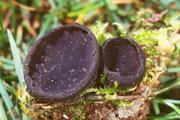 Michael Beug |
Note: With immature specimens this species is very similar to spherical-spored Pseudoplectania nigrella; however, at this stage spores may not be obtainable. With mature specimens the larger cup size and stellate margin on P. milleri and the marginal hairs of P. nigrella are sufficient to distinguish them. Plectania melaena (much more common) may also be mistaken when the orange granules wash off for Plectania milleri which is distinguished by stellate margin, and microscopically by dark hyphae penetrating the medullary excipulum and smooth tomentum hyphae.
7b Fruiting body lacking star-shaped margin (when in doubt make this choice)
................................................................................8
8a Fruiting body inner surface yellowish brown to black, exterior black or blackish, width 0.5-4 cm or occasionally wider, stem present or absent
................................................................................9
8b Fruiting body olive-tinted or charcoal gray, width usually up to 0.5(0.7) cm, stem absent
................................................................................10
Note: Nannfeldtiella guldeniae (N. aggregata) has not been authoritatively identified from the Pacific Northwest, but is included because it is expected that it will eventually be found. Fruiting body usually less than 1 cm wide; shallowly cup-shaped becoming expanded, incurving margin; interior surface dark violaceous brown, darker than exterior, which is dark brown, without hairs; stem lacking. It is terrestrial, growing in clumps, generally associated with minute (about 0.5 cm wide) orange-colored Octospora aggregata. Spores are 16-19 x 7.5-8.5 um, colorless, apiculate (pointed leaf-shaped) with several oil drops on each end, finely warted and cyanophilic. [Note that not all authors equate Nannfeldtiella guldeniae and N. aggregata. One or both have been moved to Pseudombrophila - Ian Gibson.]
9a Fruiting body inner surface black, exterior almost black with brownish cast (coming from almost invisible pressed-down fuzzy hairs), width 0.5-2 cm
................................................................................Pseudoplectania nigrella
| FRUITING BODY 0.5-2 cm wide, spherical at first, then expanding to cup-shaped or disc-shaped; stem usually lacking; margin slightly incurved and often wavy, stiff with brown hairs best seen under 10x hand lens. HABITAT widespread on rotting coniferous wood, litter, and soil, spring and summer. MICROSTRUCTURES spores 10-12 um in diameter, spherical, smooth, transparent with granular contents. REMARKS common. | Pseudoplectania nigrella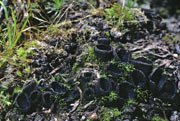 Kit Scates Barnhart |
9b Fruiting body inner surface yellowish brown spotted black when young becoming black in old age, width usually 2-4 cm, but on occasion up to 8-9 cm, variable length stem
................................................................................Pseudoplectania melaena
| FRUITING BODY cup-shaped to shallow saucer / repand; exterior black with coarsely roughened surface without visible hairs; stem length up to 6 cm long and 0.2-0.4 cm wide. HABITAT saprophytic on rotting conifer wood. MICROSTRUCTURES spores 12-17 um wide, spherical, smooth. REMARKS if long stemmed and old and not very wide, may resemble Plectania nannfeldtii. | Pseudoplectania melaena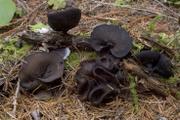 Andrew Parker |
10a Fruiting body dull olive-tan to olive-gray fruiting body with light to medium brown underside that is bald apart for a few scattered minute pustules, absent stem, growth on decaying partly buried cones, 0.15-0.5(0.7)cm wide, (spores about 21.0-23.7 x 12.5-13.2 um, elliptic)
................................................................................Strobiloscypha keliae
FRUITING BODY 0.15-0.5(0.7) cm across, top-shaped when young, becoming shallowly bowl-shaped to nearly flat, fleshy, margin not ornamented; interior dull olive tan to olive gray, underside light to medium brown, bald except scattered minute pustules near margin STEM absent. HABITAT and HABITAT on damp decaying cones of Chamaecyparis lawsonia (Port-Orford-cedar) and on cones of Sequoiadendron giganteum (Giant Sequoia), February. MICROSTRUCTURES spores (18.7)21.0-23.7 x (11.8)12.5-13.2(15.1) um, elliptic, finely warty only under oil immersion, colorless, without distinct droplets. REMARKS rare.
10b Fruiting body charcoal-gray fruiting body at first covered with a grayish veil that leaves remnants at the margin, growth among mosses in a burned area, (spores 34.8-52.0 x 15.6-23.4 um, like a section of an orange in side view)
................................................................................Selenaspora guernisacii
FRUITING BODY 0.15-0.35 cm wide, from above regular to mutually compressed, in side view nearly columnar to slightly flaring, 0.15-0.3cm tall at maturity, when young cushion-shaped; medium to dark charcoal-gray; veil covering immature upper surface, charcoal to brownish gray, membranous, after rupture remnants persisting as fleeting flanges of tissue, no marginal hairs; underside dark brownish gray in upper part, paler to grayish white toward base; bald in upper part, contorted brown anchoring hyphae near base. STEM none. HABITAT and HABITAT cespitose to gregarious, rarely scattered, among mosses (especially Funaria hygrometrica Hedw.) on soil (often previously burned) or walls. MICROSTRUCTURES spores 34.8-52.0 x 15.6-23.4 microns for one collection, in face view elliptic, in side view shaped like a lima-bean or half-moon or section of an orange, smooth, colorless to pale brown, variable number of droplets, often two prominent droplets, one near each end, and many small ones. REMARKS rare.
apothecium (plural apothecia) - fruiting body
cyanophilic - readily stained with cotton blue
excipulum - tissue containing the hymenium (spore-bearing surface)
globose - round, spherical, globe-shaped
guttulation - formation of droplets
hymenium - fertile area of a fruiting body where asci and ascospores are produced, often differing in color, texture or topography from remainder: usually the inner surface of cup-shaped / disc-shaped species or top layer of repand-shaped species.
medullary excipulum - tissue below the generative layer in an apothecium.
monilioid - having swellings at regular intervals, like a string of beads
repand - shape of disc-shaped apothecium, having downward-curved margin.
saprophytic - living on decaying organic matter.
stellate - star-shaped.
subglobose - nearly spherical
terrestrial - growing on the ground.
| GENUS AND SPECIES | KEY ENTRIES |
| DESMAZIERELLA Lib. | |
| D. acicola Lib. | 6a |
| NEOURNULA Paden& Tylutki | |
| N. pouchetii (Berthet & Riousset) Paden | 5a |
| PLECTANIA Fuckel | |
| P. melastoma (Sow. ex Fr.) Fuckel | 3a |
| P. milleri Paden & Tylutki | 7a |
| P. nannfeldtii Korf | 4a |
| PSEUDOPLECTANIA Fuckel | |
| P. melaena (Fr.) Boud. | 9b |
| P. nigrella (Pers. ex Fr.) Fuckel | 9a |
| PSEUDOSARCOSOMA M. Carbone, Agnello & P. Alvarado | |
| P. latahense (Paden & Tylutki) M. Carbone, Agnello & P. Alvarado | 2a |
| SELENASPORA R. Heim & Le Gal | |
| S. guernisacii (P. Crouan & H. Crouan) R. Heim & Le Gal | 10b |
| STROBILOSCYPHA N.S. Weber & Denison | |
| S. keliae N.S. Weber & Denison | 10a |
| URNULA Fr. | |
| U. padeniana M. Carbone, Agnello, A.D. Parker & P. Alvarado | 2b |
- END -