Kit Scates Barnhart
The key to Ramaria began with a 1981 key to Ramaria by Kit Scates Barnhart who had studied Ramaria in the Pacific Northwest for many years, photographing collections, doing extensive macrochemical work and microscopic work and maintaining a herbarium. Kit relied on research by Dr. Currie D. Marr, who has also supplied type descriptions, verified identifications, and offered much help and encouragement. Thanks and appreciation also go to the late Dr. Daniel E. Stuntz for his infinite patience, and to Ronald H. Petersen for his generosity in sending reprints on the clavarioid fungi. This 2009 revision draws heavily on the 1981 key and on the publication Ramaria of the Pacific Northwestern United States by Ronald L. Exeter, Lorelei Norvell and Efrén Cázares. Ronald Exeter was kind enough to arrange DNA analysis of the Ramaria collections of Michael Beug. The DNA work was conducted at Oregon State University.
Ramaria is a genus to interest everybody. It occurs more abundantly in the Pacific Northwest than in any other part of the Unites States. Even if it didn’t contain some of the meatiest mushrooms known, it would still be fun learning some of them by name because of their beauty. The late Dr. Alexander H. Smith, who probably spent more time doing field research than any other world-famous mycologist, calls ramarias "the prettiest fungi in the woods."
Just as in any other group containing some poisonous species as well as many fine edibles, there is still a real need for better recognition of species. Though none are known to be truly dangerous, two species are usually labeled "poisonous’" and others are suspected of causing gastrointestinal upsets. Unfortunately, due to past confusion in identifying ramarias, there are few reliable records as to potentially toxic species. It would be of real benefit should you encounter or hear of an unpleasant reaction to a Ramaria that you report to your club’s toxicology committee or to Michael Beug (beugm@evergreen.edu) which ones cause trouble. If you have been successfully eating a species traditionally labeled as poisonous, please let Michael Beug know this as well. In the more than 30 years since this key was first published, the author is aware of no poisonings other than gastrointestinal distress from eating any species of Ramaria.
Because of the changes in shape and size and color each fruiting body goes through as it ages, and the overlap between species, it is a real challenge to key out a PNW species of Ramaria. Using just macroscopic features you can probably succeed about 2/3 of the time using only care and your naked eye, provided you follow the rules below. To succeed nearly every time, however, you will need some chemicals and a microscope, as explained below.
RULES OF THE GAME:
From other club and coral mushrooms, the genus Ramaria is distinguished by the yellowish color of the spores, the branching habit, and more technically, a blue-green reaction to iron salts (typically 10% aqueous FeSO4) applied on fresh branches. Color, size and shape vary tremendously. Colors are most vivid when fruiting bodies are young and still growing. Most species become paler and duller with age, all finally ending about the same pale tan color as their spores, colored much like cardboard. Hence it will be much more difficult to identify a single old weather-battered coral. Even within one fruit body, shape changes radically with age. Most Ramaria species are cauliflower-like when young (the best stage for eating) and become bushy as the branches elongate with maturity. Just as with King Boletes, the enlarged base of a young coral will elongate in age and become more equal in diameter. Over-all size varies with weather conditions. Bases (stipes) vary proportionately from massive (1/3 to 2/3 total size and weight) to slender; a few of the small kinds growing from a mycelial mat on tree litter even seem to have their branches growing directly from the mycelium with no distinct stipe.
Most species are found in old growth coniferous forests, particularly under Western Hemlock, most of them in the fall. The biggest volume, however, seems to occur among the spring and summer species found at elevations of 2500 ft. or more.
Unfortunately, microscopic features are very important, and at times identification can be made only on the basis of size or ornamentation of the spores, staining properties of the basidia, clamp connections on the hyphae, or number of hyphal types. Spores may have walls that are smooth, striate, finely or coarsely warted, or spiny. In fact, the genus Ramaria is divided into four subgenera largely based on spore ornamentation:
USE OF CHEMICAL TESTS:
Two chemical tests are especially useful and should be used by anyone trying to identify a Ramaria.
FSW – Ferrous Sulfate: FeSO4, 10% aqueous solution. You can also rub ferrous sulfate crystals on the flesh. I also get the same reaction with ferric salts.
MI – Melzer’s Iodine: 1.5 g potassium iodide (KI) and 0.5 g elemental iodine (I2) in a mixture of 20 mL water and 20 ml chloral hydrate (a controlled substance, difficult to come by).
IKI - Lugol Solution: 1 part elemental iodine (I2), 2 parts KI in 150 parts water (use when Melzer’s is not available but be aware that the reaction with Lugol’s solution is much less obvious than the reactions with Melzer’s reagent).
[See Marr and Stuntz (1973) for additional macrochemical recipes and reactions of numerous Ramaria species.]
For microscopic work two additional chemicals are particularly useful
5% KOH (in water)– use in place of water under the cover slip to look for yellowish staining of material in hyphae, etc. Also useful at 10% and 20% as a macrochemical as noted in Key.
Cotton blue – a stain that is easy to use. Infused under a cover slip cyanophilous material and gloeocystidia will be stained bright blue. Cotton blue is also useful in visualizing spore ornamentation.
Use of spore length and width information
Many species have overlapping spore sizes but calculating the average spore length (reported here as Lm) is often very helpful in separating similar appearing species. The ratio of the average length to the average width (ratio reported here as Em) is yet another useful diagnostic tool.
1 Striate spores present (subgenus Ramaria):
................................................................................Key Leads 87-96
2 Medium to large fleshy species with warted to smooth spores (subgenus Laeticolora):
2a With a rusty root:
................................................................................Key Leads 4-7
2b With red branches (sometimes just a hint of red on a yellow ground color):
................................................................................Key Leads 71-75
2c With tan, brown or violet branches:
................................................................................Key Leads 76-83
2d With white to cream branches:
................................................................................Key Leads 84-97
2e With yellow to orange branches:
................................................................................Key Leads 4-70
2e1 Branches with red-brown or brown bruises:
................................................................................Key Entry 11-23 & 34
2e2 Stipe base gelatinous or cartilaginous:
................................................................................Key Entry 35-53
2e3 Stipe base fleshy-fibrous:
................................................................................Key Entry 54-70
2e3a Branches yellow:
................................................................................Key Entry 55-59
2e3b Branches orange to salmon (sometimes just a hint of orange or salmon on a yellow ground color):
................................................................................Key Entry 60-70
3 Small to medium thin-fleshed species on wood or on forest duff:
3a Spores echinulate (subgenus Echinoramaria):
................................................................................Key Leads 98-111
3b Spores smooth or warted (subgenus Lentoramaria):
................................................................................Key Leads 98-119
1a Small to medium size, usually dingy colored, mushroom with thin flesh growing on wood or on the ground; stipe rudimentary, never large and fleshy; spores echinulate, warted or smooth (use this lead if the spores are echinulate = spiny; also use this lead if rhizomorphs are present or if the mushroom was growing on wood
................................................................................98
1b Medium to large fleshy mushrooms growing on the ground; (always use this lead if the mushroom is brightly colored or if the stipe base is well developed)
................................................................................2
2a Stipe usually single or double, sometimes massive; branches white to cream with whitish, pink or burgundy upper branches and apices; spores striate or not, but if spores are striate, follow this lead
................................................................................84
2b Stipe single or divided; stipe base usually white but branches and tips colored some shade of red, yellow, orange, salmon or brown; spores smooth or warted, never striate or echinulate
................................................................................3
3a Flesh of base cut vertically not showing a "rusty root" (brown section bottom)
................................................................................8
3b Flesh of base showing a "rusty root"
................................................................................4
4a Stipe flesh instantly turning blue-green on application of FSW; stipe surface streaked with brown to reddish brown, becoming entirely brown in age
................................................................................6
4b Stipe flesh not instantly turning blue-green on application of FSW; stipe surface not streaked with brown or reddish-brown
................................................................................5
5a Fruits in the spring. Cream colored branches with dull red to pink tips. Texture fibrous and stringy in lower branches; outside aborted branches often recurling downward in age; branches very slowly bruising dull bluish violet; (true clamps absent but false clamps present)..."Elsie’s Stringy Pinky"
................................................................................R. coulterae
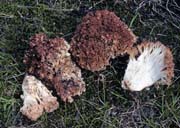
| COLOR: tips deep dull fleshy red to fleshy beige, quickly fading to light vinaceous cinnamon (fleshy pink), in age concolorous with branches but very tips brown; branches white to ivory below then pale yellow to pale beige darkening to buffy flesh (pinkish buff); base white to off white, slowly brunnescent to pallid purple-gray where handled or bruised. FLESH: base watery but not gelatinous, usually with a +/- "rusty root"; upper branches very brittle and crisp, lower branches stringy, fibrous, ripping longitudinally; taste mildly nutty; odor negligible. FORM: Small to medium, up to 12 cm H x 10 cm W; stipe large to massive, up to 8 cm H x 6 cm W, single, deeply lined or channeled, not pruinose or tomentose; very cauliflower-like tips when young, expanding to knobby in age. HABITAT: Intermountain area of Northern and West-central Idaho, rare in Oregon but found in Sierra Nevada range. EDIBILITY: since R. coulterae is readily confused with the edible R. rubripermanens (95a), it has probably been eaten frequently (and unknowingly) without known ill effect. SPORES: essentially smooth, 8.3-12.6 x 2.9-4.0 μm, Em 2.81, Lm 9.95. NOTE: see also R. botrytis (95b). | R. coulterae Kit Scates Barnhart |
5b Fruits in the fall
................................................................................undescribed Ramaria spp.
Peterson and Scates (1988b): "I know of two taxa with brownish stipe flesh which do not show the instantaneous color change in ferric salts. Both are clamped, neither has been described, and both are autumnal fruiters."
6a (4a) Stipe flesh rapidly strongly amyloid when fresh (turns violet-brown) and or dried (turns dark brown). Branches yellow-orange, light orange or peach- or salmon-colored (light orange with a tinge of light red); tips same, yellow or darker..."Pale Peach Rusty Root"
................................................................................R. amyloidea
| COLOR: Branches and tips as above; base white to cream, with brown patches, almost entirely brown with age. FLESH: Colored much like surface or slightly more reddish; texture softly stringy; taste mild; odor slightly sweet. FORM: Medium-sized, broad, 7-13 cm H x 7-15 cm W; base single, stout, 2-6.5 cm H x 2-4.5 cm W, equal or tapering; lower branches often thick and upper sections short making an almost cauliflower effect; tips usual. HABITAT: On the ground under Western Hemlock or Fir, fall. EDIBILITY: Unknown. Dried flesh at base of stipe instantly dark brown in IKI. SPORES: almost smooth, 7-10 x 3-4μm, Em 2.47, Lm 8.9. | R. amyloidea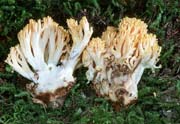 Michael Beug |
6b Stipe flesh non-amyloid or only slowly and weakly amyloid when fresh. Branches white to yellow-orange or pinkish-orange with branch tips white to yellow when young
................................................................................7
7a Branches yellow-orange, pinkish-orange or light salmon; tips yellow when very young; fruit body medium sized; in fresh specimens not amyloid or just weakly amyloid; (basidia unclamped)..."Gold Rusty Root"
................................................................................R. celerivirescens
| COLOR: tips light to sunflower yellow; branches pale to light orange to light pinkish orange; base white to yellowish-white with extensive patches of reddish-brown discoloration. FLESH: Colored much like surface except sometimes colored slightly more reddish in the branches; texture softly stringy; taste mild or bitter; odor +/- unpleasant. FORM: Medium-sized, 6-18 cm H x 3-10 cm W; base single, 2-7 cm H x 1-3 cm W, narrowing to base or equal; branches and tips usual. HABITAT: On the ground under Western Hemlock, fall. EDIBILITY: Unknown. Generally no reaction to IKI, but may have a weak amyloid reaction in fresh specimens. SPORES: warty; 8-11 x 4-6 μm; Em 1.89, Lm 9.5. | R. celerivirescens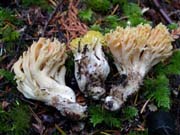 R Exeter 2004-55 |
7b Branches yellowish-white to pale yellow or creamy, tips white when young; fruit body often large to massive; not amyloid; (basidia clamped)
................................................................................R. velocimutans
| COLOR: Tips whitish; branches yellowish white to pale yellow; base white to pale yellow with stains of dark brown. FLESH: white; fleshy, aging softly stringy; taste mild, odor sweet or unpleasant. FORM: Large to very large, 7-30 cm H x 3.5-26 cm W; base entirely underground, usually single, variably shaped, 2-9 cm H x 1-4.5 cm W; branching pattern often terraced (with many forks and tips at the same level); tips usual. HABITAT: On the ground under Western Hemlocks or Western Yews, fall. EDIBILITY: Probably edible. SPORES: warty; 8-12 x 3.5-5 μm, Em 2.25, Lm 9.0; basal hyphae clamped. NOTE: See also R. coulterae (5a) which often has a fan-shaped brownish area in the base of the vertically cut stipe. R. coulterae does not turn rapidly blue-green in FSW. | R. velocimutans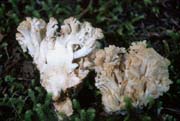 Michael Beug |
8a (3a) Branches pale to bright peachy pink or crimson or scarlet (at least on portions covered in the duff), tips may be concolor, paler, or more intense, and tips may even be yellow, orange or whitish
................................................................................71
8b Branches other colors, though the branch tips may be pink
................................................................................9
9a Branches tan, brown or violet (Beware – almost all Ramaria species are cardboard color in old age and may not key out under this lead)
................................................................................76
9b Branches yellow, yellow-brown, orange, or salmon
................................................................................10
10a Base lacking burgundy or brown stains (may have small dull violet spots or bruise weakly watery brown)
................................................................................24
10b Base with burgundy or brown stains where pressed against the substrate or bruising burgundy or brown
................................................................................11
11a Base surface not covered by white cottony fuzz
................................................................................15
11b Base surface covered by white cottony fuzz
................................................................................12
12a Odor not distinctive; bruising reddish-brown or brown
................................................................................14
12b Odor distinctly sweet; bruising carmel brown or with small wine-red spots
................................................................................13
13a Base like a bundle of cords with small oxblood-red or wine-red spots; odor pungently sweet; branches yellow; very rare; (hyphae unclamped)
................................................................................R. synaptopoda
| COLOR: tips yellow, branches light yellow becoming paler downward to a white base which has spots +/- wine-colored as above. FLESH: white; texture like stringy cartilage, brittle; taste mild; odor as above. FORM: Small, 6 cm H x 4 cm W; base 2-3 cm H x 2-3 cm W, a dense tuft of fuzz-covered slender stems; rarely with more than 2-3 tiers of branchlets, all slender; tips +/- pointed. HABITAT: On the ground under Western Hemlock, true Fir and Douglas Fir, fall. EDIBILITY: Unknown. SPORES: cylindrical with a prominent apiculus and meandering low cyanophilus warts & ridges, 9-11.5 x 3.5-4.5 μm, Em 2.42, Lm 9.9. NOTE: see also R. cystidiophora v. maculans (14b), R. maculatipes (18b), and R. vinosimaculans (17a). | R. synaptopoda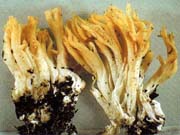 C D Marr |
13b Base may be semi-divided but not as extreme as above; odor like lemon or orange blossoms; yellow branches with intense yellow tips; (hyphae clamped; special binding hyphae in base cortex)..."Lemon Fuzzy-Foot"
................................................................................R. cystidiophora var. citronella
| COLOR: tips bright yellow; branches lighter yellow; base white; base and lower branches bruising +/- caramel brown. FLESH: yellowish white; texture fleshy-stringy; taste slightly bitter; odor as above. FORM: Medium, usually taller than broad; 5-17 cm H x 2-12 cm W; base 1-8 cm H x 0.5-4.5 cm W, single or semi-fused from several stems, all covered by a well-defined white tomentum (cottony or woolly fuzz); branches slender in many tiers; tips +/- pointed. HABITAT: In deep humus beneath Douglas fir, Western Red Cedar, and Western Hemlock. EDIBILITY: Probably edible. SPORES: warty, 9-13 x 3.5-5 μm, Em 2.45, Lm 10.3. NOTE: see var. cystidiophora Key Entry 53a. | R. cystidiophora var. citronella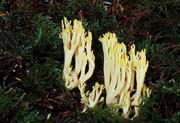 Michael Beug |
14a (12a) Branches dull yellow-orange or pale salmon (peach to light red) bruising grayish orange to cinnamon brown; tips yellow when young; FSW negative; (spores long and wide ~12.2 x 6.2μm)
................................................................................R. formosa
(see description under Key Entry 22a)
14b Branches yellow to warm buff (with citron yellow tips when young), staining or bruising distinctly reddish-brown; FSW negative; (spores long and narrow ~11.8 x 4 μm); …"Staining Fuzzy-Foot"
................................................................................R. cystidiophora var. maculans
This variety differs from R. cystidiophora var. cystidiophora (53a) by staining distinctly reddish-brown, by having longer spores (10-14 x 3.5-5 μm, Em 2.95, Lm 11.8), and lack of a distinctive odor. Note: see also R. synaptopoda (13a) in which the odor is pungently sweet.
14c Branches maize yellow when very young, soon light chocolate brown with yellow tips, staining or bruising dark brown; base flesh turning blue-green in FSW; (long normal width spores ~11.7 x 4.6 μm)..."Brunnea"
................................................................................R. testaceoflava
(see description under Key Entry 81a)
15a (11a) Bruising reaction brown
................................................................................19
15b Bruising reaction maroon or wine-red (but may turn brown in age)
................................................................................16
16a Branches salmon to peach (including yellow with a hint of pink to red coloration)
................................................................................18
16b Branches ivory to yellow
................................................................................17
17a Branches ivory to cream color; tips yellow or concolor with branches when young; spring or fall; (basidia clamped; base flesh not amyloid; long finely ornamented spores ~12.5μm)..."Pale Winey Base"
................................................................................R. vinosimaculans
| COLOR: Tips and branches pale cream to pale yellow or pale orange; base whitish except where stained as above (any part stains), stains usually present when found. FLESH: colored like surface; texture fleshy to softly stringy; taste mild; odor musty-sweet. FORM: Medium to large, broad, 12-19 cm H x 9-19 cm W; base usually single, tapering or bulbous; 4-6 cm H x 4-5 cm W; branches and tips usual. HABITAT: On the ground under Western hemlock, fall or spring. EDIBILITY: Probably edible. SPORES: some smooth, some warty, 9-13.5 x 3.5-5 μm, Em 2.93, Lm 12.0; basal hyphae clamped. NOTE: see also R. cystidiophora v. maculans (14b), R rubiginosa (17b), and R. synaptopoda (13a). | R. vinosimaculans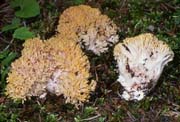 Michael Beug |
17b Branches light yellow with bright yellow branch tips when young, tips later same color as branches; fall; stipe single and thick or subcompound with 2 or more thick axes from a small primary root-like structure; (basidia unclamped; base flesh may be faintly amyloid; spores 9.4 x 4.4 μm)…..."Yellow Winey Base"
................................................................................R. rubiginosa
| COLOR: Tips and branches as above; base yellowish white; any part, but especially the base staining +/- winy (reddish-brown). FLESH: white; fleshy to softly stringy; taste mild; odor none or faintly sweet. FORM: Medium, 5-18 cm H x 4-17 cm W; base thick, 2-8 cm x 2-6 cm, single or semi-divided into two or more thick stem-branches arising from a small primary root-like structure; upper branches with short intervals between forks; tips usual. HABITAT: On the ground under Western Hemlock, fall. EDIBILITY: Probably edible. SPORES: warty, 7-11 x 3.5-6 μm, Em 2.14, Lm 9.4. NOTE: A very similar as yet unnamed species has an Em = 2.50. See also R. cystidiophora var. maculans (14b) which has clamps and R. synaptopoda (13a) which is non-clamped but has a sweet odor. | R. rubiginosa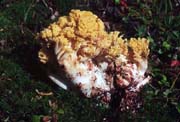 Kit Scates |
18a (16a) Odor sometimes sweet; underground portion white; branches salmon (including yellow with a hint of pink coloration) with yellow branch tips when young; stipe single when young, frequently slender and tapering; (basidia not clamped; base flesh non-amyloid; long spores, ~12.3μm)..."Sweet Formosa Stainer"
................................................................................R. rubribrunnescens
| COLOR: tips light yellow, immature branches pastel red aging a shade browner than light orange; base white to orangish-white; base and lower branches staining dark reddish-brown; upper parts fading in age to dingy pale orange. FLESH: colored like surface; texture softly stringy; taste mild; odor sweet in age, like anise. FORM: Medium, 7-16 cm H x 5.5-11 cm W; base single, tapering, 1 cm H x 0.7 cm W; branches +/- slender, abortive primordial branches common in young specimens; tips usual. HABITAT: On the ground under Western Hemlock, fall. EDIBILITY: Unknown. SPORES: warty, 10-14 x 3.5-5 μm; Em 2.37, Lm 12.3. NOTE: See also R. maculatipes (18b) and R. vinosimaculans (17a) which have clamps. | R. rubribrunnescens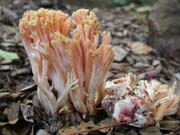 R Exeter 2003-07a |
18b No distinctive odor; underground portion orange-white; branches peach colored with yellow tips when young; stipe single to fasciculate; (basidia clamped; base flesh slowly amyloid, allow 45 minutes; spores ~10.2 μm)..."Formosa Stainer"
................................................................................R. maculatipes
| COLOR: tips light yellow; branches light orangy-yellow; base orangish-white; base and lower branches staining dark reddish-brown. FLESH: colored much like surface; texture softly stringy; taste mild; odor none. FORM: Medium, 10 cm H x 6 cm W; base single, tapering, 2-4 cm H x 1.5-2 cm W; branching pattern and tips usual. HABITAT: On the ground under Western Hemlock, fall. EDIBILITY: Unknown. SPORES: warty, 9-11 x 4-5 μm, Em 2.37, Lm 10.2. Clamped basidia. NOTE: See also R. formosa (22a) and R. rubribrunnescens (18a). | R. maculatipes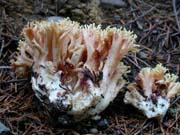 R Exeter 2003-23 |
19a (15a) Appears in the fall
................................................................................21
19b Appears in the spring
................................................................................20
20a Branches white to pale yellow with white to salmon colored flesh, weakly to strongly brunnescent; above 2500 feet (800 meters) in Idaho or 5000 feet (1,500 meters) in Sierra Nevadas, mixed conifers with true firs; (basidia clamped; long spores ~13.3 μm)
................................................................................R. thiersii
| COLOR: White to pale yellow overall; tips white where protected, pallid greenish-yellow or straw-yellow where exposed; weakly to strongly brunnescent where rubbed or handled. FORM: Medium, 15 cm H x 8 cm W; base usually single, +/- massive, tapering downward to a narrowed rounded bottom, without abortive branchlets. HABITAT: As above. EDIBILITY: Unknown. SPORES: 11.6-15.8 x 4.0-5.0 μm, Em 3.13, Lm 13.3; basal hyphae clamped. NOTE: see also R. rubricarnata v. pallida (28b). | R. thiersii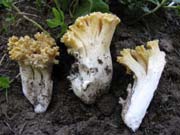 Michael Beug |
20b Branches white when buried but otherwise cream or some shade of yellow to maize yellow; white to cream flesh; weakly brunnescent; (basidia clamped, spores average ~11.5μm)
................................................................................varieties of R. magnipes
(see description under Key Entry 32a, b)
20c Branches cocoa-colored; base single to compound (composed of several fused stipes), not massive, white to off-white and bruising brown to watery brown; (basidia not clamped; spores shorter ~9.85 μm long)... "Brown Baga"
................................................................................R. marrii
(see description under Key Entry 83a)
21a (19a) Odor obnoxious, of coal tar; pale yellow to cream branches; large; (usually non-clamped, so far known only from Mendocino County, California)
................................................................................R. foetida
COLOR: branches pale light yellow when young, tips maize yellow when very young; branches darkening somewhat when mature, all parts browning weakly where rubbed; base white to off-white, strongly brunnescent. FLESH: white often with sordid tan. FORM: broadly rounded with many aborted branchlets; branch tips expanded to irregularly swollen-knobby. HABITAT: Coniferous forests. EDIBILITY: Unknown. SPORES: 7.9-10.4 x 3.6-4.3 μm; Em 2.38, Lm 9.1; clamps rare but when present are conspicuous. Amyloid.
21b Odor not distinctive
................................................................................22
22a Branches salmon or yellow-orange, tips yellow when young; any part bruising brown on handling; fruit body medium to large; base and/or lower branches thick and fleshy-stringy, not gelatinous; (basidia clamped; spores coarse-warty and "fat"; averaging 5.4 μm wide)
................................................................................R. formosa
| COLOR: Tips light yellow when young, +/- like branches in age; branches light reddish-orange; base white or brownish-white. FLESH: colored like surface or sometimes redder in branches; texture fleshy-stringy, +/- spongy in base; taste and odor mild. FORM: Medium or large, broad, 7-20 cm H x 7-14 cm W; base massive, 3 x 5 cm, single to semi-divided into several very thick "stems"; upper branches slender with short sections between forks; tips usual. HABITAT: On the ground under Douglas fir or (?) Western Hemlock. Fall, sometimes spring. EDIBILITY: Usually labeled "poisonous." SPORES: 9-12 x 4.5-6 μm, Em 1.93, Lm 10.4; hyphae clamped. NOTE: see also R. maculatipes (18b). | R. formosa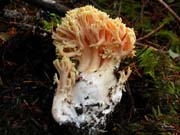 R Exeter 2002-13a |
22b Branches brown to violaceus-brown with drab tips, or tips bright orange with orange branches and a yellow "bellyband;" sometimes bruising brown; fruit body small to medium (basidia not clamped, spores not both coarse warty and fat)
................................................................................23
23a Branches brown to somewhat violaceus brown; tips violaceus brown when young; stipe deep tan to brown or orange-brown, staining brown; odor not distinctive; fruit body often quite small, base up to 5 x 2.3 cm, usually much narrower, sometimes mycelial at very base; (spores finely warted and very short, but wide (~8.6 x 5.5 μm); rare
................................................................................R. spinulosa var. diminutiva
COLOR: Tips, branches and base as above; tips concolorous at maturity; lower base often orange-brown. FLESH: Of stem dull brown, streaked as though with wood grain; taste faintly sour; odor negligible or faintly of chocolate. FORM: Size as above; 3-5 major branches; branches in 3-6 ranks, often rugulose (minutely wrinkled); tips subcristate to finger-like, rounded at maturity. HABITAT: in humus or soil, associated with Pines, known from California and Van Damme State Park, Snohomish County, WA, fall. EDIBILITY: Unknown. SPORES: small streaks or ridges and small warts 7.2-10.1 x 4.7-6.1 μm, Em 1.61, Lm 8.56. Basidia not clamped. See also R. marrii (83a), R. acrisiccescens (83b) and R. violaceibrunnea (78a ). R. caulifloriformis (34a) has clamped basidia.
23b Branches light orange with yellow "belly-band", an often fleeting band of yellow where the white stipe transitions to the colored branches; tips intense deep orange; stipe white, sometimes stained pale caramel brown; odor sweetish; fruit body small to medium; (spores finely warted ~10.8 x 4 μm)
................................................................................R. aurantiisiccescens
| COLOR: Tips intense deep orange; branches light orange, growing lighter downward to the yellow belly band just above ground level; base white; base and lower branches sometimes stained caramel brown. FLESH: Colored much like surface; texture softly stringy; taste mild; odor slightly sweet. FORM: Small to medium, 8-10 cm H x 2-8 cm W; base variable in shape and size, single to compound, 1-4 cm H x 1-2 cm W; surface with thin white fuzz; branches generally slender; tips almost pointed. HABITAT: On the ground, under Western hemlock, fall. EDIBILITY: Unknown. SPORES: warted, 8.5-14 X 3-5 μm, Em2.70, Lm 10.8. Basidia non-clamped. NOTE: See also R. gelatiniaurantia var. violeitingens (46b) | R. aurantiisiccescens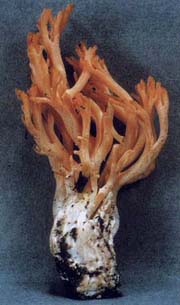 C D Marr |
24a (10a) Typically found in the fall season
................................................................................33
24b Found in spring
................................................................................25
25a Branches white to pale yellow to orange-yellow; (basidia clamped)
................................................................................29
25b Branches pale salmon-yellow to bright salmon or pale to bright orange or cocoa colored; (basidia clamped or unclamped)
................................................................................26
26a Branches cocoa-colored; base single to compound (composed of several fused stipes), not massive, white to off-white and bruising brown to watery brown; (basidia not clamped; spores ~9.85 μm long)... "Brown Baga"
................................................................................R. marrii
(see description under Key Entry 83a)
26b Branches light salmon to salmon or orange or yellow-orange; stipe large to massive (basidia clamped or not; average spore length >10μm
................................................................................27
27a Flesh white; branches yellow with an orange tint, or orange to deep orange (basidia not clamped; average spore length ~10.3 μm; the only non-clamped orange spring Ramaria)
................................................................................R. armeniaca
| COLOR: Tips dark orange, branches pallid pastel orange below, pallid orange to bright orange above; base white to off-white. FLESH: White, firm; base flesh white, watery but not slippery; taste mild, odor negligible. FORM: subcircular to broadly egg-shaped in outline up to 12 cm H x 8 cm W; base up to 4cm H x 6 cm W, single, smooth, usually without abortive branchlets, broadly tapering to a point; tips coarse, bluntly minutely knobby at maturity. HABITAT: on the ground in the spring, reported only from Northern Idaho. EDIBILITY: Unknown. SPORES: smooth to minutely warted; 8.6-11.5 (12.6) x 3.6-4.3 μm, 1-3 guttulate. Basidia unclamped. See also R. rubricarnata var. verna (28a) which has clamped basidia and finely warted spores. | R. armeniaca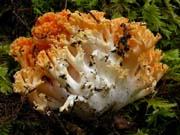 R Exeter 2003-04g |
27b Flesh buff to salmon-orange; branches pale salmon-yellow to deep salmon orange (basidia clamped, spore length average ? 11 μm)
................................................................................28
28a Flesh salmon-orange; branches salmon to yellow with a hint of orange to distinctly orange; light yellow belly band (soon fading and thus infrequently observed); tips yellow to rich yellow
................................................................................R. rubricarnata var. verna
| COLOR: tips as above; branches salmon-orange to light salmon above and light yellow at ground level; base and protected abortive branchlets white, often wine-red around soil particles. FLESH: salmon-orange. FORM: Small to medium, broad, 9 cm H x 7 cm W ; base single, large, with clusters of abortive branchlets, minutely pruinose in some areas. HABITAT: known from NE Washington and the Idaho Panhandle, spring. SPORES: delicately but distinctly roughened; 10.4-12.2 x 4.0-5.0 μm, Em 2.55, Lm 11. Basidia clamped. NOTE: R. armeniaca (27a) is distinguished by non-amyloid stipe flesh; absence of clamps; shorter, narrower spores that are more smooth. | R. rubricarnata var. verna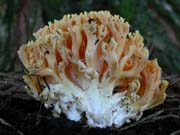 R Exeter 2004-01 |
28b Flesh muted pinkish-buff; buff to pale yellow branches with a hint of salmon; lacking yellow belly band; tips light yellow to greenish-yellow
................................................................................R. rubricarnata var. pallida
| COLOR: tips as above maturing to light yellow; branches buff to pallid buffy yellow with a hint of salmon; base white. FLESH: muted pinkish-buff, weakly or not bruising red-brown. FORM: Medium, broad 13 cm H x 10 cm W; base single, usually with some recurved stumps but not branchlets, smooth to pruinose where protected. HABITAT: Spring. SPORES: 9.7-14.4 x 4.0-4.7 μm, Em 2.68, Lm 11.44. Basidia clamped. NOTE: R. thiersii (20a) has longer spores and white rather than salmon–orange branch flesh. | R. rubricarnata var. pallida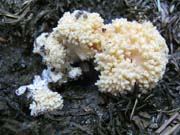 Michael Beug |
29a (25a) Branches weakly brunnescent (average spore length >11 μm)
................................................................................31
29b Branches not brunnescent (average spore length <11 μm)
................................................................................30
30a Young branches and tips pale dull orange-yellow to deep soft orange-yellow, maturing pale dull orange; tips may be blushed pink and turn dark brown in age or when dried..."Northwest Spring Coral"
................................................................................R. rasilispora var. rasilispora
| COLOR: Tips pastel chartreuse-yellow, often blushing onion-skin pink when exposed to cold, dry air, and sometimes turning dark brown in age; branches buffy yellow, pale ochraceous yellow to fleshy buff when young. FLESH: white; texture fleshy when young, aging softly stringy; taste mild; odor none to +/- unpleasant. FORM: Medium to large, broad; 5-15 cm H x 6-15 cm W, often remaining cauliflower-like for a long time depending on weather conditions; base usually single, stout, tapering downward, 3-6 H x 2.5-5.5 cm W; lower branches thick; upper branches and tips usual. HABITAT: on the ground in mixed conifer woods, usually with true Fir present, spring and early summer, usually above 2500’ (800m) elevation. EDIBLE. SPORES: entirely smooth to very finely warted; 8.3-11.5 x 3.6-4.3 μm, Em 2.57, Lm 9.95. Basidia clamped. NOTE: Some collections of this species growing in volcanic soil can have minute wine-red speckles on the mid- and upper stipe; R. rasilispora v. scatesiana is hard to separate, especially when dried; R. magnipes (32a) is distinguished by having longer spores and is more intensely colored yellow but is otherwise very similar. | R. rasilispora var. rasilispora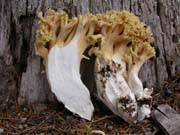 R Exeter 2006-11b |
30b Young branches yellowish-white to light yellow; tips yellow to pale greenish yellow, sometimes with a hint of pink in age..."Kit’s Creamy Coral"
................................................................................R. rasilispora var. scatesiana
| COLOR: Tips and branches cream to pale yellow to pastel greenish, sometimes aging pinkish or turning pinkish red when frosted or exposed to cold, dry air; base white. FLESH: white, texture fleshy to softly stringy; taste mild; odor none or fungoid. FORM: Medium to large, broad, 5-20 cm H x 6-20 cm W; cauliflower-like when young; base single, tapering downward; branches and tips usual. HABITAT: On the ground in mixed conifer woods with true Firs, mainly spring, but also summer and fall. EDIBLE. SPORES: smooth, 9.4-11.9 x 3.2-4.3 μm, Em 2.85, Lm 10.62. Basidia clamped. Amyloid reaction to MI or IKI slow and weak or negative. NOTE: see also R. rasilispora v. rasilispora (30a) which differs primarily in color and R. magnipes (32a) which has longer spores. | R. rasilispora var. scatesiana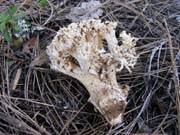 R Exeter 2006-03 |
31a (29a) Branches white to pale yellow with white to salmon colored flesh, weakly to strongly brunnescent; above 2500 feet (800 meters) in Idaho or 5000 feet (1,500 meters) in Sierra Nevadas, mixed conifers with true firs; (long spores ~13.3 μm)
................................................................................R. thiersii
(see description under Key Entry 20)
31b Branches may be white to pale yellow but never with salmon colored flesh; (average spore length <12 μm)
................................................................................32
32a May develop subsurface; base surface covered by a soft white coating which is easily rubbed off; branches some shade of yellow; tips white where protected then bright yellow to chartreuse yellow, often tinged brick red..."Big Base Goldie"
................................................................................R. magnipes var. magnipes
| COLOR: Tips white where protected, bright yellow to chartreuse yellow where exposed (changing to brick red when crushed or frosted); branches of immature fruiting bodies deep yellow, becoming paler and browner in age; base off-white. FLESH: white; texture fleshy to softly stringy; taste mild; odor mild or +/- unpleasant. FORM: large to very large 9-40 cm H x 14-40 cm W; base single, tapering downward; upper branches long remaining compressed in cauliflower-like form, finally elongating, shape usual; tips usual. HABITAT: On the ground in mixed coniferous forests, usually with true Firs, spring and summer. EDIBLE. SPORES: almost smooth; 9.4-13.3 x 3.2-5.0 μm, Em 2.89, Lm 11.5. Basidia clamped. NOTE: R. magnipes var. albidor (32b), known from the Sierra Nevada Mountains, is cream-colored and long remains underground. | R. magnipes var. magnipes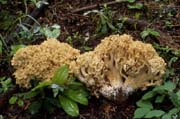 Steve Trudell |
32b Primarily subsurface development; branches white where protected, light cream to ivory where exposed; tips pale yellow when young, bright greenish-yellow where unprotected, often with a blush of muted pink
................................................................................R. magnipes var. albidior
COLOR: branches white where protected, cream to ivory where exposed, tips pale yellow when young, bright greenish yellow where unprotected, usually with a blush of muted pink where exposed; stipe white, browning weakly. FLESH: white often mottled with small hygrophanous spots. Slowly and weakly amyloid. FORM: Massive single base, abortive stumps common and recurved high on base. HABITAT: coniferous forests. EDIBILITY: not reported, probably edible. SPORES: smooth, 10.8-11.9 x 3.6-4.3 μm, Lm 11.5; Em 2.8. Basidia clamped. NOTE: See also R. magnipes var. magnipes (32a).
33a (24a) Stipe base not weakly brunnescent
................................................................................35
33b Stipe base weakly brunnescent
................................................................................34
34a Pale buff to light tan branches; short and broad stipe; non-amyloid (distinctly verrucose spores that are short and wide ~9.3 x 5.2 μm)
................................................................................R. caulifloriformis
| COLOR: branches pale buff to pale pinkish buff, tips pale pinkish buff, often turning dark brown where exposed or dried in the field, off-white where protected, browning only slightly. FLESH: white to off-white, with stipe context watery-marbled; often brittle; non-amyloid. FORM: stipe single to falsely fasciculate with numerous abortive branchlets and clusters. HABITAT: Coniferous forests, fall (rarely spring in California). EDIBILITY: Unknown. SPORES: distinctly verruculose to verrucose; 8.3-10.4 μm, Em 1.8, Lm 9.3. Clamped. Microscopically extremely close to Ramaria cartilaginea (53c) but distinguished mainly by color. If basidia are unclamped, consider R. spinulosa var. diminutiva (23a). | R. caulifloriformis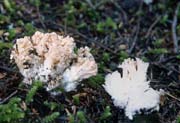 Michael Beug |
34b Pale yellow to canary yellow branches with more intense yellow tips, white where protected; maturing pale brownish orange; large to massive stipe; amyloid stipe base; (finely warted short narrow spores ~9.1 x 3.6 μm)
................................................................................R. rasilisporoides
COLOR: Branches pale yellow to canary yellow with more intense yellow tips when young becoming pale brownish orange to pinkish in age; stipe whitish becoming watery brunnescent where handled. FLESH: fleshy fibrous, cartilaginous, grainy mottled, white. FORM: massive single to compound deeply rooting stipe with recurved abortive branchlets. HABITAT: Pseudotsuga, Tsuga, Thuja in Oregon Coast Range. EDIBILITY: Unknown. SPORES: smooth to finely warted, 7-10(11) x 3-4.5 μm, Em 2.53, Lm 9.1. Basidia clamped. NOTE: See also R. rasilispora var. scatesiana (30b) which is the only member of the R. magnipes/rasilispora complex that sometimes fruits in the fall. R. rasilispora var. scatesiana (30b) has a longer average spore length with smooth spores.
34c Pale yellow to salmon color branches with yellow tips usually become same color as the branches in age; large to massive stipe; weakly amyloid stipe and branches; (delicately but distinctly roughened spores average ~10 μm long)
................................................................................R. rubricarnata var. rubricarnata
(see description under Key Entry 66a)
35a (33a) Base context fleshy-fibrous to cartilaginous but not distinctly rubbery or soapy feeling and not translucent
................................................................................54
35b Base context showing gelatinous streaks or cartilaginous (tough rubbery, pliable, often with a soapy feeling)
................................................................................36
36a Cartilaginous or rubbery or soapy feeling but with no more than very small translucent gelatinous spots
................................................................................47
36b Gelatinous to firm-gelatinous, usually with distinct translucent regions
................................................................................37
37a Branches over-all yellow; but may have a pink flush
................................................................................44
37b Branches pallid to medium orange to salmon with a yellow "bellyband" when young
................................................................................38
Note: The yellow "bellyband" is a region of yellow between the top of the white stipe and the bottom of the orange to salmon branches. The "bellyband" quickly fades and thus is easily missed.
38a Basidia not clamped
................................................................................41
38b Basidia clamped
................................................................................39
39a Compound stipe a distinctive wrinkled gelatinous mass of fused branches; odor not distinctive; branches pallid orange with yellow tips when young but over-all gray orange or even violet gray in age; (wide warted spores 8.9 x 5.1 μm)..."Gelatinous Coral"
................................................................................R. gelatinosa var. oregonensis
| COLOR: Tips same as branches or paler; branches when young light orange but becoming darker and duller with age and sometimes developing a dingy violet cast; base variably white, light yellow or light orange. FLESH: Translucent, pale dull orange; texture stiffly gelatinous; taste mild. FORM: Medium-sized, broad; 8-15 cm H x 5-12 cm W; base fused, broad, 4-7 cm H x 3-8 cm W. consisting of irregularly wrinkled gelatinous streaks; surface with white fuzz; usually with many branch stems arising from same level on base and branches nearly parallel; tips usual. HABITAT: On the ground in old coniferous forests, often under Western Hemlock, late summer and fall. EDIBILITY: Usually labeled poisonous. SPORES: coarsely warted; 7-10 x 4.5-6 μm; Em 1.75, Lm 8.9; hyphae clamped. | R. gelatinosa var. oregonensis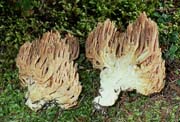 Michael Beug |
39b Compound to fasciculate stipe but branches not as fused as above; odor usually sweet or like green beans; branches orange to salmon with yellow to orange tips (shorter narrower spores 8.3-8.6 x 3.8-4 µm)
................................................................................40
40a Green-bean like odor; orange tips and orange branches…"Fused Orange Clump"
................................................................................R. sandaracina var. chondrobasis
| COLOR: Tips and upper branches salmon to deep orange; a band of bright yellow just above ground level; base white to pale yellow; stains sometimes present as above. FLESH: colored much like surface; stipe base sub-gelatinous, gelatinous streaks present when cut; taste mild; odor none or slightly beany. FORM: Medium-sized 8-15 cm H x 6-13 cm W; base usually a fused mass; branch sections rather short making a very broad fruiting body with many fine branches; tips almost pointed. HABITAT: On the ground under Western Hemlock, fall. EDIBLITY: unknown. SPORES: 7-10 x 3.5-5 μm, Em 2.08, Lm 8.3. Basidia clamped. NOTE: see also R. sandaracina var. sandaracina (52a) which also has a bean-like odor but is brittle fleshy fibrous and at most a trace gelatinous. | R. sandaracina var. chondrobasis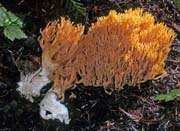 Kit Scates Barnhart |
40b Odor sweetly fragrant in most but not all collections; yellow tips when young with orange branches... "Sweet Orange Clump"
................................................................................R. sandaracina var. euosma
| COLOR: Tips light yellow; branches pale orange with a yellow band at junction with base, bruising dull violet; base white. FLESH: translucent, colored much like surface; texture sub-gelatinous, rubbery when fresh; taste mild; odor as above. FORM: Broad, 8 cm H x 9 cm W; base fused from stems about 2 cm diameter; upper branches and tips usual. HABITAT: On the ground under Douglas fir and Western Hemlock, fall. EDIBILITY: Probably edible. SPORES: 6.5-9 X 3.5-4.5 μm. Basidia clamped. NOTE: see also R. leptoformosa (70a). | R. sandaracina var. euosma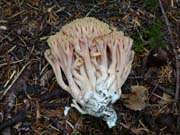 R Exeter 2002-09 |
41a (38a) Deep orange branches with deep orange tips..."Orange Jellybelly"
................................................................................R. gelatiniaurantia var. gelatiniaurantia
| COLOR: Tips and most of upper branches deep orange; just above ground level a band of light to bright yellow; underground part of base white. FLESH: Yellow in tips, base with marbled clear and whitish streaks; texture very gelatinous, especially in base; taste mild; odor beany. FORM: Medium- to large-sized 6-22 cm H x 4-11 cm W, cluster-like; base consisting of many fused gelatinous "stems;" lower branches somewhat fused; tips often pointed. HABITAT: On the ground, under Western Hemlock, fall. EDIBILITY: Unknown. SPORES: warty, 8-11 x 3.3-5 μm; Em 2.27, Lm 9.3. Basidia not clamped. NOTE: see also varieties of R. flavigelatinosa (43a, b; 46a). R. aurantiisiccescens (23b) and R armeniaca (27a) both have fleshy fibrous stipe context. | R. gelatiniaurantia var. gelatiniaurantia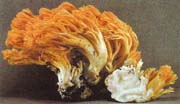 C D Marr |
41b Colors salmon or a paler orange and/or branch tips yellow
................................................................................42
42a Branches with pale salmon outer tissue, yellow interior; apices bright rich yellow, hardly fading at maturity; stipe single, tapering to a point; so far known only from Jefferson County, Wa
................................................................................R. hilaris var. olympiana
COLOR: branches and tips as above; base white with a yellow bellyband. FLESH: firm-gelatinous; base flesh translucent, +/- hyaline, white outward; taste mild; odor faintly beany. FORM: 10 cm H x 6 cm W; base single, tapering to a point, without abortive branches, rubbery texture; surface slippery though not moist. HABITAT On ground; associated with true Fir, Douglas Fir and Western Hemlock. EDIBILITY: Unknown. SPORES: scattered small warts, 9.4-11.2 x 4.0-5.0, Em 2.30; Lm 10.1. Basidia unclamped. NOTE: similar to R. gelatiniaurantia var. gelatiniaurantia (41a) and R. flavigelatinosa v. carnisalmonea (43b) and v. megalospora (43a).
42b Branches appear orange-salmon but have yellow outer branch tissue with orange-salmon to salmon branch context; bright yellow apices fade to pallid yellow; stipe base subcompound to fasciculate
................................................................................43
43a Spores average 10.9 μm long
................................................................................R. flavigelatinosa var. megalospora
COLOR: Branches orangy-yellow to pallid salmon or orange-salmon; tips bright yellow when young, fading to pallid yellow or color of branches; base white. FLESH: colored like the surface; texture as above; taste mild; odor as above. FORM: Small to medium, often broad, 5-14 cm H x 3-24 cm W; base usually consisting of many fused "stems," generally conical, 1.5-5.5 cm H x 1-6 cm W; lower branches sometimes fused; upper branches and tips usual. HABITAT: Ground, Western Hemlock, fall. EDIBILITY: Unknown. SPORES: warty; 9-15 x 4-6 μm; Em 2.67, Lm 12. Basidia not clamped.
43b Spores average 9.6 μm long
................................................................................R. flavigelatinosa var. carnisalmonea
| This variety differs from var. flavigelatinosa (46a) only by the salmon colored branch flesh which gives the yellow branches an over-all salmon orange coloration. | R. flavigelatinosa var. carnisalmonea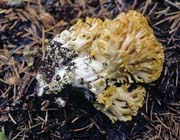 Michael Beug |
44a (37a) Like a pale yellowish-pink cauliflower with rounded or knobby tips of same color or light yellow; (rare)
................................................................................R. verlotensis
| COLOR: Tips and branches as above; base white with a band of light yellow above. FLESH: Colored like surface of branches, white-marbled inside base; texture firmly gelatinous to hard rubbery, watery when fresh; taste mild, odor slightly beany. FORM: Medium, compact and very broad; 9 cm H x 10 cm W; base single, small; 1.5 cm H x 2.5 cm W; lower branches thick and fused, upper two levels of branchlets usually free; tips as above. HABITAT: On the ground near Pines, California and Washington, November. EDIBILITY: Unknown. SPORES: large warts or low discrete plates; 9-11.2 x 4.7-6.1 μm, Em 1.9, Lm 10. Long basidia: gelatinized thin-walled hyphae are unclamped. NOTE: see also R. gelatiniaurantia v. violeitingens (46b) | R. verlotensis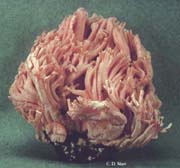 C D Marr |
44b Not as above
................................................................................45
45a Base covered by white tomentum (cottony fuzz); string bean odor; taste slightly bitter; light yellow branches and tips with tips more intensely maze or corn yellow when young; (hyphae clamped; special binding hyphae present in base cortex)..."Beany Fuzzy Foot"
................................................................................R. cystidiophora var. fabiolens
| This variety differs from var. cystidiophora (53a) in its odor like raw string-beans; its larger size, very broad, 9-18 cm H x 7-15 cm W; and its larger spores, 8-11 x 3.5-5 μm, Em 2.31, Lm 9.7. Basidia clamped.. | R. cystidiophora var. fabiolens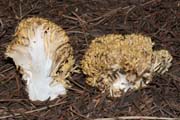 John Plischke |
45b Base lacking white tomentum; odor and taste not as above (hyphae not clamped; no binding hyphae)
................................................................................46
46a Branches yellow, not bruising; firm gelatinous stipe content
................................................................................R. flavigelatinosa var. flavigelatinosa
| COLOR: Tips bright yellow; branches lighter yellow; base white; lower parts occasionally with dull violet bruised spots. FLESH: of branches white, of base translucent white; texture firmly gelatinous, like gelatin or cartilage; taste mild; odor of raw green beans. FORM: Small to medium, often broad; 5-14 cm H x 3-24 cm W; base (1.5-5.5 cm H x 1-6 cm W) usually a cluster of +/- fused stem-branches, separated and elongated toward the top; tips usual. HABITAT: On the ground under Western Hemlock, fall. EDIBILITY: Unknown. SPORES: warty; 8-11 x 3.5 –4.5 μm, Em 2.34, Lm 9.6. Basidia unclamped. NOTE: Both variety flavigelatinosa and fragrans (49a) have pale yellow branches and a very distinctive bright yellow "belly-band". See also R gelatiniaurantia var. violeitingens (46b). | R. flavigelatinosa var. flavigelatinosa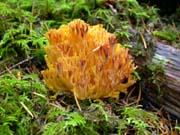 2 R Exeter 2003-30 |
46b Branches apricot yellow, bruising dull violet; stipe base sub-gelatinous
................................................................................R. gelatiniaurantia var. violeitingens
| COLOR: branches apricot yellow, bruising dull violet; apices maize yellow fading to concolor with branches. FLESH: yellow; base subgelatinous; odor and taste not distinctive.FORM: Stipe single to compound, usually slender and rooting, well-branched. HABITAT: Coniferous forests, fall. EDIBILITY: Unknown. SPORES: similar to those of var. gelatiniaurantia (41a), 8-11 x 3.5-5 μm, Em 2.27, Lm 9.3; Basidia non-clamped. NOTE: Distinguishing between the several species with orange branches and a yellow "bellyband" can be a significant challenge. Careful note must be made of average spores size, spore length to width ratio (Em), nature of the stipe flesh, fruiting season and bruising reactions. | R. gelatiniaurantia var. violeitingens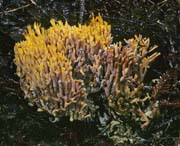 Kit Scates Barnhart |
47a (36a) Flesh of stipe gelatinous or rubbery, often with a soapy feel; tips red to orange with white to cream branches; (not amyloid; spores not striate, length averages 8.5 μm; basal hyphae not clamped)
................................................................................R. botrytoides
| COLOR: Tips and branches as above, aging cream-brown, though tips may retain some red to reddish-orange coloration; base white to cream. FLESH: gelatinous to subgelatinous in base. FORM: Medium, 15 cm H x 10 cm W, cauliflower-like; base single to fasciculate; branches sometimes hollow. EDIBILITY: Unknown. SPORES: 7-11.5 X 3.5-4.5 μm, Em 1.97, Lm 8.52. Basidia unclamped. NOTE: see also R. coulterae (5a). Members of the subgenus Ramaria, like R. botrytis (95b), are readily distinguished by their striate spores. | R. botrytoides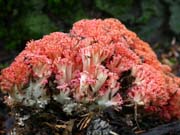 R Exeter 2004-11a |
47b Not as above
................................................................................48
48a Basidia with clamps present
................................................................................52
48b Basidia lacking clamps
................................................................................49
49a Base (sub-)compound; branches slender or average; base lacking white tomentum; cartilaginous when fresh; tips bright yellow to greenish yellow; odor slightly sweet
................................................................................R. flavigelatinosa var. fragrans
This variety differs from var. flavigelatinosa (46a) by tips and branches a bit more greenish-yellow, a sweet odor, texture like cartilage rather than firm gelatin, slightly smaller size (5.5 cm H x 7 cm W), slightly larger spores (8.5-13 x 3.5-6 μm, Em 2.08, Lm 10). It is unclamped but false clamps may be present.
49b Base a fascicle of steeply tapered to slightly bulbous stipes, rarely single; covered with white tomentum where buried; either cartilaginous or fleshy-fibrous when fresh; tips not greenish yellow; odor not sweet
................................................................................50
50a Spores average 9.9 μm; diminutive (up to 4 cm tall); stipe slender (? 4 mm thick); branches stuffed to hollow
................................................................................R. raveneliana
COLOR: tips clear yellow, aging pale orange-yellow to pale ochraceous salmon; branches flesh-colored. FORM: typically 4 cm H x 4 cm W; base fasciculate; branches few to each stem, brittle, often hollow. HABITAT: on the ground under Hemlock and Rhododendron. EDIBILITY: Unknown. SPORES: 8.9-11.2 x 5.0-6.1 μm, Em 1.80, Lm 9.94. Basidia unclamped. NOTE: R. raveneliana and R. conjunctipes varieties (51a,b) are unique in having fasciculate stipes and sparse branching.
50b Spores average 7.5 μm long
................................................................................51
51a Base a dense bundle of stringy white stems with only 2-3 branches present near the apices; rarely taller than 10 cm
................................................................................R. conjunctipes var. sparsiramosa
| This variety differs from var. tsugensis (see Key Entry 51b) only by slender stems (approx. 2-3 mm diameter) forming a cluster about 10 cm H x 3-5 cm W; branching only 2-3 times near tips. Peterson (1986) "It is likely that R. c. var. tsugensis does not differ significantly from R. c. var. sparsiramosa and that further study will conclude that they are synonyms." R. raveneliana (50a) is distinguished by longer spores and hollow stems and generally even smaller size. | R. conjunctipes var. sparsiramosa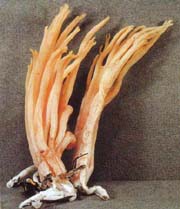 C D Marr |
51b Deeply branched; up to 18 cm tall
................................................................................R. conjunctipes var. tsugensis
| COLOR: Tips yellow; branches pale to light pinkish-orange (salmon to peach) with a waxy translucent look; base white; dull violet bruised spots sometimes occurring on branches. FLESH: colored like surface; texture fleshy-pliable or rubbery; taste and odor mild. FORM: Shrubby, clustered, robust; 4.5-18 cm H x 3-7 cm W; form of base as above, covered by white fuzz; branches often hollow. HABITAT: Under Western Hemlock, fall. EDIBILITY: unknown. SPORES: finely warted, 6-10 x 4-6.5 μm, Em 1.53, Lm 7.5. Basidia unclamped. | R. conjunctipes var. tsugensis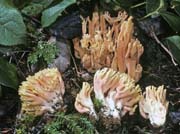 Kit Scates Barnhart |
52a (48a) Stipe context brittle fleshy-fibrous, sometimes with a small slightly gelatinous area; base sometimes with small drab (violet-gray) bruises; deep orange branches and tips; a yellow "belly-band" can be seen in very fresh young material; slender aspect; odor slightly beany or not distinctive
................................................................................R. sandaracina var. sandaracina
| COLOR: Tips and branches bright orange; a yellow area around the upper base and lower branches; base white to pale yellow, faint small dingy violet bruised spots sometimes present. FLESH: colored much like surface; texture brittle, sometimes a bit of the base slightly gelatinous; taste mild; odor beany or not distinctive. FORM: small to medium, slender, 5-10 cm H x 3-7 cm W; base single to semi-divided, tapering downward, 0.5-4 cm H x 0.5-2 cm W; branches mostly slender with elongated sections between forks; tips usual. HABITAT: On the ground under Western Hemlock or Douglas fir, fall. EDIBILITY: Probably edible. SPORES: warty, 6.5-9 x 3.5-4.5 μm, Em 2.08, Lm 8.1. Basidia clamped. NOTE: short spores help distinguish R. sandaracina from other orange clamped Ramaria species. Other sandaracina varieties, var. chondrobasis (40a) and var. euosma (40b) are not as slender. | R. sandaracina var. sandaracina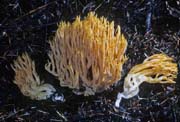 Kit Scates Barnhart |
52b Stipe cartilaginous; base lacking dull violet bruises; branches yellow to brownish yellow; odor may be either sweet and anise-like, like string beans, or not distinctive
................................................................................53
53a Odor sweet and anise-like; buff yellow to warm buff branches with citron yellow tips; base long or sub-fasciculate with white tomentum; (spores short and narrow, ~8 x 3.6 μm)… "Fuzzy Foot"
................................................................................R. cystidiophora var. cystidiophora
| COLOR: Tips light yellow, branches light to buffy yellow; base white. FLESH: Color not known; taste mild, odor as above; texture cartilage-like and +/- fragile. FORM: Medium; 10-12 cm H ; base long, 5-8 cm H x 1-1.2 cm W if single; often +/- tufted; branches slender; tips usual. HABITAT: On the ground under Western Hemlock, fall. EDIBILITY: Unknown. SPORES: warty, 7-9 x 3-4 μm, Em 2.22, Lm 8.0; hyphae clamped; hyphae of base surface "freely branched and studded with lateral spurs, multi-directional, of narrow diameter, thin-walled, containing a densely cyanophilous, granular protoplasm". NOTE: R. cystidiophora var. anisata (66b), known from north-central California and Oregon, has pallid salmon branches, a strong spicy odor vaguely of anise, and spores averaging 8.2 μm long. | R. cystidiophora var. cystidiophora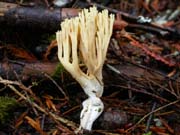 R Exeter 2004-57 |
53b Odor like green beans; over-all light yellow coloration; base single or fasciculate with white tomentum; (spores long and narrow, average ~9.7 x 4.2 μm)
................................................................................R. cystidiophora var. fabiolens
(see description under Key Entry 45a).
53c Odor not distinctive; branches and tips brownish light yellow aging more tannish yellow and contrasting in age; base usually single with thin white basal tomentum; (spores short and wide ~8.8 x 4.5 μm)
................................................................................R. cartilaginea
COLOR: branches brownish light yellow when young becoming more tannish yellow in age with the tips beginning to contrast in age. FLESH: cartilaginous (brittle). FORM: medium sized 3-13 x 4.5-10 cm with a usually single base. HABITAT: Coniferous forests. EDIBILITY: unknown. SPORES: subcylindrical to ellipsoidal; ornamented with distinct irregularly lobed, cyanophilous warts; 7.5-11 x 4-6 μm, Em 1.95, Lm 8.8. Basidia clamped. NOTE: R. flavobrunnescens var. aromatica (58a) has longer, narrower spores and a sweet odor. R. caulifloriformis (34a) differs from R. cartilaginea by color and is pale buff to light tan to coffee colors, though some authors do not recognize the two as separate.
54a (35a) Mid-branches light to distinct salmon to orange to red-orange; lower branches may be yellow; branch tips may be yellow
................................................................................60
54b Mid-branches and tips some shade of yellow
................................................................................55
55a Growing on (usually) visible wood; branches slender, erect, and parallel
................................................................................R. stricta
(see description under Key Entry 118a)
55b Growing on the ground, branches various
................................................................................56
56a Odor neither sweet nor of green beans
................................................................................59
56b Odor generally of green beans, sweet or of gardenias or anise
................................................................................57
57a Base covered by white tomentum; odor similar to anise; (binding hyphae present in cortex of base)..."Fuzzy Foot"
................................................................................R. cystidiophora var. cystidiophora
(see description under Key Entry 53a)
57b Base not covered by white cottony fuzz; odor not of anise; (binding hyphae lacking)
................................................................................58
58a Sweet odor like gardenias or curry; tips yellow aging brownish yellow; branches thick and tufted at forks; often fan-shaped over-all
................................................................................R. flavobrunnescens var. aromatica
| COLOR: Tips white when very young, then tips and branches light to bright yellow during growing stages, aging brownish yellow; base white. FLESH: white; texture fleshy or cartilage-like, aging +/- stringy; taste mild, odor sweet. FORM: Medium, shape above; 4.5-15 cm H x 3-18 cm W; base single, 1-6 cm H x 1-7 cm W, tapering or equal; upper branches +/- thick; tips usual. HABITAT: On the ground under Western Hemlock, fall, common. EDIBLE. SPORES: finely warted, 9-12 x 3-5μm, Em 2.60, Lm 10.4; hyphae clamped. R. cartilaginea (53c) has shorter, wider spores; R. rasilisporoides (34b) has shorter spores; R. rasilispora (30a, b) & R. magnipes (32a, b) have smooth spores. | R. flavobrunnescens var. aromatica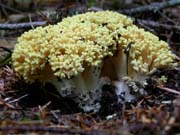 R Exeter 2002-03a |
58b Odor slightly sweet; tips bright yellow to greenish yellow; branches slender or average; shape usual
................................................................................R. flavigelatinosa var. fragrans
(see description under Key Entry 49a)
58c Odor of green beans
................................................................................R. cystidiophora var. fabiolens
(see description under Key Entry 45a)
59a (56a) Branches dull yellow when young, aging Kraft paper bag color; flesh of base like cartilage
................................................................................R. cartilaginea
(see description under Key Entry 53c, see also 51a, b)
59b Branches light yellow to creamy yellow; flesh of base fleshy-fibrous..."Kit’s Creamy Coral"
................................................................................R. rasilispora var. scatesiana
(see description under Key Entry 30b)
60a (54a) Stipe not a fascicle of thin branches
................................................................................62
60b Stipe rarely single, usually a fascicle of stipes
................................................................................61
61a Stipe covered with white tomentum; fruit body 4.5 to 18 cm tall; (very short broadly ellipsoid spores average ~7.5 x 4.9 μm)
................................................................................varieties of R. conjunctipes
(see description under Key Entry 51a, b)
61b Stipe stuffed to hollow; fruit body up to 4 cm tall; (spores average 9.94 x 5.5 μm)
................................................................................R. raveneliana
(see description under Key Entry 50a)
62a (54a) Spores Average <12 μm long
................................................................................65
62b Spores Average 13.4-13.7 μm long
................................................................................63
63a Tips yellow when young; (basidia unclamped)..."Formosetta"
................................................................................R. longispora
| COLOR: Tips bright deep yellow when young, with age fading to match branches; branches light to deep orange; a band of yellow where branches begin; base white. FLESH: colored like surface or paler; texture softly stringy; taste and odor mild. FORM: Small to medium, slender; 4-18 cm H x 2-9 cm W; base single, +/- bulbous OR often semi-divided with several branches arising from a basal root-like structure; branches usually slender; tips +/- pointed. HABITAT: On the ground under Western Hemlock, fall. EDIBILITY: Unknown. SPORES: warty; 10-18 x 4-6 μm, Em 3.0, Lm 13.5. Basidia unclamped. NOTE: Macroscopically, R. sandaracina v. euosma (40b), R. leptoformosa (70a), R. autantiisiccescens (23b), and R. gelatiniaurantia (41a) are quite similar, though the latter two have a gelatinous stipe context. The single fleshy-fibrous stipe that is frequently swollen is a good field character for R. longispora. | R. longispora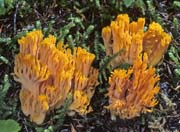 Kit Scates Barnhart |
63b Tips orange when young; (basidia clamped)
................................................................................64
64a Upper stipe white to pale yellow; branches light to bright orange; tips bright orange when young fading to color of branches; base flesh may be cartilaginous (slippery) when young, becoming softly stringy or fleshy-fibrous..."Largent’s Coral"
................................................................................R. largentii
| COLOR: Tips brilliant orange, branches same or paler; base white to pale yellow. FLESH: Colored like surface or paler; texture softly stringy; taste mild; odor as above. FORM: Medium-sized, broad, 12-15 cm H x 7-14 cm W; base massive, 4 cm H x 5 cm W, single or semi-divided, tapering downward or equal; cartilaginous; surface with white fuzz and small abortive branches; branches frequently forked, thick near base, slender above, tips usual. HABITAT: On the ground under lowland Hemlocks, fall. EDIBILITY: Presumably edible. SPORES: coarsely warted with irregular shapes and subspirals; 11-15 x 3-5 μm; Em 2.98, Lm 13.4. Basidia clamped. NOTE: distinguished from R. distinctissima var. americana (64b) by branch color and flesh color. | R. largentii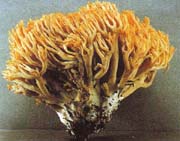 C D Marr |
64b Upper stipe bright to golden yellow when young fading to flat yellow in age; branches pink-flesh to salmon colored; tips bright orange when young fading to color of branches; base flesh white, solid and moist but not slippery
................................................................................R. distinctissima var. americana
COLOR: branches as above, tips bright orange when fresh, fading in age to concolorous with branches; base white below, upward becoming bright yellow to golden yellow, fading in age to flat yellow. FLESH: pastel orange. FORM: 14 cm H x 9 cm W; base ovate in outline, tapering downward, tomentose in lower portion. EDIBILITY: Unknown. SPORES: prominent cyanophilous warts and short ridges; 12.6-16.3 x 3.5-5 μm; Em 2.57, Lm 13.73. NOTE: This species is highly similar to R. largentii (64a), but with slightly longer spores, bright yellow "belly-band" when young, and pinkish to salmon flesh (flesh orange in R. largentii).
65a (62a) Odor not distinctive, slightly sweet or slightly like green-beans; (base flesh not amyloid; hyphae clamped or not)
................................................................................67
65b Odor slightly sweet to strong and spicy with a hint of anise; (base flesh slowly and weakly amyloid; hyphae clamped)
................................................................................66
66a Odor slightly sweet; (average spore length ~10 μm)
................................................................................R. rubricarnata var. rubricarnata
| COLOR: Upper and lower branches pale pastel salmon, pallid salmon buff or cream to occasionally yellow; tips light to bright yellow; base white, weakly bruising reddish-brown. FLESH: Texture brittle, +/- like stringy cartilage; taste mild; odor slightly sweet. FORM: Small to medium, broad 5-13 cm H x 3-12 cm W; base single, stout, tapering downward or almost equal, 2.5-5 cm H x 1-6 cm W; surface with white fuzz and small aborted branches; lower branches thick; upper branches often compacted and long remaining cauliflower-like; tips usual. HABITAT: On the ground under Western Hemlock or Douglas Fir, fall. EDIBILITY: Uncertain. SPORES: 8.6-11.2 X 4.0-4.7 μm, Em 2.32, Lm 10. Basidia clamped; amyloid stipe context. NOTE: the only other Laeticolora species that are both clamped and amyloid are R. amyloidea (6a), R. maculatipes (18b), R. magnipes (32a), R. rasilispora (30a), and R. rasilisporoides (34b). | R. rubricarnata var. rubricarnata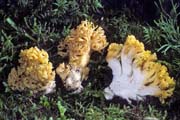 Kit Scates Barnhart |
66b Odor strongly spicy, vaguely of anise; (average spore length 8.2 μm)
................................................................................R. cystidiophora var. anisata
| COLOR: Tips clear yellow when young, fading slightly; branches pallid salmon, often flushed ruddy in age; weakly watery brunnescent where handled; base hoary white. FLESH: color and taste not known. FORM: base single, slender and tapering downward; sometimes with abortive branchlets; 11 cm H x 6 cm W. HABITAT: on ground; found in North Central California, rare in Oregon. EDIBILITY: Unknown. SPORES: 7.8-8.6 x 3.2-3.9 μm, Em 2.24, Lm 3.66. Basidia clamped. | R. cystidiophora var. anisata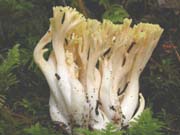 R Exeter 2004-24a |
67a (65a) Average spore width <4.5 μm
................................................................................69
67b Average spore width >4.5 μm
................................................................................68
68a Context fleshy-fibrous; branches light peach-pink (from salmon to peach); tips yellow or concolor; odor not distinctive; (average spore size 9.6 x 4.7 μm)
................................................................................R. cyaneigranosa var. persicina
| COLOR: Tips and branches as above; base white. FLESH: colored like surface; texture fleshy young, softly stringy in age; odor and taste mild. FORM: Small, 7-8 cm H x 3-4 cm W, fan-shaped in outline; branches slender, mostly forked near tips; tips +/- pointed. HABITAT: On the ground under Western Hemlock, fall. SPORES: Warty, 7-11 x 3.5-6 μm, Em 2.04, Lm 9.2. Basidia unclamped. NOTE: Also see R. cyaneigranosa var. cyaneigranosa (74a) which has brighter pink branches and a larger size. R. celerivirescens (7a) and R. rubribrunnescens (18a) are the only other Ramaria species without clamps and with peach to salmon colored branches and lacking a yellow "bellyband." See also R. araiospora (75a,b). | R. cyaneigranosa var. persicina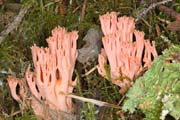 John Davis |
68b Base flesh cartilaginous with some +/- gelatinous streaks; branches orange-salmon with salmon to orange context; tips yellow when young; odor mildly beanlike to not distinctive; (average spore size 10.9 x 4.8 μm)
................................................................................R. flavigelatinosa var. megalospora
(see description under Key Entry 43a)
69a (67a) Average spore length notably short (~8.1 μm); base sometimes with small dull violet bruises; odor slightly like green beans or not distinctive; bright orange branches with a yellow "bellyband" and tips orange; (basidia clamped)
................................................................................R. sandaracina var. sandaracina
(see description under Key Entry 52a)
69b Avg. spore length >10 μm; base without violet bruises; odor sweetish or not distinctive; branches orange to light red with or without a yellow "bellyband;" tips orange or bright yellow; (basidia clamped or not)
................................................................................70
70a Slender elongate growth habit; no distinctive odor; young fruit bodies with or without a yellow "bellyband;" branches light orange or light red with sunflower yellow to chrome orange tips; (basidia clamped)..."Slim Formosa"
................................................................................R. leptoformosa
| COLOR: Tips deep yellow to orange; branches light orange to light red, sometimes yellow in lower portion; base white tinged with yellow or orange, bruising or staining reactions slight to absent. FLESH: colored like surface; texture softly stringy; taste and odor mild. FORM: Medium, usually taller than broad; 4.5-17 cm H x 2-10 cm W; base 0.5 cm H x 1-4 cm W, often semi-divided into several +/- fused stems; branches slender; tips +/- pointed. HABITAT: On the ground under Douglas Fir, Western Hemlock, and Western Yew, fall. EDIBILITY: Unknown. SPORES: warty; 8-13 x 3-5 μm, Em 2.6, Lm 10.6. Basidia clamped. NOTE: R. sandaracina varieties (40a,b; 52a) are distinguished by a yellow "bellyband" and shorter spores. | R. leptoformosa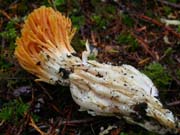 R Exeter 2004-45 |
70b Small to medium but not distinctly slender and elongate; odor somewhat sweet; young fruit bodies with a yellow "bellyband;" branches light orange to intense orange with bright orange tips; (basidia not clamped)
................................................................................R. aurantiisiccescens
(see description under Key Entry 23b)
71a (8a) Branches and tips scarlet when young, soon fading to orangish shades; (flesh of base amyloid – purplish in MI or IKI, reaction strong)
................................................................................R. stuntzii
| COLOR: Tips and branches as above, base white. FLESH: colored like surface or paler; texture softly stringy; taste slightly bitter; odor mild. FORM: Medium-sized, broad; 6-17 cm H x 4-14 cm W; cauliflower-like when young, elongating greatly with age; base single, massive 2-7 cm H x 2.5-7 cm W; equal or tapering downward; often with small abortive branches; lower branches thick; tips usual. HABITAT: On the ground in old coniferous forests, usually Western Hemlock, occasionally in fairy rings, fall. EDIBLE. SPORES Warty, 7-10 X 3-5 μm; Em 2.08, Lm 8.3. Basidia not clamped. NOTE: Some collections of R. araispora var. araispora (75a) are also amyloid in IKI or MI. R. stuntzii has smaller spores than either R. araiospora (75a,b) or R. cyaneigranosa (68a, 73a, 74a). | R. stuntzii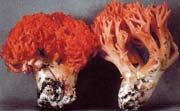 C D Marr |
71b Branches bright peachy pink or crimson (bright red with faint purplish tint) when young; (flesh of base not amyloid)
................................................................................72
72a Branches vivid red to crimson with tips red, orange or yellow; (spores 4.3 μm wide or narrower; basidia not cyanophilous; not clamped)
..................varieties of R. araiospora
................................................................................75
72b Branches +/- bright peachy pink, never more than dotted yellow; (spores average between 4.4 μm and 5 μm wide; basidia cyanophilous, not clamped)
..................varieties of R. cyaneigranosa
................................................................................73
72c Branches peach or light red with yellow tips; (spores average >5.4 μm wide; basidia not cyanophilous, clamped)
................................................................................R. formosa
(see description under Key Entry 22a)
(see also R. leptoformosa under Key Entry 70a)
73a Branch tips intensely reddish never yellow; branches pastel red in youth; in age branches and tips fading to brownish salmon; general shape conspicuously elongated..."Pink Pencils"
................................................................................R. cyaneigranosa var. elongata
COLOR: Tips as above; branches peach-colored to pastel red when young; fading to brownish salmon; base white. FLESH: colored like surface or paler; texture softly stringy; taste and odor mild. FORM: medium-sized and slender, 8-13 cm H x 1.5-3.5 cm W; branches parallel and ascending; base small, 1-4 cm H x 0.3-3 cm W, consisting of one or more "stems" covered by white fuzz, +/- fusing into a "taproot." HABITAT: Under Western Hemlock, fall. EDIBLE. SPORES: warty; 8-10 x 4-5 μm, Em 2.04, Lm 9.2. Basidia unclamped with masses of cyanophilous granules.
73b Branch tips reddish yellow or dotted with yellow; branches light red or peach to salmon; general shape not conspicuously elongated
................................................................................74
74a Base thick or slightly bulbous; branches light red..."Pink Coral"
................................................................................R. cyaneigranosa var. cyaneigranosa
| COLOR: tips colored like branches or yellow at the very top; branches about peach- or shell- or shrimp-pink; base white. FLESH: paler; softly stringy; taste and odor mild. FORM: Medium or small-sized, 4-12 cm H x 2-11 cm W; base as above, single or semi-divided, often arising from a slender taproot-like structure; branches sometimes flattened and intervals between forks rather short; tips usual. HABITAT: On the ground under Western Hemlock, fall. EDIBLE. SPORES warty; 8-15 x 4-6 μm, Em 2.39, Lm 11.0. Basidia non-clamped with masses of cyanophilous granules. NOTE: R stuntzii (71a) and R. araiospora (75a,b) are the only other red colored species in North America. R. cyaneigranosa v. elongata (73a) has branch tips that never yellow and v. persicina (68a) has peach or salmon colored branches that are not at all red. | R. cyaneigranosa var. cyaneigranosa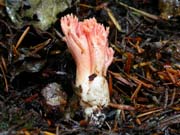 R Exeter 2004-09 |
74b Base narrowing steeply downward, slender, covered by white basal tomentum; branches salmon or peach..."Peach Fan"
................................................................................R. cyaneigranosa var. persicina
(see description under Key Entry 68a)
75a (72a) Branches vivid red when young, fading to light red in age; tips yellow to pale or deep orange..."Carmine Coral"
................................................................................R. araiospora var. araiospora
| COLOR: Tips and branches as above; base white to pale yellow, sometimes discoloring to pale brown. FLESH: Colored like surface; texture softly stringy; taste and odor mild. FORM: Small to medium in size, 5-13 cm H x 208 cm W; base single or semi-divided; bulbous, 2-3 x 1.5 cm, covered by soft white fuzz; abortive branches often present; branches elongating in age to long intervals between forks; mostly slender, 1-5 mm; tips usual. HABITAT: On the ground under Western Hemlock, fall. EDIBLE. SPORES warty; 8-13 x 3-4.5 μm, Em 2.68, Lm 9.9. Basidia non-clamped. NOTE: there are only two red colored species in western North America. R. stuntzii (71a) has amyloid stipe flesh and R. cyaneigranosa (68a, 73a, 74a) has wider spores and basidia with masses of cyanophilous material. | R. araiospora var. araiospora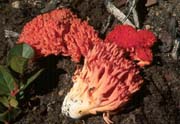 Ben Woo |
75b Branches and tips crimson to magenta (slightly bluish red) when young and when mature..."Crimson Coral"
................................................................................R. araiospora var. rubella
| (This variety differs from var. araispora only by unfading branches and tips.) | R. araiospora var. rubella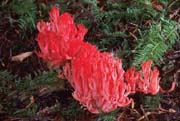 Michael Beug |
76a (9a) Lower branches or upper base tan or brown (tips may be violaceus brown when young)
................................................................................79
76b Lower branches or upper base purplish gray to violet
................................................................................77
77a Branches purplish gray or violet gray; base small, single of a fascicle of two, about 1 cm H x 1.5 cm W, tapered; very rare; (basidia unclamped)
................................................................................R. fumosiavellanea
| COLOR: Tips pale tan with slight violet tint; branches as above with brownish tint; base pale grayish orange. FLESH: Branches translucent white; base white; texture fleshy-fibrous; taste mild; odor faintly sweet. FORM: Medium, fan-shaped, 11 x 11.5 cm; base size above, single or two-fused; branches +/- flattened, +/- wrinkled; tips rounded or knobby. HABITAT: On the ground In sandy soil, Glacier Peak Wilderness Area, fall. EDIBILITY: Unknown. SPORES: warty, several guttulae with guttules dark and non-refringent; 9-13.5 x 4.5-7 μm; Em 1.93, Lm 10.3. Basidia unclamped. Violet pigment turns red in 20% KOH or bright yellow in 10% H2SO4. NOTE: Very similar to and possibly a variety of R. spinulosa. R. spinulosa var. diminutiva (23a) has brown stipe flesh while R. fumosiavellanea has off-white stipe flesh. Also compare to R. marrii (83a) and R. acrisiccescens (83b). | Ramaria fumosiavellanea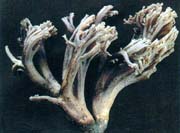 C D Marr |
77b Branches when young close to the color of lilacs or violets; base often stout and bulbous but occasionally slender; base 2-5 cm H x 0.6-5.5 cm W; (basidia clamped)
................................................................................78
78a Branches becoming browner with maturity but upper base and lower branches retaining a purplish band; uncommon..."Smoky Finn"
................................................................................R. violaceibrunnea
| COLOR: Tips as above, darkening in age; branches purple in youth, darkening with spore production to smoky olive (buffy brown); base white below substrate, upward pallid grey-violet, sometimes brunnescent in creases. FLESH: not recorded. FORM: Small to medium, 5-13 cm H x 1.5-8 cm W; base single or +/- fused, variably slender to stout, 2.5-5 cm H x 0.6-5.5 cm W; branches and tips usual. HABITAT: On the ground in mixed old growth conifer woods, fall. EDIBILITY: Unknown. SPORES: spore print deep olive buff, 9-13 x 4.3-5.4 μm, Em 2.13, Lm 10.42. Basidia clamped; violet pigment gives same reactions as in R. fumosiavellanea (77a). NOTE: We may have two different western species: R violaceibrunnea and R. fennica var. griseolilacina which would be distinguished by branches that are lilac, purple to reddish tan when young and cinnamon when mature. See also R. purpurissima v. purpurissima (78b) which has a massive rather than a slender stipe and branches and apices that retain the intense violet colors. | R. violaceibrunnea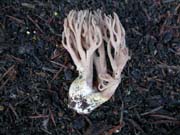 R Exeter 2005-82 |
78b Branches and tips wholly amethyst lilac, sometimes ochraceous purple in age but not turning brown; rare..."The Purple Prince"
................................................................................R. purpurissima var. purpurissima
| COLOR: Tips and branches as above; base white occasionally with brunnescent areas. FLESH: white; solid and hard; somewhat bitter; odor slight. FORM: Medium to small, 8-10 cm H x 5-15 cm W; base thick, single, massive. HABITAT: known only from conifer forests in Northern Idaho. EDIBILITY: Much too beautiful and rare to eat. SPORES: 9-11.2 x 4.7-5.4 μm, Em 2.05, Lm 10.3. Basidia clamped. | R. purpurissima var. purpurissima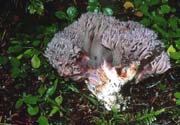 Kit Scates |
79a (76) Texture fleshy-fibrous, slightly punky or pliable; fruit bodies bruising noticeably on handling
................................................................................81
79b Texture gelatinous or brittle like cartilage; not bruising or browning slightly
................................................................................80
80a Branches brownish-orange when young, becoming browner with age; flesh of base very gelatinous, like streaked brownish-orange gelatin..."Gelatinous Coral"
................................................................................R. gelatinosa var. oregonensis
(see description under Key Entry 39a)
80b Branches pale buff to pinkish buff, often turning dark brown where exposed, chocolate brown or darker with age; base texture often brittle like cartilage, flesh watery marbled but not gelatinous..."Devil’s Flesh"
................................................................................R. caulifloriformis
(see description under Key Entry 34a)
81a (79a) Young tips yellow; base conspicuously covered by white cottony fuzz; any part bruising red-brown (allow several minutes or more); (base flesh turning blue-green in FSW)..."Brunnea"
................................................................................R. testaceoflava
| COLOR: Tips remaining golden yellow or turning +/- brown; branches golden yellow when young, aging yellowish- or reddish-brown; base white; any part quickly bruising as above. FLESH: brownish-white, immediately turning darker when cut; texture fleshy-spongy and branches pliable; taste bitter; odor none to +/- sweet. FORM: Small to medium, 5-13 cm H x 1.5-7.5 cm W; base arising from conspicuous white mycelial threads, single or +/- fused, 1.5-6 cm H x 2-6 cm W; upper branches +/- parallel and pencil-like; tips variable. HABITAT: On the ground under Western Hemlock, fall. EDIBILITY: unknown. SPORES: warty, 9.5-14 x 4.2-6.4 μm, Em 2.29, Lm 11.76; hyphae clamped; basidial protoplasm cyanogranular. | R. testaceoflava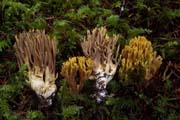 Steve Trudell |
81b Young tips not yellow; base lacking obvious white fuzz; bruising not as dark as red-brown; (base flesh not instantly blue-green in FSW)
................................................................................82
82a Spores short and wide (~8.6 x 5.4 μm); fruit body small, up to 13 cm H x 10 cm W but usually much smaller; branches brown to somewhat violaceus brown; tips violaceus brown when young: base up to 5 x 2.3 cm, usually much narrower, sometimes mycelial at very base, deep tan to orange-brown, staining brown; fruits in fall; rare
................................................................................R. spinulosa var. diminutiva
(see description under Key Entry 23a)
82b Average spore length greater than or equal to 10 μm
................................................................................83
83a Branches brown to somewhat violaceus brown; tips violaceus brown when young; stipe deep tan to brown or orange-brown, staining brown; odor not distinctive; fruit body often quite small, base up to 5 x 2.3 cm, usually much narrower, sometimes mycelial at very base; (spores finely warted and very short, but wide (~8.6 x 5.5 μmm); rare
................................................................................R. marrii
| COLOR: tips deep fleshy tan when young, fading somewhat at maturity; branches pallid tan below, upwards light brown or flesh tan, often with pinkish buff tints; base white to off-white, bruising chocolate brown to watery brown on exterior, hardly bruising on interior. FLESH: solid, soft-spongy in large stipes, off-white; often minutely marbled; taste mildly bitter to weakly astringent; odor negligible to slightly agaricoid. HABITAT: On soil and duff in mixed coniferous forests including Pine and True Fir. EDIBILITY: Unknown. SPORES: obscurely roughened, uniguttulate, 8.6-11.6 x 4.3-5.4 μm, Em 2.08, Lm 9.85; basal hyphae unclamped. NOTE: R. marrii is one of the few spring ramarias lacking clamp connections. R. spinulosa var. diminutiva (23a) is a similar, less bulky, species that fruits in the fall, has tan to tan-brown chalky-friable stipe flesh and is reported from Washington and California under Pines. They share tip, base and branch color; lack of clamp connections; brown bruising reaction; and similar spore size. See also R. acrisiccescens (83b). | Ramaria marrii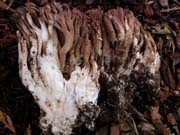 R Exeter 2005a |
83b Fruits in fall; fruit body usually taller than wide, range 5-29 cm H x 5-15 cm W; branches pale yellowish- to orangish-brown; base slender, single to sub-fasciculate, white with superficial hyphae that turn brown but base not chocolate brown where pressed against substrate; taste not distinctive when fresh but pronounced bitter taste when dried..."Blah"
................................................................................R. acrisiccescens
| COLOR: Tips variably colored: like branches, pallid, or with pinkish or purplish cast when young; branches as above; base white, but with lower branches turning brown on bruising. FLESH: brownish-white, texture fleshy to stringy; taste mild to +/- acrid when fresh, cooking or drying with pronounced bitterish-acid taste; odor +/- musty-sweet to beanlike. FORM: Size and shape as above; base single to semi-divided, 1.5-9 cm H x 1-3 cm W; usually fuzzy; branches often elongated, +/- parallel; tips usual. HABITAT: On the ground in mixed old conifer forests, fall. EDIBILITY: Mildly poisonous? SPORES: finely warty; 8-14 x 4-6 μm, Em 2.06, Lm 10.1. Basidia unclamped. NOTE: This is the only PNW species that is white and lacks clamps. R. velocimutans (7b) has clamps and a "rusty root." R. acrisiccescens may also sometimes have some brown contextual hyphae in the base of the stipe, but it will not turn blue-green with FSW. When mature and brown it could be confused with R. marrii (83a), R. fumosiavellanea (77a) or R. spinulosa var. diminutiva (23a). | R. acrisiccescens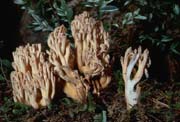 Kit Scates |
84a (2a) Flesh of vertically cut base lacking a "rusty root," a +/- triangular brown area; (spores striate or not)
................................................................................86
84b Flesh of base with "Rusty Root;" (spores not striate)
................................................................................85
85a Branches and tips white; basal flesh rapidly blue-green in FSW
................................................................................R. velocimutans
(see description under Key Entry 7b)
85b Branches may be white but tips colored +/- wine red
................................................................................R. coulterae
(see description under Key Entry 5a)
86a (84a) Base generally lacking vinaceous (purplish or reddish brown) stains but may be brunnescent; tips various colors, including white to cream to light yellow (spores striate or not)
................................................................................88
86b Base with winey stains or brunnescent when rubbed AND tips white to cream to yellow or pale orange (spores not striate)
................................................................................87
87a Under Western Hemlock, Douglas Fir and Grand Fir; spring or fall; (spore length averages 12 μm)..."Pale Winey Base"
................................................................................R. vinosimaculans
(see description under Key Entry 17a)
87b Under mixed conifers with true Firs; spring; above 2500 feet (800 meters) in Idaho or 5000 feet (1,500 meters) in Sierra Nevadas, (spore length averages 13.3 μm)
................................................................................R. thiersii
(see description under Key Entry 20a)
88a (86a) Branch tips various colors, fading as the branches elongate but not fading to white or yellowish gray; base often massive, weakly brunnescent or not; (generally slowly amyloid in IKI or Melzer’s; (spores striate or not)
................................................................................90
88b Branch tips white to violaceus or vinaceous drab fading to white or pale yellowish gray (amyloid in IKI or Melzer’s; spores striate)
................................................................................89
89a Off-white fruit body with a faint violet hue; branch tips buffy violaceus when young becoming off-white to pale light yellow or occasionally with a slight vinaceous cast; base massive, staining slightly brunnescent; quickly and distinctly amyloid (violet-brown) in IKI or MI; (spores length average >14 μm long)
................................................................................R. subviolacea
| COLOR: Tips vinaceous drab to beige drab (pale buffy yellow) and aging yellowish-gray; branches off-white to yellowish gray; base white, staining light yellow to dull orange. FLESH: solid, white, fleshy-fibrous; taste mild, odor slightly musty, occasionally pungently sweet and spicy. FORM: Medium to large 8-23 cm H x 6-23 cm W; base massive, often accounting for more than ½ of sporocarp height (single, generally short and thick and tapered downward, 2.5-7 cm H x 1.5-7 cm W, with few primordial branchlets); branches and tips usual. HABITAT: Deeply buried under grand fir and Douglas fir, fall and spring?. EDIBILITY: Probably edible. SPORES: striate,12.0-18 (19) x 5.0-7.0 (7.6), Em 2.67, Lm 14.13. Basidia clamped. NOTE: The European species R. strasseri is highly similar and may also occur in this region. It is best distinguished by narrower and slightly longer spores: 11-20 x 3.5-6 μm, Em 3.11, Lm 14.3 and sometimes gelatinous streaks in the base. See also R. rubrievanescens (96a). | R. subviolacea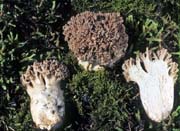 Kit Scates Barnhart |
89b Off-white fruit body with pinkish branch tips but soon fading to all white; slow to fast amyloid reaction in IKI or MI; (spore length average ~11.7 μm)
................................................................................R. rubrievanescens
(see description under Key Entry 96a)
90a (88a) Branches very pale brown (blah), usually straight and erect and tall; fruit body taller than wide; tips occasionally with faint pinkish tint; taste bitter
................................................................................R. acrisiccescens
(see description under Key Entry 83b)
90b Branches white to cream, not noticeably erect; tips often yellowish, orangish, pinkish, or vinaceous; taste mild
................................................................................91
91a Tips and upper branches orangish or wine red or pink
................................................................................93
91b Tips and upper branches cream to pale yellow or greenish yellow (may have pinkish blush in cold, dry spring weather)
................................................................................92
92a Not brunnescent; base and tips sometimes with a hint of pink in age; (amyloid reaction to MI or IKI slow and weak or negative; spores average 10.6 μm)..."Kit’s Creamy Coral"
................................................................................R. rasilispora var. scatesiana
(see description under Key Entry 30b)
92b Sometimes weakly brunnescent; neither base nor tips tinged pink (base flesh amyloid in MI or IKI; spores average 11.4 μm)
................................................................................R. rubricarnata var. pallida
(see description under Key Entry 28b)
93a (91a) Upper branchlets light orange to light salmon when young
................................................................................96
93b Upper branchlets redder, purpler, or browner than above
................................................................................94
94a Upper branches and tips deep dull fleshy red to flesh beige, soon fading to flesh pink or paler; texture fibrous and stringy in lower branches; branches very slowly bruising dull bluish violet; (non-amyloid; spores not striate; true clamps absent but false clamps present)..."Elsie’s Stringy Pinky"
................................................................................R. coulterae
(see description under Key Entry 5a)
94b Upper branches and tips pink, red, magenta or dark reddish brown fading as branches elongate; texture not noticeably fibrous and stringy, etc.; not bruising or bruises pale yellow to light brown; (slowly amyloid; spores striate; true clamps present)
................................................................................95
95a Branches brown to somewhat violaceus brown; tips violaceus brown when young; stipe deep tan to brown or orange-brown, staining brown; odor not distinctive; fruit body often quite small, base up to 5 x 2.3 cm, usually much narrower, sometimes mycelial at very base; (spores finely warted and very short, but wide (~8.6 x 5.5 μmm); rare
................................................................................R. rubripermanens
| COLOR: Tips before emerging dark reddish brown, color diluting and becoming paler with age, mostly seen in light dull winy shades, fading with age but never white before turning pale tan in old age; branches white to pale cream; base white. FLESH: White; texture fleshy; taste and odor mild. FORM: Medium to large, 9-30 cm H x 9-20 cm W; long remaining cauliflower-like; base usually single and massive, about ½ total height, taller than broad, tapering downward or equal; tips and branches usual in shape after elongation. HABITAT: On the ground in conifer forests, spring, occasionally fall. EDIBLE, usually choice. SPORES: Striate, 10.4-15.5 X 4.0-5.0 μm, Em 2.58, Lm 12.2. Basidia clamped. NOTE: Marr and Stuntz (1973): spores 8-13 x 3.5-4.5 μm, Lm 10.3; clamped. R. rubripermanens has a non-staining stipe while R. rubrievanescens (96a) bruises drab brownish violet and is only known from fall collections. R. rubripermanens and R. rubrievanescens can be very difficult to distinguish. | R. rubripermanens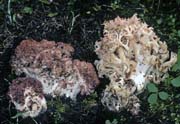 Kit Scates Barnhart |
95b Stains or bruises pale yellow to light brown; branch tips grayish magenta, (pale red to light lilac when young); found only in the fall(?); (IKI or MI on stipe flesh slowly weak amyloid; spores average 13.8 μm long)..."Wine-Tipped Coral"
................................................................................R. botrytis var. botrytis
| COLOR: Tips and a short distance downward variably pale red to light lilac; branches much paler; base white, occasionally with stains as above. FLESH: white; texture fleshy; taste mild, odor sometimes faintly sweet. FORM: Medium to large, nearly as broad as tall, 7-20 cm; long remaining cauliflower-like; base single, massive, 2-7 cm H x 2-4 cm W, tapering downward or equal; tips and branches usual in shape after elongation. HABITAT: On the ground in conifer forests, fall only (?). EDIBLE, considered choice but some people cannot stomach it. SPORES: striate, 11-17 x 4-6 μm, Em 2.94, Lm 13.8. Basidia clamped. NOTE: except for the long spores, easily confused with R. rubripermanens (95a) or R. rubrievanescens (96a). | R. botrytis var. botrytis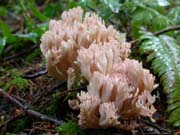 R Exeter 2004-49 |
96a (93a) Tips peachy pink to pale salmon (light orange) or a shade browner; soon losing color, then seeming white overall; spores striate..."Pale Pinky"
................................................................................R. rubrievanescens
| COLOR: Tips as above; branches and base white, usually not bruising but occasionally turning vinaceous in damaged areas. FLESH: white; texture fleshy to softly stringy; taste +/- nutty; odor +/- faintly sweet. FORM: often broad, 7-22 cm H x 7-22 cm W, often remaining cauliflower-like for a long time; base single, proportionately massive, usually ½ to 2/3 of total height but not so broad as tall, usually cylindrical with rounded bottom; branches and tips usual after elongation. HABITAT: On the ground in conifer forests, apparently fall only. EDIBLE, choice. SPORES: striate, 10-13 x 3.5-5.5 μm, Em 2.67, Lm 11.77. Basidia clamped. Context of stipe weakly amyloid. NOTE: Closely resembles R. rubripermanens (95a) which is variable in color and can fruit spring or fall while R. rubrievanescens only fruits in the fall, always has a reddening stipe surface and always has branch tips pink to pale pink. See also R. subviolacea (89a). Several other ramarias have similar coloring but do not have striate spores. | R. rubrievanescens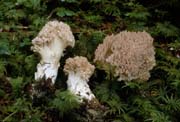 Steve Trudell |
96b Tips red or orange or a shade browner; not soon losing color; spores striate or not
................................................................................97
97a Stipe contents not gelatinous; branches pale orange and tips light orange or a shade more brown; (flesh of base slowly - ½ hour - and weakly amyloid; spores striate, length averages 13.5 μm; basidia clamped)
................................................................................R. botrytis var. aurantiiramosa
| This variety differs from R botrytis var. botrytis (95b) by presence of light orange coloration in tips and branches. | R. botrytis var. aurantiiramosa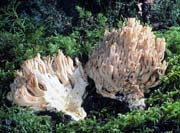 Kit Scates Barnhart |
97b Flesh of stipe gelatinous or rubbery; branches white to cream and tips red to orange; (flesh of base not amyloid; spores not striate, length averages 8.5 μm; basidia not clamped)
................................................................................R. botrytoides
(See description at Key Entry 47a)
98a (1a) Usually growing directly on wood; may be from buried wood or decayed wood; (spores not echinulate)
................................................................................112
98b Growing on duff (needles, leaves, cones, twigs, etc.); (spores echinulate, smooth, or warty)
................................................................................99
99a Odor neither musty aromatic nor of anise (but may have strong sweet odor when dried)
................................................................................101
99b Odor distinct when mature, musty to aromatic, or of anise
................................................................................100
100a Odor musty to aromatic but not of anise; taste very musty, agaricoid, strong; tips milk white; branches white to cream; on conifer duff, especially pine
................................................................................R. gracilis
| COLOR: tips and branches as above darkening in age; base off-white when young, pale ochre, pale orange to pale ochraceous cinnamon later. FLESH: as above; white (composed of thin-walled generative hyphae and cyanophilic thick-walled skeletal hyphae). FORM: small, 2.5 cm H x 2 cm W; stipe single, slender 3 mm H x 2 mm W, with a distinct felty white basal tomentum and rhizomorphic strands; branching about 5 times from the stem; tips pointed. HABITAT: In humus or soil associated with true Firs, Douglas Fir, and Western Hemlock, fall. INEDIBLE. SPORES: delicately warted, 5.5-7.1 x 3.3-4.4 μm, Em 1.65, Lm 6.02 (Castellano et al 1999: 5-6.5 x 3.5-4μm, Lm 5.3; clamp connections common). NOTE: A unique feature is strongly cyanophilous walls of skeletal hyphae in contrast the pale background of generative hyphae. R. rainierensis (100b) is stouter and taller with larger spores. | Ramaria gracilis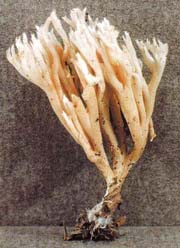 C D Marr |
100b Odor faint of anise when mature; taste bitter; yellowish-white when young; on humus associated with firs and hemlock
................................................................................R. rainierensis
COLOR: as above, becoming grayish orange in maturity; tips paler. FLESH: Orange-white to brown; taste bitter; odor negligible young, resembling anise in older specimens (stem with both thin-walled generative hyphae and thick-walled noncyanophilic skeletal hyphae). FORM: Small, 2-8 cm H x 0.4-7 cm W; base single, slender, 0.5-3.5 x 0.2-1 cm with felty basal tomentum and a few white rhizomorphic strands; tips pointed and appearing somewhat cristate (multiple short apices). HABITAT: In humus or soil associated with true Firs, Douglas Fir, and Western Hemlock. INEDIBLE. SPORES: with a prominent lateral apiculus 1 x 1.5 μm; 8.1-11.1 x 4.4-5.9 μm, Em 1.89, Lm 9.5 (Castellano et al 1999: 7-10 x 4.5-6 μm, Lm 8.5); with ornamented inflated clamps; rhizomorphs dimitic.
101a (99a) Not bruising or bruising brown to brunnescent
................................................................................104
101b Bruising dull to deep green or blue-green
................................................................................102
102a Rhizomorphic strands delicate, inconspicuous; conspicuous snow-white basal tomentum below substrate level that remains white on handling and drying; (average length of spores 9.5 μm)
................................................................................R. glaucoaromatica
COLOR: tips yellow to cream, branches greenish-ochraceous when fresh, ochraceous olive in age; staining intense blue-green; base snow white even after drying. FORM: 15 cm H x 5 cm W; base cottony; HABITAT: in duff under conifers. INEDIBLE. SPORES: with spines up to 1 μm, 8.2-11.1 x (4.1-) 4.4-5.5 μm, Em 2.05, Lm 9.5. NOTE: R. abietina (103a) is smaller with smaller spores and less conspicuous basal tomentum.
102b Rhizomorphic strands snow-white, distinct, felty, not bruising or bruising brown; (average length of spores <8.5 μm)
................................................................................103
103a Rhizomorphic not bruising; stipe not bruising; branches generally some shade of ochre quickly bruising blue-green; (average length of spores 8.2 μm)
................................................................................R. abietina
| COLOR: Tips and branches dingy olive yellow, bruising dull to deep green; base like branches except where covered by white cottony fuzz. FLESH: Similar; texture leathery; taste bitter; odor earthy. FORM: Small, 2-5 cm H x 1-3 cm W; base distinct, usually short and slender, 0.5-1.5 cm H x 0.1-0.3 cm W, with distinct wooly mat beneath and surrounding it on the duff; branching pattern usual; tips +/- pointed. HABITAT: On conifer debris, rare but scattered throughout conifer forests spring and fall. EDIBILITY: unknown. SPORES: warts or rounded spines <1 μm long, (5.5-) 7.0-9.0 (-11) x (3.3-) 3.7-4.5 (-4.8) μm, Em 1.92, Lm 8.2. Basidia clamped. NOTE: Resembles R. eumorpha (110b) and R. curta (111a) which both lack green tones. | R. abietina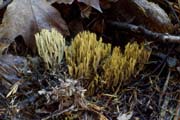 Steve Trudell |
103b Rhizomorphic strands snow-white, bruising brown in some areas; stipe bruising red-brown where handled but displaying blue-green stains; branches with olive-brown coloration but not obviously staining; (spores ~ 6.6 μm)
................................................................................R. mutabilis
(see description under Key Entry 106a).
104a (101a) Not bruising
................................................................................108
104b Bruising brown to brunnescent
................................................................................105
105a Rhizomorphs ill-defined; hyaline rhizomorphs; (spores warty)
................................................................................R. suecica
| COLOR: Tips white when young to pinkish cinnamon when mature; branches and stipe orange-white to pallid ochre to pinkish ochre when fresh, cinnamon when old; sometimes with grayish-orange to brick red bruises or stains on the lower branches. FLESH: taste mildly acrid or bitter; odor faintly spicy or fragrant; (monomitic, thin-walled hyaline rhizomorphs). FORM: Up to 7 cm tall; usually stipitate, but often branched from base; tips somewhat stout, acute; with litter-binding basal mat. HABITAT: On litter in cool coniferous northern temperate forests, August through October. INEDIBLE. SPORES: thin-walled with coarse scattered warts, 8.1-10.4 x 3.7-5.2 μm, Em 2.10, Lm 9.0; inflated clamps up to 15μm broad. NOTE: Macroscopically similar to R. rainierensis but rhizomorphic strands of R. suecica have abundant unornamented inflated clamps while R. rainierensis (100b) clamps are not so abundant and are heavily ornamented. | R. suecica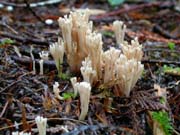 R Exeter 2003-35b |
105b Rhizomorphic strands distinctive, pure white; (spores echinulate)
................................................................................106
106a Branches olive-brown to yellowish olive-brown; tips creamy yellow green to ochraceous olive; stipe sometimes with a distinct greenish coloration; medium size; somewhat spindle-shaped
................................................................................R. mutabilis
COLOR: Branches and tips above; base white below basal mycelium, brown to olive-brown above, occasionally with greenish coloration, bruising reddish-brown; white rhizomorphs. FORM: Medium, 16 cm H x 10 cm W; massive rhizomorphs. HABITAT: on duff in coniferous forests. EDIBILITY: Unknown. SPORES: Spines up to 0.6 μm, 5.5-7.5 x 3.3-4.1 μm, Em 1.75; Lm 6.53. Clamped. NOTE: Unlike R. abietina (103a), the branches do not stain blue-green when handled and the spores are smaller. If growing on wood or woody duff, R. mutabilis is larger and more congested than described here.
106b Branches deep ochre to honey brown lacking olive to greenish tones; tips concolor with branches or rarely white to silvery; stipe snow white, brown where handled
................................................................................107
107a Average spore length ~7.5 μm
................................................................................R. incognita
COLOR: Branches deep ochre to honey brown when fresh, drying dull orange brown; tips whitish to concolorous with branches; base snow white when fresh and dry, bruising brunnescent on handling; white rhizomorphs. FORM: Small, 5 cm H x 3 cm W; rhizomorphs substantial to 2 cm long. INEDIBLE. SPORES: Echinulate, 6-8.6 x 3.3-4.5 μm, Em 1.95, Lm 7.45; clamps present. NOTE: in general appearance very similar to R. argentea (107b).
107b Average spore length ~6.3 μm
................................................................................R. argentea
COLOR: Stipe snow white, bruising brown; branches honey color to moderately olivaceous tan; apices becoming whitish when dry. FORM: slender (up to 7.5 x 5 cm); stipe single to complex; branches irregular and usually highly congested; apices irregular and congested, becoming flattened to mitten-shaped in age. HABITAT: on humus or woody debris in coniferous forests; reported from California and Idaho. INEDIBLE. SPORES: ellipsoid to tear-drop shaped; hilar appendix obscure, densely scattered narrowly rounded spores 4.5-8.0 x 3.0-4.5 µm, Em 1.73, Lm 6.3. NOTE: The white tips distinguish this species from the similar R. abietina (103a), R. eumorpha (110b), and R. curta (111).
108a (104a) Rhizomorphic strands ill-defined, not extensive, when dried turning pale lemon yellow in 10% KOH; (spores with warts)
................................................................................R. suecica
(see description under Key Entry 105a)
108b Rhizomorphic strands not yellowing in 10% KOH; (spores echinulate)
................................................................................109
109a Rhizomorphs white
................................................................................111
109b Rhizomorphs off-white to cream colored
................................................................................110
110a Fruit bodies very small, much-branched, open, delicate, honey-yellow with green-olive tones in age; tips always paler than branches; copious off-white long slender rhizomorphs; (spores with sparse small sharp presumably non-cyanophilous prickles (up to 0.3 μm), average length < 5 μm long)
................................................................................R. myceliosa
| COLOR: Tips at first paler than branches then concolorous chamois to honey yellow, olivaceous in age; off-white rhizomorphs. FORM: Small, 5 cm H x 3.5 cm W; rhizomorphs copious, long, stringy. HABITAT: On conifer litter. INEDIBLE. SPORES: Spines up to 0.3 μm; 4.4-5.7 x 3.3-4.1 μm, Em 1.65, Lm 6.53; clamped. NOTE: R. curta (111a) is similar but has shorter spores. | Ramaria myceliosa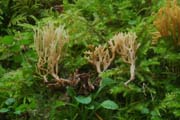 A and O Ceska |
110b Fruit bodies small to medium, branches congested, light ochre and non-greening; off-white to yellow rhizomorphs in a yellowish cob-webby basal mat; (spores with numerous short (up to 1 μm) cyanophilous spines, average length >7 μm long)
................................................................................R. eumorpha
| COLOR: Branches yellow ocher when young, darker and duller when mature (clay colored); tips buff yellow when young, aging cream buff to honey colored; base off-white to pale yellow in region of basal tomentum, color of branches above; rhizomorphs yellowish-white to pale yellow, (ephemerally bright yellow in 15% KOH). FLESH: Paler, texture leathery; taste mild; odor faintly earthy. FORM: 2.5-7 cm H x 1.5-3.5 cm W; stipe single, slender, 1-3 x 0.3 cm, with a conspicuous white or creamy white basal mat of tomentum; branching pattern usual; tips +/- pointed. HABITAT: In needle duff under Western Hemlock and other conifers as well as Beech and Oaks, fall. EDIBILITY: Unknown. SPORES: with spines 0.25-1.5 μm tall, 6.3-10 x 3.3-4.8 μm, Em 1.92, Lm 7.8. Basidia clamped. | R. eumorpha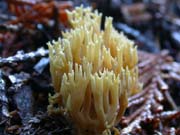 R Exeter 2002-22a |
111a (109a) Rhizomorphs few, slender and stringy, white, felty; congested cream to yellow branches with pale tips; (very short spores average ~ 4.4 μm long with sparse very fine cyanophilous spines)
................................................................................R. curta
| COLOR: Branches yellow-ochre; tips pale when fresh, lighter than branches when dry; base covered with white basal tomentum below, colored like branches above. FORM: Small, 3 cm H x 1.5 cm W; short, slender, discrete base (0.5 cm x 0.4 cm). HABITAT: Under Pines. INEDIBLE. SPORES: With sparsely scattered very fine spines or small ridges, 4.2-5.5 x 2.8-3.5 μm, Em 1.48, Lm 4.4; clamps present. NOTE: The extremely small spores distinguish R. curta (syn. R. myceliosa v. microspora) from the otherwise similar species R. abietina (103a) and R. eumorpha (110b). | R. curta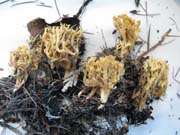 Michael Beug |
111b Rhizomorphs snow white, usually flattened, somewhat mealy, quickly browning in 10% KOH; congested pale olivaceous to honey color non-greening branches with white tips; (spores average 6.3 μm long with densely scattered cyanophilous spines up to 1.2 μm long)
................................................................................R. argentea
(see description under Key Entry 107b).
112a (98a) Bruising green, brown, red-brown, wine-red
................................................................................115
112b Not bruising
................................................................................113
113a Branches pinkish buff, pale pinkish cinnamon; tips white to pale cream; base white with copious white mycelia
................................................................................R. rubella f. blanda
| COLOR: branches pink-tan, pale pink-cinnamon, pale winy cinnamon, tips often lighter; base white. FLESH: White, tough; taste acrid; odor indistinct. FORM: Up to 8 cm H x up to 5.5 cm W; short stem 1 cm thick, almost branched from base; branches often flattened, especially at axils, branching somewhat antler-like; tips narrowly to broadly rounded. HABITAT: on wood in conifer forests. INEDIBLE. SPORES: 6.3-8.1 x 4.4-5.9 μm, Em 1.45, Lm 7.14; with scattered prominent warts or meandering ridges; apiculus prominent over 1 μm long, eccentric. Basidia clamps present. NOTE: see also R. rubella f. rubella (116a) which has white rhizomorphs that turn bright pink in 10% KOH; f. blanda rhizomorphs do not turn pink in 10% KOH. | R. rubella f. blanda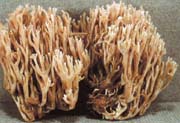 C D Marr |
113b Branches dull ochraceous to tan, darkening with age; tips pale tan to ocher-tan but not yellow or greenish yellow; base deep cinnamon to avellaneous; with or without green coloration at branch axils or tips or stipe base
.........varieties of R. concolor
................................................................................114
GENERAL DESCRIPTION FOR R. concolor VARIETIES:
COLOR: Tips pale tan to ocher-tan, not yellow or greenish-yellow; branches ochraceous to tan becoming darker in age, branch axils or tips greenish in form tsugina; base cinnamon when fresh, becoming violaceous to ruddy in age, (deep chocolate brown in form fumida - but f. fumida is known only from NE North America); rhizomorphic strands white. FLESH: Taste in various varieties mildly bitter and weakly astringent (form marrii) or mildly acrid; Odor aromatic and strong of anise to indistinct and weakly of anise in form marrii. FORM: Small to medium-small, 4-14 cm H x 3-10 cm W; Often branched from base; branches vary with form from lax and open to erect and crowded. HABITAT: Lignicolous but may fruit in humus under hardwoods and conifers, generally fall, sometimes spring. INEDIBLE. SPORES: 7.8-10 x 3.7-4.8 μm, Em 1.92, Lm 8.06; thin-walled cyanophilic, with scattered low warts and a prominent eccentric apiculus; clamps present.
114a Branches erect, often crowded, not lax and open
................................................................................R. concolor f. concolor
| Color and spore size conforms to species description (see Key Entry 113b). The stipe is deep cinnamon to avellaneous, not deep chocolate brown; form of branches and tips as above. HABITAT: On rotten wood, usually deciduous but sometimes conifers. NOTE: R. concolor has creamy, tan or buffy ochre branches and tips while R. stricta (118a) has yellow to citron yellow branch tips but are otherwise very similar. | R. concolor f. concolor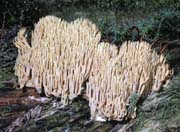 Kit Scates Barnhart |
114b Branches open, lax, curved ascending
................................................................................ R. concolor f. marrii
| General color and spores size conforms to species description (see Key Entry 113b). Characterized by the distinct form as above and the white rhizomorphs arising from a mycelial mat. The taste is bitter and a bit astringent but not acrid and the odor is only weakly of anise. Reported from decaying deciduous wood under western red cedar, rare. | R. concolor f. marrii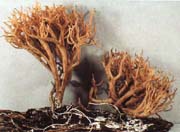 C D Marr |
115a (112a) Spores smooth
................................................................................Lentaria pinicola
| COLOR: Tips pale yellow when young, aging same as branches; branches variable from light yellow to pale tan or bronze, any part bruising darker brown with handling or aging; stem when present similar or browner. FLESH: Paler; texture leathery; taste slightly bitter; odor as above. FORM: Small, 1.5-7.5 cm H, arising from white rhizomorphs ("rootlets") up to 2 mm in diameter and surrounded by white cottony threads; usually clustered and stem not visible; occasionally stem present, single, slender; branching pattern usual; tips pointed or toothed. HABITAT: Usually on rotting coniferous wood, often smaller pieces, fall. INEDIBLE. SPORES: 8-12 x 4-6 μm; hyphae clamped; rhizomorphic strands monomitic. | Lentaria pinicola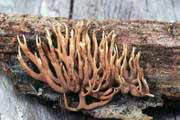 Michael Beug |
115b Spores warted or ridged
................................................................................116
116a Rhizomorphs turn bright pink in 10% KOH; branches pinkish
................................................................................R. rubella f. rubella
| COLOR: branches pale red or dull violaceus rose when young, aging buff pink to grayish red, somewhat vinescent when handled; base whitish below where covered by white cottony fuzz to hair brown upward aging dark brownish drab. FLESH: paler; texture rubbery-leathery; taste mild to acrid; odor not distinctive to musty sweet. FORM: Small, sometime broad; 3-10 cm H x 0.5-7 cm W; stem variable, usually missing or branched from base, when present single to several, slender to stout; branches numerous, often flattened in upper parts; tips +/- pointed. HABITAT: On decaying hardwood or conifer wood, fall. EDIBILITY: Uncertain. SPORES: warty; 6.3-9.5 x 4.1-5.5 μm, Em 1.75, Lm 7.5; dimitic rhizomorphic strands with inflated clamp connections up to 35 μm diameter. | R. rubella f. rubella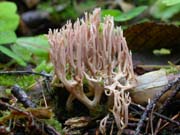 R Exeter 2004-73 |
116b Rhizomorphs turn yellow or brown or do not react to 10% KOH; branches not pinkish
................................................................................117
117a Branch tips light cinnamon, darkening at maturity, no hint of green; branches slowly bruise and age red-brown
................................................................................R. apiculata var. brunnea
| COLOR: Tips light cinnamon; branches cinnamon where fertile, pinkish cinnamon or darker where sterile; base dull brown to color of the branches, occasionally with white basal tomentum. FLESH: Taste mildly acrid to astringent. FORM: Small, up to 8 cm H x 5 cm W; branches as above; arising from copious basal tomentum almost devoid of rhizomorphic strands. HABITAT: On very rotten wood, old sawdust. INEDIBLE. SPORES: warty, 9.2-11.0 x 3.8-5.0, Em 2.17, Lm 9.8; clamps present. Monomitic rhizomorphs. NOTE: The elliptical spores readily separate this species from other members of Lentoramia, like R. rubella (116a), which have broadly ovoid spores. | R. apiculata var. brunnea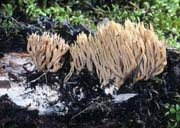 Kit Scates Barnhart |
117b Branch tips light yellow-green, green or bruise green, branches and/or stipe bruising brown or red-brown
................................................................................118
118a Branches erect, flattened, parallel; tips light yellow or greenish yellow; all parts bruising light brown
................................................................................Ramaria stricta
| COLOR: Tips and a short distance downward light yellow to light greenish yellow; branches light brown; stem brown except where covered by white cottony fuzz; bruising as above. FLESH: paler, texture leathery; taste bitter; odor strongly of anise. FORM: Small to medium, +/- bushy; 5-10 cm H x 2-7 cm W; stem varying from absent to single and distinct, arising from white mat of mycelial threads, sometimes with rhizomorphs up to 2 mm diameter; branches as above; tips pointed. HABITAT: usually on rotting conifer wood, fall. INEDIBLE. SPORES: warty, 7-10 x 3.5-5 μm; hyphae clamped; rhizomorphs dimitic with numerous skeletal hyphae. | R. stricta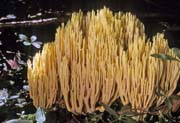 Kit Scates Barnhart |
118b Branches not distinctively erect and parallel; tips green or bruise green; branches bruise red-brown
................................................................................119
119a Small, bushy brownish-orange coral with pale green branch tips and branch axils; branches bruising strongly red-brown; stipe +/- absent, major branches few, stout, vinaceous cinnamon or red-brown; on rotting hemlock; rare
................................................................................R. tsugina
COLOR: Tips creamy yellow, sometimes with greenish coloration; branches as above; rhizomorphic strands white. FORM: Up to 8 cm tall by 5 cm W, arising from a small basal tomentum with a small tangle of slender rhizomorphs; base and branches as above; tips up to 4 mm long. HABITAT: On rotted Western Hemlock wood. INEDIBLE. SPORES: 7.0-9.3 X 3.5-4.2 mm, Em 1.93, Lm 9.11, thin-walled cyanophilic with scattered low warts; clamps present. Rhizomorphic strands dimitic. NOTE: R. apiculata (117a, 119b) can be distinguished by its monomitic rhizomorphs and slightly longer spores.
119b Small to medium bushy tan to red-brown coral with yellow-green to malachite green tips that quickly darken when cut; branches bruise red-brown; base white to cream or some shade of green
................................................................................R. apiculata var. apiculata
| COLOR: Tips green or bluish-green, sometimes colored like branches when green coloring occurs in forks or on base; branches pale orangish-brown, aging or bruising darker orangish brown; base similar except where covered by white cottony fuzz. FLESH: paler, texture leathery; taste mildly acrid to bitter; odor none. FORM: Small to medium, mostly less than 14 cm H x 10 cm W; shape as above; tips flattened and toothed when young, pointed when mature. HABITAT: Usually on rotting coniferous wood, fall. INEDIBLE. SPORES: warty, 8.5-11 x 4.1-5.2 μm, Em 2.02, Lm 9.66; hyphae clamped. Rhizomorphic strands monomitic. | R. apiculata var. apiculata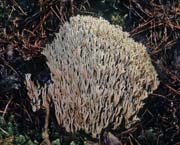 Kit Scates Barnhart |
| abietina | 103a |
| acrisiccescens | 83b |
| amyloidea | 6a |
| apiculata var. apiculata | 119b |
| apiculata var. brunnea | 117a |
| araiospora var. araiospora | 75a |
| araiospora var. rubella | 75b |
| argentea | 107b |
| armeniaca | 27a |
| aurantiisiccescens | 23b |
| botrytis var. botrytis | 95b |
| botrytis var. aurantiiramosa | 97a |
| botrytoides | 47a |
| cartilaginea | 53c |
| caulifloriformis | 34a |
| celerivirescens | 7a |
| concolor | 113b |
| concolor f. concolor | 114a |
| concolor f. marrii | 114b |
| conjunctipes var. sparsiramosa | 51a |
| conjunctipes var. tsugensis | 51b |
| coulterae | 5a |
| curta | 111a |
| cyaneigranosa var. cyaneigranosa | 74a |
| cyaneigranosa var. elongata | 73a |
| cyaneigranosa var. persicina | 68a |
| cystidiophora var. anisata | 66b |
| cystidiophora var. citronella | 13b |
| cystidiophora var. cystidiophora | 53a |
| cystidiophora var. fabiolens | 45a |
| cystidiophora var. maculans | 14b |
| distinctissima var. americana | 64b |
| eumorpha | 110b |
| flavigelatinosa var. carnisalmonea | 43b |
| flavigelatinosa var. flavigelatinosa | 46a |
| flavigelatinosa var. fragrans | 49a |
| flavigelatinosa var. megalospora | 43a |
| flavobrunnescens var. aromatica | 58a |
| foetida | 21a |
| formosa | 22a |
| fumosiavellanea | 77a |
| gelatiniaurantia var. gelatiniaurantia | 41a |
| gelatiniaurantia var. violeitingens | 46b |
| gelatinosa var. oregonensis | 39a |
| glaucoaromatica | 102a |
| gracilis | 100a |
| hilaris var. olympiana | 42a |
| incognita | 107a |
| largentii | 64a |
| leptoformosa | 70a |
| longispora | 63a |
| maculatipes | 18b |
| magnipes var. albidior | 32b |
| magnipes var. magnipes | 32a |
| marrii | 83a |
| mutabilis | 106a |
| myceliosa | 110a |
| pinicola, Lentaria | 115a |
| purpurissima var. purpurissima | 78b |
| rainierensis | 100b |
| rasilispora var. rasilispora | 30a |
| rasilispora var. scatesiana | 30b |
| rasilisporoides | 34b |
| raveneliana | 50a |
| rubella f. blanda | 113a |
| rubella f. rubella | 116a |
| rubiginosa | 17b |
| rubribrunnescens | 18a |
| rubricarnata var. pallida | 28b |
| rubricarnata var. rubricarnata | 66a |
| rubricarnata var. verna | 28a |
| rubrievanescens | 96a |
| rubripermanens | 95a |
| sandaracina var. chondrobasis | 40a |
| sandaracina var. euosma | 40b |
| sandaracina var. sandaracina | 52a |
| spinulosa var. diminutiva | 23a |
| stricta | 118a |
| stuntzii | 71a |
| subviolacea | 89a |
| suecica | 105a |
| synaptopoda | 13a |
| testaceoflava | 81a |
| thiersii | 20a |
| tsugina | 119a |
| velocimutans | 7b |
| verlotensis | 44a |
| violaceibrunnea | 78a |
| vinosimaculans | 17a |
- END -