John Plischke
The following key to the Pezizaceae includes the genera Pachyella, Peziza, Plicaria and Sarcosphaera and only those species that are reported to have occurred in the Pacific Northwest. The key was composed from material gathered from various publications and books and not from original research. I greatly appreciate the help received from Dr. Donald H. Pfister, Harvard University; Dr. Edmund E. Tylutki, University of Idaho; Dr. Joseph Ammirati, University of Washington; and Kit Scates-Barnhart, in the form of reprints, publications, slides, and encouragement.
The family of Pezizaceae, well represented in this area, has fleshy to brittle fruit bodies, cup- to disc-shaped with the spores produced on the upper surface of the disc. Although basically sessile they sometimes have a short stipe or pseudostipe. Field characteristics are variable and fruit bodies are so similar in size, shape and color that final identification must be made with the microscope.
The edibility of most of this family is untested except in the case of Sarcosphaera crassa, which is reported to be poisonous to some people. I have sampled it creamed and pickled and find it to be completely tasteless both ways. While some are reported to be edible, most of the species are too fragile to be considered as a food source, therefore edibility will not be noted in this key.
Although often listed under Psilopezia, Pachyella is separable from the genus by the amyloid reaction of the asci of Pachyella.
Pachyella is separable from Peziza in that Pachyella has gelatinous tissue in which hyphoidal hairs are imbedded. Further separation can be found in the diffusely amyloid ascus of Pachyella, whereas the amyloid reaction of Peziza is restricted to the apex of the ascus in the form of a ring. Because of its spherical ascospores, Plicaria separates easily from Pachyella, Peziza, and Sarcosphaera, all of which have ellipsoid ascospores.
Phylogenetic relationships in the Pezizaceae have been investigated in the last few years by molecular techniques (K. Hansen et al. 2001, 2002, 2005). The family retains its integrity for the most part, but some Peziza species appear to be more closely related to species in other genera within the family than they are to some other Peziza species. To reflect this, either more species would need to be drawn into Peziza, or Peziza will need to be broken up into a number of genera.Peziza cerea is considered a synonym of P. varia. Peziza repanda is considered a doubtful name, so we use Peziza 'repanda' to indicate what we have been calling Peziza repanda in the past.
K. Hansen et al. (2002) comment about the use of the Peziza repanda concept, "Since the name lacks a type specimen and has been used inconsistently it is best treated as of uncertain application.". This is elaborated as follows: Persoon described the habitat as "in sylvaticis ad terram" (in the woods on the ground). Fries used the name for a species on old trunks, primarily of Fagus (beech), but also included blackened soil as the substrate. Some authors have followed one and some the other, and still others have used the name for a species occurring on soil and only exceptionally on wood, and in all cases the spores are smooth and are in the size range for Peziza varia.
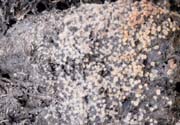
| Iodophanus carneus is a species presently considered to be in this family, but usually does not exceed 1 mm in size. It is pale pink to salmon-colored and grows on dung, rotting vegetable matter, including textiles and rope, and on soil, throughout the year. Peziza vacinii, which does not reach 1 cm in size, has been found near Corvallis Oregon by Nancy Smith-Weber. Marcelleina persoonii or something close to it was also found near Corvallis Oregon by Nancy Smith-Weber. It is also a minute species, and it figures in work on Peziza taxonomy(1). A variety of truffles are included in Pezizaceae(2) but bring no confusion to the identification of the cup fungi. The name Peziza brunneovinosa is mentioned by Seaver with a description similar to that used here. Pfister (1982) gives the revised name for this taxon as Peziza michelii (Boud.) Dennis. Peziza sylvestris (Boud.) Sacc. & Trotter is usually considered a synonym of Peziza arvernensis Boud. | Iodophanus carneus John Plischke |
References were not included in the initial key, but the main ones have been added in this update.
Peziza oliviae J.L. Frank was added, changing lead 4.
1a Fruit body very large, up to 25 cm high, becoming subglobose, elongated, and convoluted like Gyromitra but sessile
................................................................................Peziza proteana var. sparassoides
| FRUIT BODY sessile, up to 25 cm high, convoluted like Gyromitra, whitish becoming flushed with pink, lilac or pale ochraceous or orangish tints with somewhat darker edges when dried. HABITAT on the ground, woody debris or sandy soil, October. SPORES 9-11 x 4-6 um, ellipsoid, biguttulate, minutely warted. | Peziza proteana var. sparassoides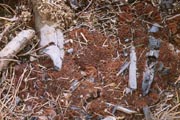 Michael Beug |
1b Fruit body under 15 cm and not convoluted like Gyromitra
................................................................................2
2a Fruit body buried in duff or sand when young, splitting in a star-like manner at maturity
................................................................................3
2b Fruit body not buried in duff or sand when young and not spitting in a star-like manner
................................................................................4
3a Habitat coastal sands
................................................................................Peziza ammophila
FRUIT BODY 1-2 cm, cup-shaped and partially sunken in sand, finally splitting in star-like manner and flattening. EXTERIOR pale ochraceous. INTERIOR dark brown. STIPE pseudostipe of sand grains firmly bound together by mycelium, but sometimes no stipe at all. HABITAT widespread on coastal sands, September to December. SPORES 14-16 x 10 um, ellipsoid, smooth.
3b Habitat duff
................................................................................Sarcosphaera coronaria
| FRUIT BODY 15cm, at first a hollow subterranean ball, breaking and becoming cup-shaped with split margin, somewhat star-shaped at maturity, sessile or with a short stipe. EXTERIOR whitish becoming cream colored at the base, finely scurfy. INTERIOR violet, smooth. HABITAT single to gregarious on soil, duff or litter in mixed woods in the spring and early summer. Common. SPORES 14-22 x 7-9 um, ellipsoid but with somewhat truncate ends, smooth or nearly so, biguttulate. | Sarcosphaera coronaria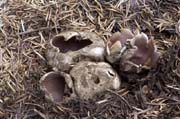 Steve Trudell |
4a (2b) Fruit body hazel to umber (drying black), soft, gelatinous, small (2-10 mm) without stalk, on water soaked wood or debris, may be under flowing water
................................................................................Pachyella babingtonii
FRUIT BODY 0.2-1 cm, humped or cushion-shaped, sessile, soft and gelatinous, translucent, attached at the margin, hazel to umber, drying black. HABITAT gregarious to scattered on water-soaked rotten logs, leaves or woody debris. Often found under flowing water, in the fall. SPORES 17-23 x (9)10-16 um, ellipsoid, thick-walled, smooth or slightly punctate with age, uni- or biguttulate or in some cases indistinct.
4b Fruit body olive to golden brown, 8-40 mm across with stalk 1-10 mm, associated with dead woody debris embedded in stream bottoms or on saturated wood, at the stream surface or on stream banks
................................................................................Pachyella oliviae
FRUIT BODY 0.8-4.0 cm across, olive to golden brown varies from stalked cup or goblet-shape slightly convex disc with short but distinct stalk; margin crenulate; exterior roughened, bald. STEM 0.1-1.0 cm x 0.3-0.7 cm. HABITAT associated with dead woody debris embedded in stream bottoms or on saturated wood, at the stream surface or on stream banks, June through October. SPORES 19.5-24 x 9.5-12 um, elliptic, smooth, without droplets.
4c Fruit body fleshy, not as above
................................................................................5
5a On carbon or burned soil
................................................................................6
5b On rotten wood, duff, soil, sand, or manure
................................................................................14
6a Fruit body entirely white when young
................................................................................Peziza proteana var. proteana
FRUIT BODY 3-6 cm, cup-shaped to expanded and often repand. EXTERIOR entirely white when young, aging with a faint reddish or lilac tint. INTERIOR concave, then plane or convex, white when young but darkening with age to rose, pale lilac or slightly brownish. HABITAT on old moss-covered burned areas. SPORES 12-13 x 5-7 um, ellipsoid, smooth at first then forming minute warts, biguttulate.
6b Fruitbody not entirely white when young
................................................................................7
7a Exterior dark brown; interior blackish
................................................................................8
7b Exterior pale to dark brown, whitish with gray, lilac or purplish tints; interior dark brown, grayish-reddish-brown, pale violet, purple-brown or reddish violet
................................................................................9
8a Interior smooth
................................................................................Plicaria carbonaria
| FRUIT BODY 2 cm, discoid, sessile. EXTERIOR dark brown, interior smooth, blackish, margin splitting. HABITAT gregarious or densely crowded, on burned ground. SPORES 12-16 um wide, globose, hyaline to pale brown ornamented with small warts about 2 um high. | Plicaria carbonaria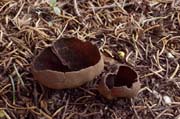 Steve Trudell |
8b Interior rough with small warts
................................................................................Plicaria trachycarpa
FRUIT BODY 2 cm, subglobose, expanding to shallow cup-shaped, sessile. EXTERIOR dark brown, scurfy, margin tending to split, elevate and incurve. INTERIOR rough with small warts, blackish. HABITAT scattered to gregarious on burned soil in spring and fall. Uncommon. SPORES 12-16 um wide, globose, hyaline to pale brown, finely warted, warts about 1 micron high. REMARKS Greatly resembles Plicaria carbonaria which has more prominent spines on the spores.
9a (7b) Fruit body small, under 4 cm
................................................................................10
9b Fruit body medium to large, over 4 cm
................................................................................12
10a Found near snow banks at time of melt
................................................................................Peziza nivalis
FRUIT BODY 1 cm, plane, fragile, drying to thin crust. Dark brown with purplish tints. No color change when bruised. HABITAT single to cespitose on burned ground in mountains at 4,200-5000 feet. SPORES 16-21 x 11-12 um, ellipsoid, smooth or slightly ornamented.
10b Not found near snow banks
................................................................................11
11a Exterior grayish white; young hymenium pale violet to red-violet, quickly aging brown. Rim of fruit body rough
................................................................................Peziza violacea(3)
| FRUIT BODY 3 cm, cup-shaped to expanded, sessile. EXTERIOR pale grayish white, delicately pruinose near margin. INTERIOR pale violet to reddish violet. FLESH thin, pale purple. HABITAT scattered to gregarious on burned soil in spring or summer. Uncommon. SPORES 16-17 x 8-10 um, ellipsoid, smooth, eguttulate. | Peziza violacea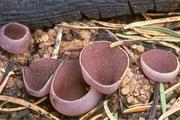 Boleslaw Kuznik |
11b Exterior pale purple, hymenium purple to purple-brown and retaining purple tones. Rim of fruit body splitting but smooth
................................................................................Peziza praetervisa
| FRUIT BODY3 cm, cup-shaped to discoid, sessile. EXTERIOR pale purple, finely scurfy. INTERIOR purple to purple-brown. FLESH thin, mauve. HABITAT scattered to gregarious on burned soil or remains of oldcampfires and on sawdust in spring. SPORES12-14 x 7-8 um, ellipsoid, finely warted, biguttulate. | Peziza praetervisa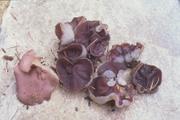 Andrew Parker |
12a (9b) Exterior grayish lilac, interior unevenly colored light grayish-reddish-brown to medium brown near margin
................................................................................Peziza petersii
FRUIT BODY 4-8 cm, cup-shaped to repand. EXTERIOR grayish lilac, smooth to slightly furfuraceous, sessile to stipitate, base translucent. INTERIOR unevenly colored light grayish-reddish-brown to medium brown near margin, convoluted to wrinkled. FLESH thin, gray. HABITAT scattered to clustered on burned ground, under conifers in spruce fir zone, summer and fall. SPORES 10-12 x 5.5-6 um, ellipsoid, finely warted, biguttulate.
12b Exterior light to medium brown or red-brown, interior dark brown
................................................................................13
13a Exterior red-brown or almost white below, margin with coarse blisters
................................................................................Peziza echinispora
| FRUIT BODY 6-8 cm, shallowly cup-shaped, sessile. EXTERIOR red-brown or almost white below with coarse blisters near the conspicuously incurved tooth-like marginwhich tends to split. INTERIOR darkbrown. FLESH thin. HABITAT on burned soil and charcoal,May to October. Common. SPORES 14-18x 7-9.5 um, ellipsoid, finely warted. | Peziza echinispora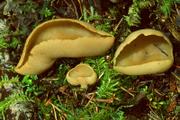 Michael Beug |
13b Exterior medium brown, smooth
................................................................................Plicaria endocarpoides
| FRUIT BODY 7 cm, cup-shaped then flat, sessile. EXTERIOR pale dark brown, smooth. INTERIOR dark brown. FLESH brittle. HABITAT scattered to gregarious on burned soil in the spring. SPORES 8-10 um wide, globose, smooth, with granular contents. | Plicaria endocarpoides.jpg) Michael Wood (MykoWeb) |
14a (5b) On manured soil or dung
................................................................................15
14b On soil, rotten wood, debris or sand
................................................................................16
15a Fruit body up to 2 cm, exterior light brown, granulose, on isolated cow dung
................................................................................Peziza fimeti
FRUIT BODY 2 cm, subglobose becoming expanded. EXTERIOR light brown, sessile or with small stipe, often slightly deformed. INTERIOR concolorous, concave to nearly plane. HABITAT scattered on cow dung in late spring. SPORES 16 x 8 um, ellipsoid.
15b Fruit body 5-8 cm, exterior pale tan with minute wart-like pustules. On manure piles
................................................................................Peziza vesiculosa
| FRUIT BODY 5-8 cm, deep cup-shaped to vesicular, margin at times incurved; sessile. EXTERIOR pale tan with minute wart-like pustules. INTERIOR light yellow-brown, becoming detached at times and forming a blister. FLESH brittle. HABITAT often clustered on dung or manured soil in spring and early summer, or year round as conditions permit. SPORES 18-24 x 10-14 um, ellipsoid, smooth. | Peziza vesiculosa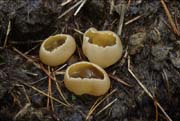 Steve Trudell |
16a (14b) On rotten wood, wood debris or soil with rotten wood
................................................................................17
16b On soil or sand
................................................................................25
17a Exterior pallid bluish gray
................................................................................Pachyella clypeata
FRUIT BODY 8 cm, flattened, attached to substrate at margin, sometimes becoming convolute or in age becoming shallowly cup-shaped. EXTERIOR pallid to glaucous gray. INTERIOR umber to chestnut. FLESH sometimes becoming yellow when broken. HABITAT gregarious to scattered on water-soaked rotten logs and stumps in late summer and fall. SPORES 18-25(28) x 13-16 um, ellipsoid, thin-walled, smooth, biguttulate. Has gelatinous tissues and hyphoid hairs embedded in gel.
17b Exterior another color
................................................................................18
18a Interior dark: dark-brown, orange-brown, dark red-brown or olive-brown
................................................................................19
18b Interior lighter: yellow-brown, tawny or fawn
................................................................................21
19a Fruit body broadly attached at base to water-soaked wood. Outer layer has gelatinous tissue which contains embedded colorless hairs
................................................................................Pachyella adnata
FRUIT BODY 5 cm, flat, sometimes convoluted, appressed, or sometimes becoming shallowly cup-shaped in age. EXTERIOR broadly attached to wood. INTERIOR yellow-brown to red-brown, black when dried. HABITAT gregarious or scattered on rotten, usually water-soaked wood in the fall. SPORES 18-20 x 10-12(14) um, ellipsoid, thin-walled, ornamented with long blunt warts sometimes exceeding 1 um in length, uni- to biguttulate.
19b Fruit body not broadly attached and no gelatinous tissue
................................................................................20
20a Exterior brownish orange, growing on matted white mycelium; fruiting in spring
................................................................................Peziza phyllogena
FRUIT BODY 5 cm, cup-shaped to flat or sometimes eccentric, sessile, on matted or woolly white mycelium. EXTERIOR brownish orange. INTERIOR concolorous, smooth. FLESH brittle. HABITAT on rotting wood or conifer litter, rarely on soil, in late spring and summer. SPORES 17-21 x 8-10 um, ellipsoid with more or less truncate ends, ornamented with small warts, uni- to biguttulate.
20b Exterior reddish brown, no matted white mycelium; fruiting in fall
................................................................................Peziza badia
FRUIT BODY 8 cm, cup-shaped, margin wavy, sessile. EXTERIOR reddish brown, scurfy toward margin. INTERIOR dark brown, smooth. FLESH thin, pale reddish brown. HABITAT scattered to cespitose on soil or humus, sometimes on sandy soil in coniferous woods, mid-summer through fall. SPORES 15-20 x 7-10 um, ellipsoid, rough with short ridges forming an irregular reticulum, biguttulate with one droplet larger than the other.
21a (18b) Fruit body up to 4 cm, exterior smooth and pruinose; flesh yellowish and comparatively thick and watery
................................................................................Peziza ampliata
FRUIT BODY 1-4 cm, cup-shaped, expanding and flattening in age, sessile, margin entire or lobed. EXTERIOR light brown to pale yellowish brown, pruinose. INTERIOR concolorous but a bit darker. FLESH thick, watery and yellowish. HABITAT on very rotten wood or soil containing decayed wood, spring. SPORES 16-21 x 8-11 um, ellipsoid, smooth.
21b Fruit body not combining the above features
................................................................................22
The following species have been separated in this key by variable physical features which when present are distinctive; however, final identification must be made microscopically.
22a Exterior with granular blisters or thick, fine tomentum
................................................................................23
22b Exterior minutely scurfy with dandruff-like flakes
................................................................................24
23a Exterior granular with blisters
................................................................................Peziza varia
| FRUIT BODY 5-6 cm, cup-shaped but soon flattened or convex, often with appearance of a short stipe. EXTERIOR whitish to brownish, pruinose with granular blisters near the often crenulate margin. INTERIOR light gray-brown soon becoming dark gray-brown. FLESH elastic, watery gray to fawn, stratified. HABITAT single to gregarious or crowded on rotting wood, duff or soil year round. SPORES 14-19 x 9-11 um, ellipsoid, smooth or minutely verrucose, eguttulate. Paraphyses moniliform, apex inflated up to 14 um wide. REMARKS This species is separable from other similar species by the moniliform paraphyses. | Peziza varia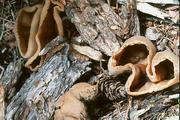 Ben Woo |
23b Exterior finely tomentose
................................................................................Peziza sylvestris
| FRUIT BODY 4-8 cm, cup-shaped, margin wavy, sessile. EXTERIOR whitish to tan, margin yellow and covered with thick fine tomentum. INTERIOR medium brown. HABITAT gregarious inconiferous woods on soil and litter, spring. SPORES 15-20 x 9-10 um, ellipsoid, smooth, or finely verrucose, eguttulate. REMARKS This species, Peziza sylvestris (Boud.) Sacc. & Trotter, is usually considered a synonym of Peziza arvernensis Boud. - I.G. | Peziza sylvestris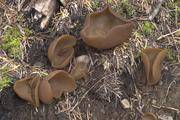 Andrew Parker |
24a (22b) Fruit body up to 12 cm; habitat usually on ground, sawdust or tramped areas
................................................................................Peziza repanda
| FRUIT BODY large, 12 cm, cup-shaped, becoming expanded and undulating, sessile or with stem-like base. EXTERIOR whitish, pruinose. INTERIOR pale brown. FLESH whitish to fawn. HABITAT scattered to clustered on theground in the woods, on tramped areas, on sawdust from spring through fall. SPORES 15-16 x 9-10 um, ellipsoid, smooth, eguttulate. Paraphyses slightly clavate up to 7 um wide at apex. REMARKS see Update 2007 for comments on the name. – I.G. | Peziza repanda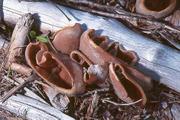 Ben Woo |
24b Fruit body up to 7 cm; habitat on duff, rotting sandbags, between paving stones in damp cellars
................................................................................Peziza cerea
FRUIT BODY 5 cm, cup-shaped, becoming expanded. EXTERIOR white, minutely scurfy. INTERIOR pale ochraceous or yellowish brown. FLESH white, firm. HABITAT on woody debris, on rotting sandbags, on soil between paving stones and in damp cellars, all year. SPORES 14-17 x 8-10 um, ellipsoid, smooth. Paraphyses scarcely clavate, straight. REMARKS This species is now considered a synonym of P. varia. - I.G.
25a (16b) Cut flesh yielding blue or yellow juice or stains
................................................................................26
25b Cut flesh yielding white or watery juice or none
................................................................................27
26a Exterior gray, cut flesh yielding yellow juice or stains
................................................................................Peziza succosa
FRUIT BODY 2-5cm, permanently cup-shaped. EXTERIOR gray, sometimes yellowish at margin, sessile. INTERIOR grayish brown with slight olivaceous tint. FLESH thin, whitish, yielding abundant bright yellow juice. HABITAT gregarious or scattered on ground in woods, July to September. Common. SPORES 17-22 x 9-12 um, ornamented by coarse warts and short ridges, biguttulate. REMARKS Hansen et al.(2005) give this species in a group with P. michelii that yield a yellow juice. – I.G.
26b Exterior bay-brown, cut flesh yielding blue (opalescent) juice
................................................................................Peziza badiofusca
FRUIT BODY 1-1.5cm, soon expanded and flattened. EXTERIOR pale bay-brown, scurfy with a slightly scalloped margin. INTERIOR bay-brown. FLESH broken flesh yielding blue (opalescent) juice. HABITAT on bare ground in woods in fall. Uncommon. SPORES 13-15 x 9-10 um, ellipsoid, usually with one large central guttule, regularly warted.
27a (25b) Exterior white with yellowish margin; interior violaceous
................................................................................Peziza emileia
FRUIT BODY 8-10 cm, cup-shaped to expanded with undulating margin, sessile. EXTERIOR whitish, scurfy, often yellowish toward a somewhat even or lobed margin. INTERIOR from violaceous with yellowish tints to fawn. FLESH thin. HABITAT gregarious or scattered on lawns and in woods, June-October. Uncommon. SPORES 17-22 x 8-11 um, ellipsoid, biguttulate, finely warted.
27b No part of fruit body having violaceous tones
................................................................................28
28a Fruit body dark olive to purplish black
................................................................................Peziza limnaea
FRUIT BODY 4.5 cm, cup-shaped to repand and somewhat convoluted outside. EXTERIOR dark olive becoming purplish in age. INTERIOR concolorous. HABITAT on damp mud in swampy, well-wooded areas, and on muddy banks in deep shade. SPORES 18-22 x 9-10 um, ellipsoid, smooth at first and hyaline then marked with prominent curved warts (curved in the dimension of the spore wall not at right angles to it) with tapering spurs or with interconnecting lines or ridges, uniguttulate or when biguttulate, guttules unequal in size.
28b Fruit body white to buff, fawn, yellow-brown, bay-brown, or dark brown
................................................................................29
29a On sterilized greenhouse soil
................................................................................Peziza ostracoderma
FRUIT BODY 0.8cm, cup-shaped to repand. EXTERIOR pale brownish to umber, furfuraceous, translucent, margin often splitting. INTERIOR concolorous but darker. HABITAT on sterilized greenhouse soil, October. SPORES 10-13 x 6-8 um, ellipsoid, hyaline, biguttulate.
29b On bare ground or damp soil
................................................................................30
30a Fruit body with concentric rings of depressions like ripples
................................................................................Peziza concentrica
FRUIT BODY 2-4 cm, subglobose, becoming widely expanded. EXTERIOR pale brownish with concentric rings of depressions and elevations which resemble ripples. INTERIOR concave to nearly plane, pale to medium brown or sometimes with olivaceous tints, with same concentric rings as exterior. HABITAT on ground in early spring. SPORES 18-20 x 10 um, ellipsoid, hyaline or subhyaline, smooth.
30b Fruitbody without concentric rings of depressions
................................................................................31
31a Fruit body under 3 cm; exterior or interior dark brown or red-brown
................................................................................32
31b Fruit body over 3 cm; exterior or interior whitish, yellow-brown, orangish brown or if dark brown, over 3 cm
................................................................................35
32a Exterior dark brown, interior blackish brown sometimes with olive or greenish tints
................................................................................Peziza brunneoatra
| FRUIT BODY 1-2 cm, shallow cup-shaped then flattened with a slightly raised even margin, sessile. EXTERIOR reddish brown, smooth. INTERIOR blackish brown with greenish tints. FLESH thick and red-brown. HABITAT scattered to gregarious on damp ground, June to October. SPORES 20-32 x 10-11 um, ellipsoid, hyaline, with large warts that stain blue and forming an incomplete reticulum, uni- to biguttulate. Note that this spore size was recorded by D. Pfister. Dennis reports spore size at 14-18 x 9-11 um. [Note also that it may not be coincidental that Seaver reports spores as 20-22 x 10-11 um. - I.G.] | Peziza brunneoatra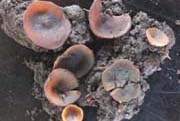 A and O Ceska |
32b Exterior dark brown or red-brown with no olive or green tints
................................................................................33
33a Exterior pale brownish-wine; interior concolorous but deeper color
................................................................................Peziza brunneovinosa
FRUIT BODY 0.5-1.2 cm, cup-shaped to flat. EXTERIOR pale brownish-wine or ochraceous, margin irregular. INTERIOR deep brownish wine. HABITAT cespitose on soil or sand, spring and fall. SPORES 16-20 x 10 um, ellipsoid, smooth, biguttulate.
33b Exterior or interior with no wine color
................................................................................34
34a Fruit body entirely dark brown, short white stipe disappearing at maturity
................................................................................Peziza spissa
FRUIT BODY 1-2 cm, shallow cup-shaped, flattening in age, short stem-like base disappears at maturity. EXTERIOR white on short stipe. INTERIOR dark brown. HABITAT gregarious on damp soil. SPORES 25-27 x 12-14 um, ellipsoid, usually biguttulate and often with several smaller guttules, smooth, becoming very minutely sculptured.
34b Exterior dark brown; interior pale brown
................................................................................Peziza sterigmatizans
FRUIT BODY 2 cm, shallow cup-shaped, becoming expanded to repand, sessile. EXTERIOR dark brown. INTERIOR paler. FLESH thin, whitish. HABITAT on wet ground, fall to winter. Uncommon. SPORES 17-20(23) x 9-10(13) um, ellipsoid, smooth, eguttulate. Paraphyses thick, closely septate, straight but commonly forked near the apex which is clavate. REMARKS The thick branched paraphyses appear characteristic of this species.
35a (31b) Exterior pustulate or finely tomentose
................................................................................36
35b Exterior smooth or minutely scurfy
................................................................................37
36a Exterior with granular blisters (see 23a)
................................................................................Peziza varia
36b Exterior finely tomentose (see 23b)
................................................................................Peziza sylvestris
37a (35b) Exterior red-brown or orange-brown
................................................................................38
37b Exterior whitish to buff, yellow-brown or fawn
................................................................................39
38a Exterior and interior brownish orange; fruiting in spring (see 20a)
................................................................................Peziza phyllogena
38b Exterior red-brown, interior dark brown; fruiting in fall (see 20b)
................................................................................Peziza badia
39a (37b) Fruit body over 5 cm
................................................................................40
39b Fruit body less than 5 cm
................................................................................41
40a Found in damp cellars
................................................................................Peziza domiciliana
FRUIT BODY 10 cm, concave to repand, becoming irregular, often angular in outline. EXTERIOR whitish, margin sometimes splitting, short stipitate when young. INTERIOR plane or convex, umbilicate, white becoming dingy buff or brownish. HABITAT gregarious, sometimes cespitose, in cellars, caves or greenhouses on moist soil, plaster, cement, sand, gravel, all seasons. SPORES 13-15 x 8-10 um, ellipsoid, hyaline when young, often with two small guttules.
40b Found on ground in the woods, on tramped areas, in sawdust (see 24a)
................................................................................Peziza ‘repanda’
41a (39b) Flesh thin and yellowish yielding white milky juice
................................................................................Peziza michelii
FRUIT BODY 2.5-5 cm, cup-shaped to expanded with a slightly raised even margin, sessile. EXTERIOR fawn, minutely scurfy near margin. INTERIOR reddish brown. FLESH thin, golden yellow, yielding white milk when broken. HABITAT on bare soil in woods, fall. Uncommon. SPORES 13-17 x 7-9 um, ellipsoid, biguttulate, ornamented by well defined low warts. REMARKS Hansen et al. (2005) give this species in a group with P. succosa that yield a yellow juice. – I.G.
41b Flesh variable; juice, if any, not white
................................................................................42
42a Exterior light yellow-brown, smooth; flesh fragile
................................................................................Peziza arvernensis
FRUIT BODY 4 cm, cup-shaped, then expanded to undulating. EXTERIOR pale yellowish brown. INTERIOR paler, almost smooth. FLESH fragile. HABITAT on the ground in woods, May to July. SPORES 17-19 x 9-10 um, finely verrucose, eguttulate.
42b Exterior whitish, minutely scurfy; flesh firm, white (see 24b)
................................................................................Peziza cerea
biguttulate – having two oil drops
cespitose – close together but not joined
clavate – club-shaped
crenulate – scalloped
eguttulate – without oil drops
filiform – threadlike
furfuraceous – covered with variously sized flaky granules
glabrous – smooth
glaucous – appearing frosty
globose – round
guttulate – having oil drops
hyaline – clear or transparent
moniliform – chain-like
paraphyses – sterile cells scattered around the area of the asci in the hymenium
pruinose – appearing as if covered with fine powder
punctate – dotted with points
pustules – small granular spots which look like blisters
repand – having a downward curve
reticulum – connected ridges
septate – with cross walls
stipitate – having a stem
tomentum – a covering of densely matted woolly hairs
truncate – having blunt ends
verrucose – covered with warts
vesicular – with bladder-like cell or cavity
| GENUS AND SPECIES | KEY ENTRIES |
| IODOPHANUS Singer | |
| I. carneus (Pers.) Korf | Update 2007 |
| MARCELLEINA | |
| M. persoonii (H. Crouan & P. Crouan) Brumm. | Update 2007 |
| PACHYELLA | |
| P. adnata (Berk. & M.A. Curtis) Pfister | 19a |
| P. babingtonii (Berk. & Broome) Boud. | 4a |
| P. clypeata (Schwein.) LeGal | 17a |
| PEZIZA | |
| P. ammophila Durieu & Lev. | 3a |
| P. ampliata Pers. ex Pers. | 21a |
| P. arvernensis Boud. | 42a |
| P. badia Pers. ex Merat | 20b |
| P. badiofusca | 26b |
| P. brunneoatra Desm. | 32a |
| P. brunneovinosa | 33a |
| P. badiofusca | 26b |
| P. cerea Sowerby ex Merat | 24b |
| P. concentrica | 30a |
| P. domiciliana Cooke | 40a |
| P. echinispora P. Karst. | 13a |
| P. emileia Cooke | 27a |
| P. fimeti (Fuckel) E.C. Hansen | 15a |
| P. limnaea Maas Geest. | 28a |
| P. michelii (Boud.) Dennis | 41a |
| P. nivalis (R. Heim & L. Remy) M.M. Moser | 10a |
| P. oliviae J.L. Frank | 4b |
| P. ostracoderma Korf | 29a |
| P. petersii Berk. & M.A. Curtis | 12a |
| P. phyllogena Cooke | 20a |
| P. praetervisa Bres. | 11b |
| P. proteana (Boud.) Seaver | 1a, 6a |
| P. 'repanda' Pers. | 24a |
| P. spissa Berk. | 34a |
| P. sterigmatizans W. Phillips | 34b |
| P. succosa Berk. | 26a |
| P. sylvestris (Boud.) Sacc. & Trotter | 23b |
| P. vacinii (Velen.) Svrček | Update 2007 |
| P. varia (Hedw.) Fr. | 23a |
| P. vesiculosa Bull. | 15b |
| P. violacea Pers. | 11a |
| PLICARIA | |
| P. carbonaria (Fuckel) Fuckel | 8a |
| P. endocarpoides (Berk.) Rifai | 13b |
| P. trachycarpa (Curr.) Boud. | 8b |
| SARCOSPHAERA | |
| S. coronaria (Jacq. ex Cooke) Boud. | 3b |
| = Sarcosphaera crassa (Santi) Pouzar | |
| = Sarcosphaera eximia (Durieu & Lev.) Maire |
(1) In molecular data presented by Hansen et al.(2005), Marcelleina appears with Peziza gerardii to be in a sister group to the rest of Pezizaceae. The asci of Marcelleina do not turn blue asci in iodine solutions, a reaction otherwise a chief characteristic of Pezizaceae (shared within Pezizales only by Ascobolaceae).
(2) including Pachyphloeus citrinus, Pachyphloeus thysellii, Hydnobolites californicus, Peziza ellipsospora, and Peziza stuntzii, all of which occur in the Pacific Northwest.
(3) There have been difficulties interpreting P. violacea Pers. and P. praetervisa Bres. According to Pfister (1982), "Peziza praetervisa has lightly ornamented spores as described by Seaver for P. violacea. The spores of P. violacea are completely smooth. Though P. violacea exists in North America, it is infrequently collected. Most collections under that name are P. praetervisa." Peziza praetervisa Bres. in the sense of Dennis is used for this species, as the sense of Bresadola may correspond to Peziza petersii Berk. & Curt. Because of these difficulties the name Peziza subviolacea Svrček has been proposed for P. praetervisa Bres. sensu Dennis. In effect, one view (that of Dennis (1978), Pfister (1982), and Breitenbach & Kränzler (1984) and the one used here) uses the name P. praetervisa Bres. for the commoner species in North America that has finely warted mature spores and P. violacea Pers. for the one with smooth mature spores. The other view uses the name Peziza violacea Pers.:Fr. or Peziza subviolacea Svrček for the commoner species in North America with finely warted spores and Peziza sublilacina Svrček for the one with smooth spores. – I.G.