MORCHELLACEAE in the Pacific Northwest
An Introduction
by Ian Gibson, South Vancouver Island Mycological Society
Copyright © Pacific Northwest Key Council, 2007, 2009, 2012, 2015, 2019, 2023
Photo copyright held by each photographer
Do not copy photos without permission
| Morchella elata clade
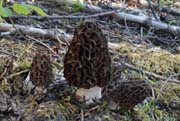
Steve Trudell | Morchella esculenta clade
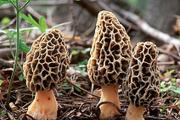
Pamela Kaminski (e. N.Am.) |
|
The most important three articles for our purpose in the last few years are Clowez (2010), Kuo et al. (2012) and Richard et al. (2015). The third made an attempt to co-ordinate and expand on the findings of the first two. Morchella eohespera was described in 2016, but later synonymized with Morchella norvegiensis. Loizides et al. (2022) reviewed Morchella systematics.
Kuo, Michael, Damon R. Dewsbury, Kerry O'Donnell, M. Carol Carter, Stephen A. Rehner, John David Moore, Jean-Marc Moncalvo, Stephen A. Canfield, Stephen L. Stephenson, Andrew S. Methven, Thomas J. Volk. 2012. Taxonomic revision of true morels (Morchella) in Canada and the United States. Mycologia 104(5): 1159-1171.
Clowez, Phillippe. 2010. Les morilles, une nouvelle approche mondiale du genre Morchella. Bull. soc. mycol. France 126(3-4):199-376.
Richard, Franck, Mathieu Sauve, Jean-Michel Bellanger, Philippe Clowez, Karen Hansen, Kerry O'Donnell, Alexander Urban, Régis Courtecuisse, and Pierre-Arthur Morea. 2014. True Morels (Morchella, Pezizales) of Europe and North America: Evolutionary relationships inferred from multilocus data and a unified taxonomy. Mycologia 104(5): 359-382.
|
Current species established for the Pacific Northwest following the Richard et al. Mycologia article are the following. Characters are mnemonic and not meant to characterize the species completely.
- Morchella tomentosa - "black fuzzyfoot" burn morel
- Morchella tridentina - blond morel colors but black morel shape, ridges do not darken with age, forests, (includes what is referred to as 'mountain blond morel' or 'western blond morel')
- Morchella populiphila - western North American half-free morel, associated with Populus trichocarpa
- Morchella sextelata - a 'burn black', microscopic elements on ridges cylindric, subclavate, subfusiform, or subcapitate, distinguished from M. eximia only by DNA
- Morchella eximia - a 'burn black' that includes M. anthracophila, M. carbonaria, M. septimelata
- Morchella exuberans - a 'burn black', includes Morchella capitata with microscopic elements on ridges overwhelmingly capitate
- Morchella importuna - a 'black' morel found in wood-chip and garden/landscape settings, cross ridges often give a ladder-like appearance, often several in clusters
- Morchella snyderi - pale to greenish to burgundy when young but black morel form, ridges darken with age, stipe often with conspicuous lacunae/ridges (even when young) and with granularity, typically in clusters of 2-20, generally non-burn with montane conifers
- Morchella 'Mel-19' - unnamed but described in 2016 as Morchella eohespera, and later synonymized with Morchella norvegiensis; it is similar to Morchella brunnea but with conifers
- Morchella brunnea - 'natural black', grows singly in forest with hardwoods
- Morchella americana - North American 'esculenta' yellow morel, with hardwoods
- Morchella prava - like a Morchella americana with contorted ridges and pits
- Morchella rufobrunnea - pale ridges, dark pits, yellow morel form, developing orangish to reddish stains, wood-chip and landscape settings
| Current Name |
Kuo et al. |
Clowez |
O’Donnell
et al. |
English name |
| M. tomentosa |
M. tomentosa |
M. tomentosa |
Mel-1 |
fuzzy-foot morel |
| M. tridentina
|
M. frustrata |
M. elatoides |
Mel-2 |
blond morel |
| M. populiphila |
M. populiphila |
Not covered |
Mel-5 |
western half-free morel |
| M. sextelata
|
M. sextelata |
Not covered |
Mel-6 |
a burn morel |
| M. eximia |
M. septimelata |
M. eximia
M. anthracophila
M. carbonaria
|
Mel-7 |
a burn morel |
| M. exuberans
|
M. capitata |
M. exuberans |
Mel-9 |
a burn morel |
| M. importuna |
M. importuna |
M. elata
M. vaporaria |
Mel-10 |
landscape morel |
| M. snyderi |
M. snyderi |
Not covered |
Mel-12 |
Snyder’s morel |
| M. norvegiensis= M. eohespera |
Unnamed |
Unnamed |
Mel-19 |
|
| M. brunnea |
M. brunnea |
Not covered |
Mel-22 |
natural black morel |
| M. americana |
M. esculentoides |
M. americana
M. californica |
Mes-4 |
American. yellow morel |
| M. prava |
M. prava |
Not covered |
Mes-7 |
|
| M. rufobrunnea |
M. rufobrunnea |
M. rufobrunnea |
Mrb |
blushing morel |
NOTES
- Pink and green morels were found in more than one 'burn black' proposed species. Gray morels are often black fuzzyfoots.
- Michael Beug photographed a Washington State collection whose ITS DNA sequence matched numerous European sequences identified as Morchella vulgaris.
- Loizides et al. 2022 included the following about the status of names.
- Morchella eximia : "Not conclusively resolved because M. septimelata forms a distinct clade, warranting further investigation to confirm or reject its conspecificity with M. eximia; until further clarified, the usage of the current name for the inclusive clade is provisionally recommended"
- Morchella americana: "Not conclusively resolved because it appears to encompass two biogeographically supported clades and an earlier name probably exists for at least the European clade should the two clades be split in the future; until further clarified, the usage of the current name is provisionally recommended for the inclusive clade"
- Morchella importuna "Not conclusively resolved because most European collections belong to a clade distinct from that of the American type, suggesting two species may be involved, and because several old European names, incl. the seminal M. elata, are candidate prioritary synonyms for at least the European clade; until further clarified, the usage of the current name is provisionally recommended for the inclusive clade"
- Morchella sextelata: "Not conclusively resolved because as currently delineated, the species encompasses two well-delimited and quite distant (19 SNPs) clades; careful examination of sequenced collections in the two groups should allow identifying diagnostic features"
- Morchella tridentina: "Not conclusively resolved because currently available sequences delineate distinct clades according to their geographical origins (Eurasian, North American, South American), but with no apparent morphological differences suggesting either (1) the presence of several cryptic species or (2) that subpopulations of this widespread species are phylogenetically continentalized; careful integrative analyses of collections from different continents are necessary to assign the most suitable taxonomic rank, if any, to each clade ... a sequenced epitype from Northern Italy further needs to be designated to definitively stabilize the usage of this classical name." This leaves open the possibility that the synonymy of M. frustrata with M. tridentina is not correct.
MORELS AND FALSE MORELS
The morels and false morels have some similarity in general appearance. Fruitbodies normally have a distinct stipe (stem) and a head (cap) that is usually convoluted in some way (or saddle-shaped in the case of some false morels). Spores are borne on the outer surface (or in large pits in the outer surface). Presently they fall into two families, Helvellaceae and Morchellaceae.
The Trial Key to HELVELLACEAE and DISCINACEAE in the Pacific Northwest was written by Harold Treibs and covers Discina, Gyromitra, and Helvella.
HISTORY
There is no comprehensive key to Morchellaceae for the good reason that the taxonomy is partly based on recent molecular research and the macroscopic appearances, ecology, and distribution are still being worked out. It is easy to distinguish the thimble morels (Verpa conica and Verpa bohemica) from true morels (Morchella).
Molecular techniques have been used in an attempt to untangle species concepts. This account will discuss Jung (1993), Bunyard et al. (1994), Pilz et al. (20040, Kuo 2006, Clowez (2010), O'Donnell et al. (2011), Kuo et al. (2012), and Richard et al. (2014).
Early molecular research suggested that the black morels (known by the names M. angusticeps, M. elata, M. conica) and the yellow morels (known by the names M. esculenta, M. crassipes, and M. deliciosa) are separate taxonomic groups (Bunyard), and immunological techniques suggested the gray, tan, and large tan forms in the M. esculenta complex are immunologically indistinguishable and likely conspecific. (Jung).
Five putative morel species were designated with the aid of molecular techniques: PS A, PS B, PS C, PS D, and PS E. They had field characters as follows. PS A is a member of the black morel grouping, called the natural black morel because it occurs away from fires: it has mature pits grayish tan or pale tan. PS B is a second member of the black morel grouping and occurs after fires. It includes the so called pink morel with mature pits rosy tan to pinkish brown. PS C is a third member of the black morel grouping, and also occurs after fires. It includes the green morel (so called because of the olive tinged gray or olive tinged brown color of mature pits). These three black morels all key out to the M. elata (complex), M. conica, or M. angusticeps, depending on the reference used, but all of these names are of uncertain application. PS D is the black stocking morel, a common member of the "gray morel" grouping. It has the surface of the stem distinctly velvety when young, dark brown to black (as opposed to color at all ages entirely off-white, ivory, tan, dull pink or dull purple), becoming paler when old "as the velvety layer is stretched apart (use a hand lens to look for dark tufts of hyphae in old specimens)". This PS D morel is one of the burn morels, fruiting the spring following a fire. It had been called Morchella atrotomentosa (see for example McKnight 1987), but there are nomenclatural problems with the use of that name. Later it was described by Kuo 2008 as Morchella tomentosa Kuo. PS E (mountain blond morel) occurs away from fires and has the ribs separating the pits lighter in color (ivory to nearly white) than the lining of the pits when old. By maturity the ribs are off-white sometimes with amber stains and bruises. Pits are gray when very young, becoming tan, golden, or straw yellow when mature. It differs from most descriptions of M. esculenta from Europe or elsewhere in North America in that 1) it has a relatively narrow head, rather than oval or rounded, especially in young specimens, 2) "the primary ribs are strongly vertical and relatively straight producing elongated pits rather than the rounded to somewhat irregular pits generally attributed to M. esculenta", and 3) it "seems to be characteristic of conifer forests including either lodgepole or ponderosa pine, whereas the complex centered on M. esculenta is commonly associated with hardwoods sometimes mixed with conifers." Both PS E and a morel that fits the classic concept of M. esculenta occur in eastern Oregon. (Pilz 2004).
The Morel Data Collection Project, outlined in Kuo(2005) and Kuo(2006), included a number of Pacific Northwest taxa:
- Morchella rufobrunnea,
- the fuzzy-foot morel which was later named Morchella tomentosa,
- several taxa similar to the natural black morel in appearance but distinguished by DNA methods, three to five according to the method used, and all recorded (among other places) in Oregon.
- a half-free morel,
- the western blond (mountain blond renamed to include not only mountain conifer habitat but lowland hardwood habitat), and
- a taxon resembling the European Morchella esculenta.
Further molecular work defined 3 lineages, a monotypic lineage consisting of the commercially cultivated Morchella rufobrunnea, and two other lineages comprising the elata clade (black morel) and the esculenta clade (yellow morel). Included in the elata clade are these among others: Morchella tomentosa, the natural black and burn black morels, the half-free morel, and the taxon apparently corresponding to the mountain blond. They designated the members of the elata clade as Mel1, Mel2, etc. and members of the esculenta clade as Mes-1, Mes-2, etc. The same study suggested that of 13 western North American Morchella taxa, only 2 were the same as 8 eastern North American taxa. Little overlap of North American taxa with Europe and Asia was seen either. (O'Donnell 2011).
Two years later Mycologia released a pre-publication version of an article that applied Latin names to these taxa. Unfortunately, and apparently unbeknownst to the authors, a French monograph of Morchella worldwide by Clowez had already described a number of North American species. Four new species that appear to apply to the Pacific Northwest were
- Morchella anthracophila, a black burn morel described from British Columbia,
- Morchella carbonaria, another black burn morel described from British Columbia,
- Morchella fallax, which corresponds to the so-called western blond, and
- Morchella americana, the common yellow morel that went in years past under the European name Morchella esculenta, often identical in color but with the cap more elongated, and the pits more numerous, slightly long, smaller, and less regular.
Clowez used the following two names (also accepted by the prepublication version of the Kuo et al. article) for two Pacific Northwest taxa:
-
Morchella rufobrunnea (pale ridges, dark pits, yellow morel form, developing orangish to reddish stains, wood-chip and landscape settings),
- Morchella tomentosa (black stocking burn morel).
In addition, the Kuo et al. article described
- Morchella capitata, M. sextelata, and M. septimelata, three burn black morels, the first perhaps distinguished by a predominance of microscopic capitate elements on the ridges,
- Morchella brunnea, a "natural black" occurring in non-burned forests, associated with hardwoods, “probably also to be expected with non-burned conifers”
- Morchella importuna (a black morel with a laddered pattern of pits/ridges, favoring wood-chip and garden/landscape settings),
- Morchella populiphila (western North American half-free morel associated with Populus trichocarpa),
- Morchella snyderi (pale colors when young but black morel form, ridges become brown, stem often with conspicuous pits/ridges (even when young) and with granularity, occurring under montane conifers),
- Morchella frustrata (pale colors but black morel form, in forests, likely what has been called the mountain blond or western blond, and may be the same as Morchella fallax), and
- Morchella esculentoides (the North American esculenta-like yellow morel that is likely the same as Morchella americana).
English names applied to Morchella tomentosa include "black stocking morel", "black foot morel" and "fuzzy-foot". It has been called a "gray" morel, but that term is applied by different people to different morels. The term "gray" is sometimes used of yellow morels at a certain stage of development or under certain ecological conditions. The term "yellow morel" includes the morels resembling Morchella esculenta of Europe in colour, and has been applied to the esculenta clade. The term "black morel" has been applied to the whole elata clade but traditionally comprises those with prominently dark colors including the natural black morel, the green morel, the pink morel, and sometimes the black stocking morel. Green burn morels and pink burn morels are however found in more than one of the taxa of the elata clade designated in O'Donnell 2011 and Kuo 2012.
Black morels develop in burn areas earlier in the season than the gray and green members of the black burn morel group. They have light stems that fade to rusty brown, and the ridges turn black. There is often a taproot. (Larry Evans, speaking of Montana in particular, pers. comm.)
Richard et al. (2014) synonymized
a) M. frustrata and M. elotoides with M. tridentina,
b) M. septimelata, M. anthracophila, and M. carbonaria with M. eximia
c) M. capitata with M. exuberans, and
d) M. esculentoides and M. californica with M. americana.
REFERENCES
- Arora, David. 1986 Mushrooms Demystified Second Edition. Ten Speed Press, Berkeley.
- Breitenbach, J., Kränzlin, F. 1984. Fungi of Switzerland Volume 1 Ascomycetes. Edition Mykologia Lucerne.
- Bunyard, Britt A., Michael S. Nicholson, Daniel J. Royse. 1994. "A systematic assessment of Morchella using RFLP analysis of the 28S ribosomal RNA gene." Mycologia 86(6): 762-772.
- Clowez, Phillippe. 2010. "Les morilles, une nouvelle approche mondiale du genre Morchella." Bull. soc. mycol. France 126(3-4):199-376
- Jung, C.H. 1993. "Systematics of Morchella esculenta complex using enzyme-linked immunosorbent assay. Mycologia 85(4): 677-684.
- Kuo, Michael. 2005. Morels. University of Michigan Press.
- Kuo, Michael. 2006, March. North American Morels in the MDCP. Retrieved from the MushroomExpert.Com Web site: http://www.mushroomexpert.com/mdcp/results_legent.html
- Kuo, Michael. 2008. "Morchella tomentosa, a new species from western North America, and notes on M. rufobrunnea." Mycotaxon 105: 441-446.
- Kuo, Michael, Damon R. Dewsbury, Kerry O'Donnell, M. Carol Carter, Stephen A. Rehner, John David Moore, Jean-Marc Moncalvo, Stephen A. Canfield, Stephen L. Stephenson, Androw S. Methven, Thomas J. Volk. 2012. Taxonomic revision of true morels (Morchella) in Canada and the United States. Mycologia 104(5): 1159-1177.
- Loizides, Michael, Pablo Alvarado, Pierre-Arthur Moreau, Boris Assyov, Viktorie Halas?, Marc Stadler, Andrea Rinaldi, Guilhermina Marques, Georgios I. Zervakis, Jan Borovi?ka, Nicolas Van Vooren, Tine Grebenc, Franck Richard, Hatira Ta?kin, Matthias Gube, Carmel Sammut, Carlo Agnello, Timothy J. Baroni, Pedro Crous, Vassiliki Fryssouli, Zacharoula Gonou, Urbano Guidori, Gro Gulden, Karen Hansen, Roy Kristiansen, Thomas Læssøe, Javier Mateos, Andrew Miller, Gabriel Moreno, Branislav Peri?, Elias Polemis, Joan Carles Salom, José Leonardo Siquier, Martin Snabl, Øyvind Weholt, Jean-Michel Bellanger. 2022. Has taxonomic vandalism gone too far? A case study, the rise of the pay-to-publish model and the pitfalls of Morchella systematics. Mycological Progress 21: 7-38.
- McFarlane, Erika M., David Pilz, and Nancy S. Weber. 2005. "High-elevation gray morels and other Morchella species harvested as non-timber forest products in Idaho and Montana." Mycologist 19: 62-68.
- McKnight, Kent H., McKnight, Vera B. 1987. A Field Guide to Mushrooms North America. Peterson Field Guide Series. Houghton Mifflin, New York.
- O'Donnell, Kerry, Alejandro P. Rooney, Gary L. Mills, Michael Kuo, Nancy Weber, Stephen A. Rehner. 2011. "Phylogeny and historical biogeography of true morels (Morchella) reveals an early Cretaceous origin and high continental endemism and provincialism in the Holoarctic." Fungal Genetics and Biology 48: 252-265.
- Pilz, David, Nancy S. Weber, M. Carol Carter, Catherine Parks, and Randy Molina. 2004. "Productivity and diversity of morel mushrooms in healthy, burned, and insect-damaged forests of northeastern Oregon." Forest Ecology and Management 198: 367-386.
- Richard, Franck, Mathieu Sauve, Jean-Michel Bellanger, Philippe Clowez, Karen Hansen, Kerry O'Donnell, Alexander Urban, Régis Courtecuisse, and Pierre-Arthur Morea. 2014. True Morels (Morchella, Pezizales) of Europe and North America: Evolutionary relationships inferred from multilocus data and a unified taxonomy. Mycologia: 104(5): 359-382.
- Tylutki, Edmund E. 1979. Mushrooms of Idaho and the Pacific Northwest. Volume 1. Discomycetes. University of Idaho Press, Moscow, Idaho.
- Voitk, Andrus, Michael W. Beug, Kerry O’Donnell & Michael Burzynski. 2016. Two new species of true morels from Newfoundland and Labrador: cosmopolitan Morchella eohespera and parochial M. laurentiana. Mycologia 108(1): 31-37.
- Weber, Nancy Smith. 1988. A Morel Hunter’s Companion A Guide to the True and False Morels of Michigan. Chief Photographer James A. Weber.
- END -
