Andrew Parker
A few missing details have been added (and marked as such) from David Arora: Mushrooms Demystified, A.H. Smith: Mushrooms in their Natural Habitats, Kent H. McKnight: A Field Guide to Mushrooms North America, and in the case of Limacella roseicrema, Murrill's original description from Mycologia 4: 212. 1912.
Limacella glioderma has been changed to a group. DNA sequencing from one reddish species in Washington State and another in Oregon is close to but not exactly the same as the DNA sequencing from material identified as Limacella glioderma. Some authorities regard L. glioderma as a synonym of Limacella delicata (Fr.) Earle ex Konrad and Maubl.
Limacella glischra has been changed to a group. Washington collections have shown have shown DNA sequences suggesting two different species, close to but not exactly the same as DNA sequences from other material identified as Limacella glischra.
A proposed name for Limacella illinita is Zhuliangomyces illinitus (Fr.) Redhead (2019). The publication of the name follows the publication of a new closely related species, Myxoderma olivaceum Zhu L. Yang, Y.Y. Cui & Q. Cai (2018). The Myxoderma name had already been used for a Cyanobacterium; as a result the species was recombined as Zhuliangomyces olivaceus. Note the similarity of the genus name to the name of the first author of the Myxoderma species. Although there are herbarium collections labeled as Limacella illinita from BC and WA, it is not yet clear whether illinita is the correct species epithet. A white collection identified as this species shows a DNA sequence that does not match other material identified as Limacella illinita.
The DNA information here is based on a personal communication from Danny Miller.
Limacella is a small genus in the family Pluteaceae. It is characterized by a viscid to slimy glutinous cap with free or almost free gills; a central stem that varies from dry to glutinous in different species, with or without an annulus, but lacking a volva. (The spore deposit is white; the spores are smooth, small, mostly globose or subglobose, and nonamyloid; clamp connections are present; the gill trama is divergent.)
Information in this key is based mostly on The Genus Limacella in North America by Helen V. Smith, to whom I am indebted for a copy of her monograph.
Features of importance for following the key or making photographs are the color and amount of gluten on cap and stem, the color of the cap cuticle beneath the gluten, characteristics of the annulus, if any (membranous? merely glutinous? ragged? persistent? disappearing?); and odor and taste. Edibility varies from species to species.
1a Stem viscid or glutinous; cap glutinous; mostly without strong odor or taste
................................................................................2
1b Stem dry; cap may be viscid in wet weather; odor and taste strongly farinaceous
................................................................................5
2a Cap white or disc tinged pale brown or gray; gluten colorless
................................................................................3
2b Cap cream tinged rose with colorless gluten OR yellow-brown with bright reddish brown gluten
................................................................................4
3a (2a) Cap white to cream.
................................................................................Limacella illinita (Fr.) Murrill var. illinita
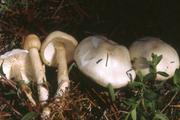
| CAP 2-7 cm, covered with clear colorless gluten which often drips from the margin in wet weather, pure white to whitish, the disc at times tinged yellowish. ODOR and TASTE mild. GILLS free; according to Arora white, close, free or may be notched. STEM 5-9 x 0.3-0.8 cm, white or whitish, lower portion covered by thick colorless gluten which may end in a fibrillose annular zone, according to Arora cap margin often hung with slimy veil remnants. MICROSTRUCTURES spores 5-6.3 x 4.5-5.5 um, with distinct apiculus. | Limacella illinita var illinita Andrew Parker |
3b Cap grayish brown to pale clay color on the disc (darkest when young)
................................................................................Limacella illinita var. argillacea
CAP pellicle "Verona" (medium) brown on disc, "Cinnamon Buff" (tan) on margin; otherwise similar to above; according to Arora stem tinged tan or buff.
4a (2b) With membranous persistent annulus; gluten colorless; cap color cream tinged with rose.
................................................................................Limacella roseicrema Murrill
| CAP 6 cm, convex to flat with broad umbo, margin inflexed; cream tinged with rose; smooth, bald, viscid, margin not striate; flesh white. ODOR farinaceous. GILLS free, rather close, arched, white. STEM 5-10 x 0.8-1.2 cm, enlarged at base, white, fleshy, solid, smooth, bald, viscid. ANNULUS persistent, superior, ample, remaining stretched from margin to stem for some time. HABITAT type collected on ground in woods. MICROSTRUCTURES spores 4-5 microns, round, smooth, "corroded, apparently not maturing". REMARKS This description as a whole is derived from Murrill's type description. | Limacella roseicremea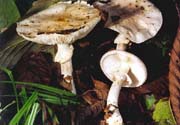 Nancy Burnett |
4b With disappearing, non-membranous annulus, gluten bright reddish brown; cap color pale beneath gluten.
................................................................................Limacella glischra (Morg.) Murrill group
| CAP 2-4 cm, with a slimy layer of gluten near "Burnt Sienna" in color, pale under gluten; margin appendiculate from glutinous patches of universal veil. ODOR and TASTE mild, (McKnight). GILLS white, almost free, according to McKnight white to pale pinkish brown, and close. STEM 6-8 x 0.9-1.2cm, surface covered with a thick layer of gluten similar to that on cap; base white-cottony, according to McKnight stem solid, and white to pale brownish. ANNULUS evanescent, not membranous. MICROSTRUCTURES spores 3-5 um, round or nearly so, (McKnight) | Limacella glischra group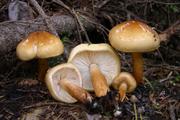 Andrew Parker |
5a (1b) With persistent white annulus; cap white at first but aging pinking-buff
................................................................................Limacella solidipes (Peck) H.V. Smith
CAP 3-7cm, viscid when moist (not slimy), white at first but aging pale leather color, surface subrimose (somewhat cracked) in age but never fibrillose or scaly, always opaque and dull. ODOR and TASTE strongly farinaceous. GILLS almost free or attached by a narrow tooth, according to A.H. Smith white, broad, and close to crowded. STEM according to A.H. Smith, 5-10 x 0.8-1.7 cm, solid, whitish, unpolished above annulus, and somewhat lacerate-fibrillose below it. ANNULUS superior, white and persistent, ample and pendulous. MICROSTRUCTURES spores 3.8-4.6 um, round, (A.H. Smith).
5b Annulus usually evanescent or ragged; cap cuticle chestnut brown when young, fading to pale reddish brown
................................................................................Limacella glioderma (Fr.) Maire group
| CAP 3-8 cm (Arora), almost dry to viscid when moist, granulose under a lens, breaking up into crustose patches in age. ODOR and TASTE strongly farinaceous. STEM 4-12 x 0.5-1(1.5) cm (Arora), dry overall or viscid when gluten from cap has dropped on it, according to Arora whitish or pallid above annulus, with cap colored scales, patches, and/or fibrils below. ANNULUS fleeting or ragged, according to Arora margin often hung with veil remnants. MICROSTRUCTURES spores 3-5 microns, round, according to Arora. | Limacella glioderma group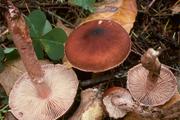 Boleslaw Kuznik |
- END -