Sharon Godkin
1a Cap uniformly white or ivory or pale cream color
................................................................................2
1b Cap straw color, ochre, yellow, or some shade of brown, at least at the center (margin may be pallid or cream color or yellow)
................................................................................11
2a Stipe pruinose (as if covered with fine sand; use a hand lens) only at the top if at all
................................................................................3
2b Stipe pruinose in its entire length
................................................................................5
3a Odor strong of green corn
................................................................................I. sororia [2]
3b Odor not of green corn
................................................................................4
4a Cap and stipe white, becoming flushed or stained with pink or red, especially when dried
................................................................................I. pudica [3]
4b Cap and stipe white, not developing any pink or red stains, and not becoming pink when dried
................................................................................I. geophylla [4]
5a (2b) Odor sweet, like sweet pea or lily-of-the-valley, or both
................................................................................I. suaveolens [5]
5b Odor not as in the above
................................................................................6
6a Stipe pink at the apex only, or all over
................................................................................7
6b Stipe ivory, cream color, or pale yellow, lacking pink colors
................................................................................8
7a Pileus entirely white; stipe pink all over
................................................................................I. grammata [6]
7b Pileus cream color; stipe pink at the apex only, elsewhere cream color or ivory
................................................................................I. kauffmanii [7]
8a (6b) Stipe discoloring dingy brown or gray or nearly black, from the base up, in older specimens and when dried
................................................................................9
8b Stipe not discoloring brown or gray, remaining pale yellow in older specimens and when dried
................................................................................10
9a Odor sharp, penetrating, resinous with component of acetic acid; stipe discoloring dull brown or vinaceous brown rather than gray
................................................................................I. picrosma [8]
9b Odor merely spermatic or scarcely notable; stipe discoloring definitely gray, frequently dark gray
................................................................................I. leucomelaena [9]
10a (8b) Pileus silky, soon becoming scaly at least at the center, not lubricous when wet
................................................................................I. kauffmanii [7]
10b Pileus becoming rimose but not scaly; lubricous when wet
................................................................................I. mixtilis [10]
11a (1b) Odor strong of green corn
................................................................................I. picrosma [11]
11b Odor varies, but not of green corn
................................................................................12
12a Pileus white at the center, grayish vinaceous or brownish vinaceous at the margin; stipe pink, entirely pruinate, with a definite marginate bulb
................................................................................I. grammata [6]
12b Not with all three of the above features
................................................................................13
13a Center of pileus either brown or slate gray or nearly black, these colors shading to white or dingy ivory at the margin, and - base of the stipe the same color as the center of the pileus, shading up to white at the apex
................................................................................14
13b Neither cap nor stipe colored as in the above
................................................................................15
14a Center of pileus and base of stipe gray to nearly black
................................................................................I. fuscodisca [12]
14b Center of pileus and base of stipe red-brown to umber, without any gray tones
................................................................................I. agglutinata [13]
15a (13b) Young gills orange (use unopened caps)
................................................................................I. cinnamomea [14]
15b Young gills white, pale cream, greenish, or some shade of lavender or purplish
................................................................................16
16a Young gills and apex of stipe lavender, lilac, violet, or similar purplish color
................................................................................17
16b Young gills white, pale cream, yellow, or tinged greenish
................................................................................18
17a Stipe lavender at the apex, pallid below and with streaks of brown fibrils or tomentum
................................................................................I. cincinnata [15]
17b Stipe entirely lavender or violet, satiny, lacking brown fibrillose or tomentose streaks
................................................................................I. pusio [16]
18a (16b) Stipe entirely pruinose
................................................................................19
18b Stipe pruinose at the apex only, if at all, elsewhere satiny, glabrous, fibrillose-streaked, fibrillose-scaly, squarrose, or tomentose, but not pruinose below the apex
................................................................................26
19a Stipe some shade of pink, at least at the apex
................................................................................20
19b Stipe entirely without pink colors
................................................................................22
20a Stipe entirely pink; pileus uniformly bay or umber, or red-brown at the center and yellow at the margin
................................................................................21
20b Stipe pink at the apex only, elsewhere cream color or ivory: pileus at most dingy yellowish or straw color
................................................................................I. kauffmanii [7]
21a Mature pileus red-brown (bay) at the center, brassy yellow at the margin; stipe bright salmon pink
................................................................................I. laetior [17]
21b Mature pileus uniformly red-brown or umber; stipe usually very pale pink
................................................................................I. glabrodisca [18]
22a (19b) Odor sweet, like sweet pea or lily-of-the-valley, or both
................................................................................I. suaveolens [5]
22b Odor sharp and resinous-acetic, or spermatic, or not notable
................................................................................23
23a Stipe discoloring dingy brown or gray or nearly black from the base up, in older specimens and when dried
................................................................................24
23b Stipe not discoloring brown or gray, remaining pale yellow in older specimens and when dried
................................................................................25
24a Odor sharp, penetrating, resinous with component of acetic acid; stipe discoloring dull brown or vinaceous brown rather than gray
................................................................................I. picrosma [8]
24b Odor merely spermatic or scarcely notable; stipe discoloring definitely gray, frequently dark gray
................................................................................I. leucomelaena [9]
25a (23b) Pileus silky, soon becoming scaly at least at the center, not lubricous when wet
................................................................................I. kauffmanii [7]
25b Pileus becoming rimose but not scaly: lubricous when wet
................................................................................I. mixtilis [11]
26a (18b) Stipe yellow ochre, frequently darkening to smoky brown at the base; pileus either uniformly yellow ochre, or brown at the center and yellow ochre at the margin
................................................................................I. olympiana [19]
26b Stipe white, ivory, cream color, pink, or some shade of brown; pileus either uniformly brown, or in one case, bicolorous
................................................................................27
27a Pileus bicolorous, tawny or orange brown at the center, shading to straw color or yellow at the margin, conic or at least sharply umbonate; gills often with a distinct greenish cast; stipe satiny, glabrous, dingy pallid; odor strong, spermatic
................................................................................I. rimosa [20]
27b Pileus uniformly brown, or the center a deeper shade of the same brown as the margin, not bicolorous, not conic or sharply umbonate; lamellae never with a greenish cast; stipe varies in color and surface
................................................................................28
28a Stipe flesh-pink or rosy-pink, at least at the apex
................................................................................I. subdestricta [21]
28b Stipe white or pallid or some shade of brown, lacking any pink colors
................................................................................29
29a Stipe white or pallid, in age sometimes flushed with vinaceous brown; odor complex, of green corn then becoming sweet-aromatic with lingering green corn component
................................................................................I. lanatodisca [22]
29b Stipe brown; odor fishy, spermatic, or not notable
................................................................................30
30a Pileus silky-smooth, becoming rimose but not scaly
................................................................................31
30b Pileus definitely scaly
................................................................................32
31a Stipe glabrous, satiny, with a napiform (turnip-shaped) bulb
................................................................................I. napipes [23]
31b Stipe fibrillose-streaked, lacking a bulb at the base
................................................................................I. lacera [24]
32a (30b) Stipe merely fibrillose-streaked, not scaly or tomentose; pileus lacerate-fibrillose-scaly, not squarrose
................................................................................I. lacera [24]
32b Pileus squarrose; stipe either squarrose, or tomentose at least at the base or lower half
................................................................................33
33a Stipe fibrillose-squarrose, dull green inside and out at the base; odor like raw fish (sometimes with a resinous component); growing on the ground
................................................................................I. calamistrata [25]
33b Stipe tomentose at least in lower part, not green at the base; odor spermatic or not notable; growing on rotten wood
................................................................................I. lanuginosa group [26]
apedicellate - without a pedicel or stalk
applanate - horizontally expanded, plane, flat
avellaneous - dull grayish brown, hazel-brown, or light gray yellow brown, or closer to drab, or gray tinged with pink, in Ridgway 1912 closer to pinkish buff
bicolorous - of two colors
boletoid - of spores, resembling spores of boletes, which are typically long and narrowly elliptic or spindle-shaped in face view and inequilateral in profile
capitate - with a head
catenate - in chains or end to end series
caulocystidium (pl. caulocystidia) - cystidium on stipe (stem)
caulocystidioid - like a caulocystidium
cheilocystidium (pl. cheilocystidia) - cystidium on edge of gill
cheilocystidioid - like a cheilocystidium
clavate - like a caveman's club, same as club-shaped; when used of stems, implies base is thicker and stem tapers upward; when used of cystidia, implies part that extends outward beyond the hymenium is thicker
crystalliferous - bearing crystals
cystidium (pl. cystidia) - a sterile cell frequently of distinctive shape, at any surface of a fruiting body
equal - of a stem, the same diameter throughout its length
farinaceous - of odor, with the smell of fresh ground meal from whole grain
floccose - with easily removed cottony or woolly tufts; woolly or cottony; dry and loosely arranged; having the appearance of cotton flannel; with a soft cottony texture
flocculose - with fine, easily removed cottony or woolly tufts; finely woolly or cottony
fuscous - color of a very dark storm cloud: variously described as combinations of gray, brown, purple, or black
fusiform - spindle-shaped, fairly slender and narrowing from middle to both ends
glabrescent - becoming bald
glabrous - bald, without hairs or raised fibers or scales or raised patches
hispid - covered with long rough hairs or bristles
hygrophanous - surface changing color markedly as it dries, usually having a water-soaked appearance when wet and turning a lighter opaque color on drying
inflexed - bent inward, incurved
lageniform - of cystidia, swollen at the base with the middle and top part tapered into a long beak, like a gourd, therefore gourd-like
lanceolate - of a cystidium, slightly swollen at or below the middle and tapered to both ends, hence lance-shaped
lubricous - greasy or slippery or oily but not viscid (sticky) or slimy
marginate - of bulb at the base of stem, having a circular ridge that forms the top of the bulb
nodulose - of spores, covered with broad-based blunt bumps large enough to change the overall shape of the spore
notched - refers to a gill that appears as if a wedge of the gill had been removed near the stem (includes sinuate and uncinate but not adnexed)
paracystidia - short club-shaped sterile cells between and among other cystidia
pedicel - of cystidia, a slender stalk
pleurocystidium (pl. pleurocystidia) - cystidium on sides of gills
pruinate - same as pruinose
pruinose - looking finely powdered or finely granular, on the stem generally reflecting the presence of caulocystidia
pyriform - pear-shaped
recurved - curved back: when used of cap margin or scales on cap or stem means curved back upward
rimose - cracked, referring to surface of cap or stem, often revealing paler flesh underneath
saccate - of a cystidium, shaped like a sac
spermatic - resembling the odor of male flowers of Castanea (chestnut catkins)
squamulose - with small scales
squarra (pl. squarrae) - upright or curved-up pointed scale
squarrose - covered with upright or curved-up pointed scales
sub- - prefix meaning nearly, more or less, somewhat, slightly
tomentose - covered with soft hairs, often soft densely matted hairs, like a woollen blanket
tomentum - a covering of densely matted woolly hairs
umber - a deep dull dark brown, smoky brown; earth brown sometimes with a very slight reddish tinge
ventricose - wider in the middle
(Note some of these reported Pacific Northwest species are not mentioned in the key.)
| SPECIES | KEY ENTRIES |
| INOCYBE (Fr.) Fr. | |
| I. agglutinata Peck | 14b |
| I. albodisca Quél. - See I. grammata | |
| I. armeniaca Huijsman | |
| I. assimilata (Britzelm.) Sacc. | |
| = I. umbrina Bres. | |
| I. brunneolipes Grund & D.E. Stuntz | |
| I. calamistrata (Fr.) P. Karst. | 33a |
| I. castanea Peck | |
| I. catalaunica Singer | 28a |
| I. chalcodoxantha Grund & D.E. Stuntz | |
| I. chelanensis D.E. Stuntz | Footnote 1 |
| I. cicatricata Ellis & Ev. | |
| I. cincinnata (Fr) Quél. var. major (S. Peterson) Kuyper | 17a |
| = I. phaeocomis (Pers.) Kuyper var. major S. Peterson sensu Kuyper & Stangl | |
| = I. cincinnatula Kühner | |
| = I. obscuroides Orton | |
| I. cincinnatula Kühner - see I. cincinnata var. major | |
| I. cinnamomea A.H. Sm. | 15a |
| I. dulcamara (Pers.) P. Kumm. | Footnote 1 |
| I. eutheloides Peck | |
| I. fallax Peck | |
| I. fastigiata (Schaeff.) Quél. - see I. rimosa | |
| I. flavella P. Karst. | 27a |
| I. flavidolilacina (Britz.) Sacc. | 4a |
| I. flocculosa Sacc. | |
| = I. lucifuga (Fr.) Quél. | |
| I. fraudans (Britz.) Sacc. | 4a |
| = I. pyriodora (Pers.: Fr.) Kumm. sensu Kauffman, D.E. Stuntz | |
| I. fuscidula Vel. | 28a |
| I. fuscodisca (Peck) Massee | 14a |
| I. geophylla (Fr.) P. Kumm. | 4b |
| I. glabrodisca Orton | 21b |
| = I. decemgibbosa (Kühner) Vauras | |
| = I. oblectabilis (Britz.) Sacc. f. decemgibbosa Kühner | |
| I. griseolilacina J. Lange | 17a |
| I. grammata Quél. | 7a, 10b, 12a |
| = I. albodisca Peck | |
| I. griseoscabrosa (Peck) Earle | |
| I. hemileuca F.H. Nishida & D.E. Stuntz | |
| I. heterochrominea Grund & D.E. Stuntz | |
| I. hirsuta (Lasch) Quél. var. maxima A.H. Sm. sensu Grund & D.E. Stuntz | Footnote 25 |
| I. hotsoniana D.E. Stuntz | |
| I. intricata Peck var. pallidistipitata Grund & D.E. Stuntz | |
| I. jacobi Kühner | |
| = I. fulvella sensu D.E. Stuntz 1947 | |
| I. kauffmanii A.H. Sm. | 7b, 10a, 20b, 25a |
| = I. longipes Kauffman | |
| I. lacera (Fr.) P. Kumm. | 31b, 32a |
| I. laetior D.E. Stuntz | 21a |
| I. lanatodisca Kauffman | 29a |
| I. lanuginosa (Bull.: Fr.) P. Kumm. | 33b |
| = I. nodulospora (Peck) Sacc. | |
| = I. ovatocystis Boursier & Kühner | |
| I. leiocephala D.E. Stuntz - see I. catalaunica | |
| I. leptophylla G.F. Atk. | 33b |
| I. leucomelaena | 9b, 24b |
| I. lilacina (Boud.) Kauffman | 4a, 4b |
| = I. geophylla var. lilacina (Peck) Gillet | |
| I. maculata Boud. | 29a |
| I. mixtilis (Britzelm.) Sacc. | 10b |
| = I. trechispora (Berk.) Karst. sensu Kauffman | |
| I. monticola Kropp, Matheny et Nanagyulyan | |
| I. napipes Lange | 10b, 31a |
| I. nitidiuscula (Britzelm.) Sacc. | 21a, 28a |
| = I. friesii R. Heim | |
| = I. subdestricta Kauffman ? | |
| I. oblectabilis (Britzelm.) Sacc. forma decemgibbosa Kühner - see I. glabrodisca | |
| I. obscuroides sensu D.E. Stuntz - see I. pusio | |
| I. olympiana A.H. Sm. | 26a |
| I. pallidipes Ellis & Ev. | |
| I. petiginosa (Fr.) Gillet | |
| I. phaeocomis (Pers.) Kuyper var. major S. Peterson sensu Kuyper & Stangl - see I. cincinnata var. major | |
| I. picrosma D.E. Stuntz | 7b, 9a, 24a |
| I. posterula (Britz.) Sacc. | |
| I. praecox Kropp, Matheny et Nanagyulyan | |
| I. praetervisa Qué., Bres. | Footnote 10 |
| I. prominens Kauffman | |
| = I. umboninota Peck | |
| I. pudica Kühner | 4a |
| = I. whitei (Berk. & Br.) Sacc. f. whitei sensu Kuyper | |
| I. pusio Karst. | 17b |
| = I. obscuroides sensu D.E. Stuntz | |
| I. pyriodora (Pers.: Fr.) Kumm. sensu Kauffman, D.E. Stuntz - see I. fraudans | |
| I. pyrotricha D.E. Stuntz | 17a |
| I. rainierensis D.E. Stuntz | Footnote 1 |
| I. rimosa (Bull.: Fr.) P. Kumm. | 27a |
| = I. fastigiata (Schaeff. ex Fr.) Quél. | |
| = I. holoxantha Grund & D.E. Stuntz | |
| = I. confusa P. Karst. | |
| I. semifulva Grund & D.E. Stuntz | |
| I. sindonia (Fr.) P. Karst. | |
| I. soluta Velen. | |
| I. sororia (Peck) Massee | 3a, 11a |
| I. stellatospora (Peck) Massee | 33b |
| = I. longicystis G.F. Atk. non Velen. | |
| = I. lanuginosa sensu M.M. Moser | |
| = I. lanuginosa sensu Stangl | |
| I. suaveolens D.E. Stuntz | 5a, 22a |
| I. subcarpta Kühner & Boursier | 33b |
| I. subdecurrens Ellis & Ev. | |
| I. subdestricta Kauffman | 28a |
| I. submuricellata G.F. Atk. | |
| I. umbratica Quél. | |
| I. umbrina Bres. - see I. assimilata (Britzelm.) Sacc. | |
| I. variabillima Speg. | |
| = I. acystidiosa Kauffman | |
| = I. decipientoides Peck | |
| = I. astoriana Murrill | |
| I. volvata D.E. Stuntz | |
| I. xanthomelas Boursier & Kühner | Footnote 10 |
This key is presented as originally written about 1978. Footnotes are added to describe the species briefly, to mention some other similar species, and to note a few nomenclatural problems.
Thanks are due to Dr. P. B. Matheny for reviewing the footnotes and Dennis Oliver for finding some references.
Some names (on the left) replace others (on the right).
Inocybe catalaunica Singer = Inocybe leiocephala D.E. Stuntz
Inocybe fraudans (Britz.)Sacc. = Inocybe pyriodora (Pers.: Fr.) P. Kumm. sensu Kauffman, D.E. Stuntz
Inocybe glabrodisca P.D. Orton = Inocybe oblectabilis (Britzelm.) Sacc. forma decemgibbosa Kühner
Inocybe grammata Quél. = Inocybe albodisca Peck
Inocybe pusio P. Karst. = Inocybe obscuroides sensu D.E. Stuntz
Inocybe cincinnata (Fr.: Fr.) Quél. = Inocybe cincinnatula Kühner
Inocybe rimosa (Bull.: Fr.) P. Kumm. = Inocybe fastigiata (Schaeff.) Quél.
Most amateurs can learn to recognize a handful of common Inocybe species with practice and by consulting with knowledgeable people. This key is presented as an aid to that process. Inocybe species are sometimes called fiberheads, in reference to the silky, fibrillose, or minutely scaly cap that often has a detectable radial pattern. Few species are brightly colored. The caps are often conical or umbonate, and are usually less than 8cm across. Stipes are typically whitish to cap-colored, and may be fibrillose or pruinose. The partial veil when present is fibrillose or cobwebby. Odor is often "spermatic" like male flowers of Castanea (chestnut catkins), or otherwise distinctive (fresh green corn, sweet pea flowers, geranium leaves, etc.). Spore deposit is dull brown, (in contrast to the rusty or cinnamon color of Cortinarius species). Most grow on the ground.
It is not possible to identify the full range of known Inocybe species in the Pacific Northwest without microscopic characters. Whenever reliable identification is needed, the microscopic characters should always be checked against a description that includes them. Even when the microscope is used, it is not uncommon to encounter species previously undocumented from the Pacific Northwest, or even undescribed in the scientific literature. Spores and cystidia are described here where information is available. Basidia are only mentioned when they are not 4-spored, but basidia should be examined to look for the several members of the I. dulcamara (Alb. & Schw.) P. Kumm. group. They have "necropigmented" basidia, meaning that they become ochraceous and collapse with age. Inocybe dulcamara has a woolly-fibrous ocher cap, and a relatively short stem. Another microscopic curiosity is the "rocket-shaped" spores of I. chelanensis D.E. Stuntz, (a bullet shape with 3 or 4 basal nodules). Inocybe chelanensis is typically a snowbank mushroom, with a fibrillose-cracking brown cap that has a paler center, and a stout lined brownish stem that is slightly pruinose at the top (the rare I. rainierensis D.E. Stuntz has similar spores but uniform dark brown cap and bulbous stem base).
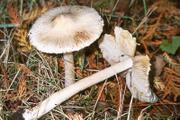
| Inocybe sororia is common and characterized by a green corn odor. CAP 2-8cm, creamy to pale yellowish, silky, radially fibrillose, soon deeply cracked everywhere except umbo, margin with persistent veil remnants. GILLS adnate to adnexed, close or crowded, rather narrow, pallid becoming yellowish or olive-yellow to brown, edges usually paler. STEM 3-14cm x 0.2-1.0cm, equal or with a slightly bulbous base, white or tinged cap color, fibrillose (often scurfy), pruinose at top. ODOR green corn. MICROSTRUCTURES spores 10-17 x 5-8 um, elliptic, sterile cells crowded in a broad band along the edge of the gill, 45.5-73.5(81.5) x 13-28(35) um, saccate, or clavate to subcapitate, very variable in shape and size, smooth, thin-walled. REMARKS I. rimosa has a spermatic to mild odor and slightly darker (yellow-brown to brownish ocher) cap, at least at the center. | Inocybe sororia Sharon Godkin |
| Inocybe pudica is common and distinguished by the whitish, relatively smooth, often convex cap, and the tendency of all parts to slowly blush salmon-pinkish when bruised or upon drying. CAP 2-4 cm, often lacking umbo, white at first but developing pinkish to reddish or orange stains as it ages, silky-fibrillose to nearly smooth; flesh white with pinkish stains. ODOR spermatic. GILLS adnate to adnexed, notched, or free, close; pallid or flushed pinkish or orange. STEM 2.5-8cm x 0.2-1cm, equal or slightly enlarged at base, white, but discoloring like cap, smooth or silky fibrillose, at top pruinose-floccose. CORTINA fibrillose or cobwebby. MICROSTRUCTURES spores 7-10 x 4-6.5 um, smooth, elliptic; pleurocystidia common to sparse, 50-58 x 15-18 um, subfusiform, fusiform, sparse crystals at apex, thick-walled, bright or pale yellow, cheilocystidia numerous, similar to pleurocystidia, frequently with bright yellow contents, walls bright yellow, paracystidia rather round, 13 x 18 um, thin-walled; caulocystidia similar to pleurocystidia, rare; clamp connections present in all tissues. REMARKS Inocybe flavidolilacina (Britzelm.) Sacc. has nomenclatural priority over I. pudica according to Singer (1986). Cripps (1997) followed Kuyper (1986) and applied the name I. whitei to this species. However, for reasons discussed under the footnote for I. agglutinata, we do not follow this treatment. Inocybe geophylla lacks pinkish stains and has a more conical to umbonate cap. Inocybe lilacina (Peck) Kauffman has lilac rather than salmon pinkish cap and has been regarded as a variety of I. geophylla. Inocybe fraudans (Britzelm.) Sacc. (= I. pyriodora sensu Kauffman, Stuntz) reddens when cut or when old but is not common and the odor according to Arora (1986, p. 459) is "fragrant, usually spicy (cinnamon- or matsutake-like), but sometimes like overripe pears or unpleasant in old age". | Inocybe pudica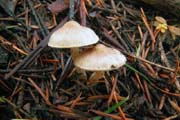 A and O Ceska |
| Inocybe geophylla is very common, relatively small, with a white umbonate cap, a whitish stem that is silky or finely fibrillose, spermatic odor, and elliptic spores. CAP 1.5-3cm, with nipple-like umbo, whitish, smooth, radially silky fibrous. ODOR spermatic. GILLS adnexed to notched, close, broad, white to light brown, edges fringed, white or colored as faces. STEM 2-6cm x 0.2-0.3cm, equal or slightly thicker at base, whitish, smooth, shining, pruinose at top, remainder finely fibrillose. CORTINA fibrillose to cobwebby. HABITAT on ground or occasionally very rotten wood. MICROSTRUCTURES spores 8-9.5 x (4.5)5-5.5 um, elliptic, smooth, a few spores obviously larger, 12-14 x 4.5-6.5 um, long elliptic; basidia 1-, 2-, and 4-spored; pleurocystidia 54-72 x 9-14 um, moderately thick-walled, narrowly subfusiform or nearly cylindric, crystals at apex, cheilocystidia similar to pleurocystidia, paracystidia 18 x 9 um, thin-walled, clavate; caulocystidia on stem apex, similar to pleurocystidia, clamp connections present in all tissues. REMARKS I. lilacina (Boud.) Kauffman has been regarded as a variety of this species (see remarks on I. pudica), but DNA sequences at the moment suggest it deserves autonomous status (P. B. Matheny, unpubl.). | Inocybe geophylla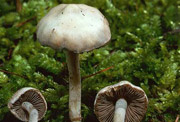 Michael Beug |
| Inocybe lilacina is common, relatively small, with dry lilac cap that is silky-fibrillose and often umbonate, close gills that are pallid or tinged lilac then grayish brown to dull brown, fibrillose stem colored like cap and more or less equal, spermatic odor, and elliptic spores. CAP 1.5-4 cm, obtusely conic or bell-shaped, expanding when old but often retaining an umbo, pale to deep lilac, often with some pinkish, grayish or brownish color, often paler when old, radially silky-fibrous. ODOR spermatic. GILLS adnate to adnexed or notched, close, moderately broad, tinged lilac at first then pallid becoming more gray-brown. STEM 2-6 cm x 0.2-1 cm, equal or slightly bulbous at base, colored similarly to cap but paler, near top pruinose, in lower part smooth to indistinctly fibrillose. CORTINA fibrillose to cobwebby. HABITAT on ground in woods. MICROSTRUCTURES spores 7.5-10.5 x 4.5-6.5 um, elliptic, smooth, basidia 4-spored, pleurocystidia frequent, 42-69 x 12-21 um, (sub)fusiform to (sub)utriform, sometimes more cylindric, thick-walled, crystals at apex, cheilocystidia frequent, similar to pleurocystidia, clamp connections present. | Inocybe lilacina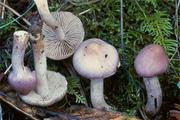 Boleslaw Kuznik |
Inocybe suaveolens is characterized by its white silky cap tinged with buff or cream color, its entirely pruinose white to pale yellow stem with a marginate bulb, and especially the persistent sweet odor, resembling that of the common sweet pea (Lathyrus). CAP 2-4.5cm, white, toward margin becoming yellowish or buff-tinged, silky-smooth and almost shining, soon becoming scaly. GILLS adnexed, rather close, pallid at first. STEM 3.5-8.5cm x 0.25-0.7cm, with distinct marginate bulb, whitish, everywhere densely white-pruinose. ODOR spermatic for an instant when flesh first cut, then immediately becoming and long remaining fragrant, like a mixture of the odors of sweet pea and lily-of-the-valley (Convallaria majalis). MICROSTRUCTURES spores 7-9(10) x 5.5-6.5(7) um, merely angular to decidedly nodulose; pleurocystidia 43-58(60) x 10-16.5 um, subfusiform to sublanceolate, apedicellate, very thick-walled, cheilocystidia of two kinds, one like the pleurocystidia in size and shape, the other smaller, clavate, thin-walled, 15-22.5 x 9-11 um, in dense clusters.
| Inocybe grammata Quél. is common and has a cap creamy white at disc and light grayish brown or pinkish brown toward margin, with a pinkish-tinged stem. I. albodisca Peck is a synonym according to Kühner (1933) and Vauras (1998). This key lead is designated "I. albodisca, the white form" in the original Stuntz key. CAP 1.5-3.5cm, pale grayish brown or pinkish brown except at center which has a persistent cream-colored superficial layer; smooth then a little fibrillose, silky. GILLS adnexed, close, narrow, whitish at first, edges fringed. STEM 3-5cm x 0.3-0.5cm, with a distinct marginate bulb; pale flesh-colored, pruinose at least in upper part. ODOR spermatic. MICROSTRUCTURES spores 6.5-8(9) x 4.5-6 um, angular in outline, with 7 to 9 rather small nodules; pleurocystidia 46-66 x 13-20 um, ventricose above a short narrow pedicel, with or without a short cylindric neck, colorless, thick-walled, edge of gills with thick-walled cheilocystidia like the pleurocystidia (50-65 x 14-20 um), and an abundance of thin-walled clavate sterile cells (19-35 x 5.5-9 um); apex of stem with clusters of cystidia, comprising two or more thick-walled cystidia 50-70 x 11-20 um and many thin-walled clavate sterile cells 22-33 x 8-11 um, base of stem with similar clusters. REMARKS For other species with a marginate bulb and nodulose spores, see remarks under I. mixtilis. | Inocybe grammata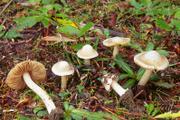 Michael Beug |
Inocybe kauffmanii.CAP 3-6cm, cream to pale yellow brown, fibrillose-scaly at center, becoming cracked toward margin. GILLS adnexed, close, narrow, broader near margin, pale gray brown, the edges white-fringed. STEM 4-8cm x 0.4-1.0cm, widened toward base, same color as cap or paler, may be pink at top; becoming bald, finely striate, entirely pruinose. MICROSTRUCTURES 8-10 x 5-6 um, elliptic-almond-shaped, cystidia moderately abundant, 45-50 x 12-16 um, thick-walled. REMARKSI. picrosma is similar but the stem becomes flushed dull vinaceous brown or dusky brown, and the odor is a mixture of radish-like and resinous with a vinegar component.
Inocybe picrosma is characterized especially by its unique odor, described as a mixture of radish-like and resinous with a vinegar component. CAP 1.5-4cm, pale creamy yellow to pale buff, sometimes flushed darker especially on disc, appressed silky-fibrillose, smooth and shiny at first, usually becoming scaly. GILLS adnexed to narrowly adnate, close, moderately broad, pallid in color when young. STEM 2.5-8.5cm x 0.3-0.7cm, equal with a flat bulb which may be abrupt, pale yellow becoming flushed dull vinaceous brown or fuscous brown, the margin of the bulb usually with a flush of salmon, satiny-shining, longitudinally hygrophanous-lined, white-pruinose at first, remaining so at top. ODOR sharp, penetrating (though not strong), spermatic for an instant when flesh first exposed, immediately becoming complex, a mixture of radish-like and resinous with component of vinegar. TASTE a little astringent and peppery at first, soon becoming mild and almost sweet, but leaving an unpleasant aftertaste. MICROSTRUCTURES spores 7-10(11) x 5-6 um, almond-shaped; pleurocystidia 36-60(63) x 16.5-21 um, fusiform-clavate, with obtuse apex and slender pedicel, very thick-walled above, cheilocystidia of two kinds, some similar to pleurocystidia in size and shape, others clavate, thin-walled, 22-56 x 8-11.5 um. REMARKS I. kauffmanii has a stem that does not become vinaceous brown and a different odor. I. suaveolens has a sweet odor and different microscopic characteristics.
Inocybe leucomelaena . It is not clear what species concept is being used here, though I. xanthomelas Boursier & Kühner would key out here and appears to occur in the Pacific Northwest (P. B. Matheny, pers. comm.) The name does not appear in Index Fungorum online as accessed November 18, 2004. It could be a provisional name.
| Inocybe mixtilis is common on the west coast. It has a conspicuously flat-marginate bulb on the stem, yellowish brown cap that is greasy when moist, and prominently nodulose spores. CAP 1.5-4cm, light brownish orange, honey, ocher, darker brown when young; smooth, or smooth in center and outwards indistinctly radially fibrous, lubricous (greasy) when moist. ODOR none or faintly spermatic. GILLS narrowly attached, notched, broad, cream or light gray at first, edges colored as faces. STEM 4-6cm x 0.4-0.7cm, equal down to distinct cuplike marginate base (to 1.0cm), white or with yellow-ocher hues; smooth and pruinose for entire length. CORTINA not observed. MICROSTRUCTURES spores 7.5-9.5 x 5.5-6.5 um, nodulose with about 8 protruding knobs and apiculus; pleurocystidia common, 40-58 x 14-19 um, fusiform to subfusiform, crystals at apex, walls pale yellow, thick-walled, cheilocystidia similar to pleurocystidia, paracystidia 13 x 9 um, thin-walled, clavate; clamp connections present in most tissues. REMARKS Inocybe napipes is similar in having a marginate bulb and nodulose spores but has a dry dark brown to chestnut cap, a turnip-shaped bulb, and a stem that is not obviously pruinose. Inocybe glabrodisca is similar in having a marginate bulb and nodulose spores but has a reddish brown to dark brown dry cap. Inocybe grammata also has a stem with marginate bulb, but has spores less distinctly nodulose, and has a bicolorous cap that is whitish at the center and light grayish brown or pinkish brown toward the margin. Inocybe xanthomelas Boursier & Kühner has a pruinose stem with a marginate bulb and nodulose spores, but the stem is pale yellow and darkens to gray or black with age and especially on drying, and the odor is oily-radish-like. Inocybe praetervisa Quél. has a stem with marginate bulb and somewhat larger nodulose spores (9-12(13) x 5-7(9) um): it has pale yellowish brown cap 2-6cm across with a greasy feel when moist and strong tendency to crack, crowded gills, and a whitish to straw-yellow stem that is pruinose at top and bald or slightly fibrillose. | Inocybe mixtilis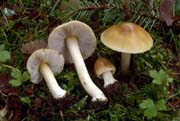 Steve Trudell |
See footnote 2 above. This key lead is designated "I. albodisca" in the original Stuntz key.
Inocybe fuscodisca is easily characterized by the dark brown fibrillose disc against a pallid ground color. CAP 1-2.5cm, umbo dark brown, cap covered with dark brown to dull brown, radially flattened fibrils over a pale buff to whitish ground color; smooth and subviscid over disc, otherwise moist to dry. ODOR spermatic. GILLS attached, close, broad, whitish at first. STEM 4-7.5cm x 0.15-0.3cm, equal, somewhat bulbous at base; sheathed from base to ring zone with dark brown to olive-brown fibrils over a whitish ground color, pruinose at top. CORTINA fleeting. MICROSTRUCTURES spores 7-10 x 4.5-6 um, elliptic, occasional ones up to 12-13 um long from 2-spored basidia); pleurocystidia 45-65(77) x (12)14-22(30) um, mostly 50-55 x 16-20 um, ventricose above a slender pedicel, with cylindric or slightly tapering neck, moderately thick-walled, cheilocystidia of 2 kinds, some resembling pleurocystidia, others thin-walled, clavate, 18-33 x 10-13 um; apex of stem with abundant dense clusters of caulocystidia, some like the pleurocystidia in wall thickness, but clavate to fusoid, and up to 85 um long, others thin-walled, varying greatly in size and shape, mostly clavate, about 20-50 x 14-20 um, base with abundant tangled superficial hyphae bearing numerous cylindric or clavate terminal cells, no caulocystidia; clamp connections present on almost all septa.
| Per P. B. Matheny (pers. comm.), I. agglutinata is a later name for I. whitei (B. & Br.) Sacc. However, Kuyper (1986) applied the name I. whitei to I. pudica. Until this taxonomic confusion is resolved, it is preferrable to maintain the most widely applied North American names, viz. I. agglutinata and I. pudica, to these species. CAP 1-3cm, reddish brown to orange brown or darker brown with no gray tones, the umbo usually darker, shading to whitish at margin; dry, fibrillose, streaked with appressed-agglutinate fibrils. GILLS adnexed, close, broad, at first whitish, the edges white-fringed. STEM 3-5cm x 0.2-0.4cm, equal, white or whitish, reddish brown or orange-brown to darker brown below, shading to whitish at top, pruinose at top, may be fibrillose below. MICROSTRUCTURES 9-11(12) x 5-5.5(6) um, elliptic or wedge-shaped, smooth; cystidia rather abundant on the sides of gills, more on the edges, 50-60(70) x 12-18 um, thick-walled, tapering below or with an abruptly slender pedicel, variable in shape, ovoid to ventricose-elliptic or subcylindric. | Inocybe agglutinata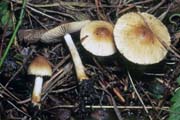 P Brandon Matheny |
| Inocybe cinnamomea resembles Chroogomphus tomentosus in color and stature. CAP 1.0-2.5cm, obtusely conic, sometimes becoming broadly conic to broadly bellshaped; dark avellaneous to dull reddish brown on disc with margin pale cinnamon colored; densely appressed fibrillose, not cracked. ODOR mild. TASTE disagreeable. GILLS adnate, moderately close, fairly broad, variable in color, at first tinged orange or orange cinnamon. STEM 4-6(8)cm x 0.4-0.6cm, equal or slightly club-shaped; covered by a soft coating of cinnamon fibrils which when old tend to become arranged in patches, becoming smooth. MICROSTRUCTURES spores 7-9 x 4-5.5 um, more or less oval, smooth; cheilocystidia of 2 types, 1) 25-33 x 10-20 um, fusoid-ventricose, with apices slightly incrusted and the walls above the inflated portion only slightly thickened, 2) saccate to subclavate, thin-walled, colorless. | Inocybe cinnamomea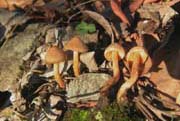 A and O Ceska |
Inocybe cincinnata usually has a lilac-tinted stem particularly at the top. The scattered brown fibrils on the stem and often brown gill edges are diagnostic. Stuntz used the name I. cincinnatula for this species. CAP 1.5-4.5cm, small compared with stem length, not umbonate, light brown, yellow-brown, medium brown, appressed-squamulose in center, with dark umber or concolorous scales which are recurved when old, radially fibrous or fine-scaly toward margin. ODOR spermatic. GILLS adnexed, more rarely notched or somewhat decurrent, well-spaced, somewhat broad when mature; white-gray-lilac combination when young, edges indistinctly fringed and colored as faces. STEM 3.5-7.5cm x 0.3-0.7cm, long compared with cap width and stout, equal, usually lilac at top or entire length, otherwise whitish-gray, with dark brown fibrils over entire length, especially toward base, almost reticulate in some. CORTINA present in some, fleeting and buff. MICROSTRUCTURES spores (8.5)9-11 x 5.5-6.5 um, somewhat almond-shaped to somewhat lemon-shaped, thick-walled; pleurocystidia numerous, 60-100 x 14-23 um, long and narrowly fusiform, pedicel long, crystals at apex, thick-walled, pale or bright yellow, cheilocystidia similar to pleurocystidia but shorter (to 60 um), paracystidia 13-36 x 9-18 um, pyriform or clavate, walls brown encrusted; caulocystidia absent, or extremely rare, similar to pleurocystidia; clamp connections present all tissues. REMARKS Inocybe griseolilacina J. Lange has a lilac upper stem but lacks the dark brown fibrils (stem not pruinose either). The odor is geranium-like instead of spermatic. Inocybe pyrotricha D.E. Stuntz is lavender at the top of the stem, but has rusty-red fibrils and an odor somewhat radish-like or faintly spermatic.
| Inocybe pusio has a violet to lilac stem, at least on the upper half. Stuntz used the name I. obscuroides in his key for this taxon or one very close. CAP 1.0-3.0(3.5)cm, dark hazel-brown, usually darker in center; finely fibrillose to tomentose, when old coarsely fibrillose to slightly appressed-scaly, margin with gray-whitish fibrils of cortina attached when young. ODOR faintly spermatic. GILLS broadly attached, 30-35 reach stem, broad; light gray with faint violet tint when young, edges white-fringed. STEM 2-4cm x 0.2-0.4cm, base slightly enlarged, violet to lilac overall or at least on upper half, sometimes tinted brownish toward the base, white-pruinose on upper third, weakly and sparsely whitish-fibrillose in lower part. MICROSTRUCTURES spores 7.7-10.8 x 4.7-6 um, elliptic to almond-shaped; cheilocystidia 47-70 x 13-18 um, fusiform, lageniform, to subutriform, thick-walled, with apical crystals, moderately thick-walled, abundant clavate cells present among them; pleurocystidia similar to cheilocystidia; most septa with clamps. | Inocybe pusio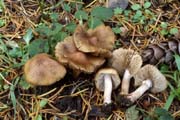 Steve Trudell |
Inocybe laetior is recognized easily by red-brown cap with brassy yellowish margin and salmon-pink stem. CAP 2-3.5cm, at first uniformly brown then becoming brassy yellowish at margin, smooth, appressed silky, marginal area often radially streaked with fibrils of the center. ODOR slight, spermatic or somewhat radish-like. GILLS adnexed to narrowly adnate or notched, not close, rather broad, pallid at first, edges usually finely saw-edged. STEM 2.5-7cm x 0.25-0.55cm, equal but the base usually slightly bulbous, bright salmon pink, base persistently white, stem satiny, longitudinally lined and entirely white-pruinose. MICROSTRUCTURES spores 9-11(13.5) x 5.5-6(6.5) um, inequilaterally almond-shaped, smooth; pleurocystidia (53)60-80 x 20-30 um, ventricose, with very short pedicel and obtuse apex, thick-walled, cheilocystidia mostly like the pleurocystidia in size and shape but a few small clavate thin-walled cells also present. REMARKS I. nitidiuscula has uniformly colored cap and less brightly colored stem.
Inocybe glabrodisca has a smooth red-brown to dark brown cap, a stem with pinkish flush that is entirely pruinose and that has a conspicuous flat-margined bulb, and prominently nodulose spores. Stuntz used the name I. oblectabilis forma decemgibbosa for this species. CAP 2-4cm, reddish brown to dark brown, the umbo often paler; lubricous when moist, shiny when dry, rimose (cracked), white webby fibrillose at first, becoming silky smooth. ODOR none. GILLS adnexed and notched, moderately broad, moderately close; pallid gray, becoming darker and more olivaceous. STEM 2.5-7cm x 0.3-0.7cm, with conspicuous flat marginate bulb, stem pale yellow, usually with more or less a pinkish flush, (base persistently white), satiny, finely white-pruinose and longitudinally hygrophanous-lined. MICROSTRUCTURES spores 9-11 x 6.5-8 um, oblong, with an average of eight rather coarse nodules; pleurocystidia 45-67.5 x 13.5-20 um, fusiform-ventricose with short neck and pedicels, moderately thick-walled, cheilocystidia like pleurocystidia in size and shape, also thin-walled and clavate, 22.5-30 x 9-11.5 um. REMARKS For other species with marginate bulb and nodulose spores see remarks under I. mixtilis.
| Inocybe olympiana CAP (2)3-7cm, yellow-brown to dull cinnamon, (either uniformly yellow-ocher or brown at center and yellow ocher at margin); innately fibrillose or when old finely scaly. TASTE more or less farinaceous. GILLS adnate or with slight decurrent tooth, close, broad, whitish when young, edge white-fringed. STEM 6-12cm x 0.8-1.2cm, equal above a somewhat marginate bulb, pallid soon becoming cap-colored or dingy brown, frequently darkening to smoky brown at base; sparsely fibrillose in lower part and coarsely pruinose in upper part. MICROSTRUCTURES spores 7-9 x 4-5 um; pleurocystidia very abundant, 60-90 x 10-16 um, thick-walled, apex incrusted, cheilocystidia similar but shorter. | Inocybe olympiana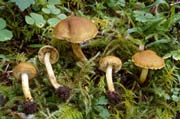 Steve Trudell |
| Inocybe rimosa has a large radially silky straw-yellow cap that is often darker at the center, and often strongly spermatic odor. Stuntz and many field guides used the name I. fastigiata. CAP 2-8cm, straw yellow to yellow-ocher (umbo darker), covered in radial silky fibers. ODOR mild to spermatic. GILLS adnexed, close, narrow, whitish then grayish tinged with olive. STEM 3-9cm x 0.4-1.2cm, no bulb, white or pale straw-colored, silky-fibrillose. CORTINA absent. MICROSTRUCTURES spores (9.0)9.5-14.5(15.5) x (5.5)6-8.5 um, elliptic; basidia 4-spored, a few 2-spored; pleurocystidia absent, cheilocystidia (28)30-65(80) x (9)10-22(23) um, (broadly) cylindric to (sub)utriform or subclavate, thin-walled, sometimes with yellowish brown contents; caulocystidia in clusters at apex of stem, similar to cheilocystidia (when stem apex flocculose) or as long catenate hairs with cheilocystidioid terminal element (when stem woolly-hairy) or as a mixture of both types. REMARKS A brighter yellow variant has been called I. holoxantha Grund & D.E. Stuntz. I. flavella P. Karst. is similar to I. rimosa with brownish yellow cap and slightly more slender (8-14 um wide) cheilocystidia. I. sororia has a corn silk odor and lighter cap. | Inocybe rimosa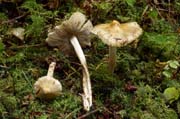 Steve Trudell |
Inocybe subdestricta Kauffman is possibly a synonym of I. nitidiuscula (Britzelm.) Sacc. and descriptions of both of these are given here. The description of I. subdestricta is derived from Kauffman (1924), and that of I. nitidiuscula from Cripps (1997).
Inocybe subdestricta has a dark-brown to rufous-brown cap, the umbo dark-chestnut or umber, a stem that is pallid, tinged rufous, and pruinose in upper part, and spores that are somewhat almond-shaped. CAP 2-4cm, subconic, conic-bellshaped, then expanded-umbonate, at length depressed around the darker abrupt umbo; dark-brown to rufous-brown, the umbo dark-chestnut or umber; dry, innately fibrillose at first, at length lacerate-scaly or rimose or both; flesh whitish. GILLS sinuate-adnexed, or deeply emarginate, with a slight decurrent tooth, close, medium-broad, ventricose; whitish, then pale-brownish-ashy, the edges white-fimbriate. STEM 2.5-5cm x 0.25-0.5cm, equal, scarcely subbulbous, solid; pallid, tinged rufous; varying flocculose-fibrillose to glabrescent, pruinose at apex. ODOR slightly nauseous. HABITAT on ground in mixed woods. MICROSCOPIC spores 8-10 x 5-5.5 um, almond-shaped, subelliptic, subinequilateral, smooth; pleurocystidia and cheilocystidia abundant, 50-65 x 15-18(20) um, rather thick-walled, varying thin-walled, subcylindric to ventricose, subovoid to subflaskshaped, obtuse at apex, tapering to a short pedicel.
| Inocybe nitidiuscula has a shiny cap that is brown to copper-tinted, a stem that is whitish (typically watery orange), floccose-pruinose in upper part, and covered with longitudinal white hairs in lower half, and somewhat almond-shaped spores. CAP 1-4cm, conic-convex when young with inflexed margin, then expanded conic-convex, margin inflexed or straight, umbonate or not, occasionally applanate; medium brown, dark brown, gray brown, with or without copper tints, infrequently with whitish bloom, shiny or becoming shiny on drying, smooth or minutely woolly at very center, outward becoming radially fibrous from fibrils which darken and sometimes diverge to reveal white flesh. ODOR spermatic. GILLS sinuate or adnate, occasionally broad, white or cream at first, edges white, tan, or colored as faces. STEM 2.5-6(8)cm x 0.3-0.7cm, club-shaped, white, typically watery orange to pinkish in upper half, heavily floccose-pruinose in upper third, covered with longitudinal white hairs on lower stem (watery orange if hairs removed on handling). CORTINA fleeting, white. MICROSTRUCTURES spores 10-12(13.5) x 5.5-6.5(7.5) um, subamygdaliform (somewhat almond-shaped), with or without conical apex which is occasionally large; pleurocystidia frequent, 50-63 x 13-22 um, variable, subfusiform, crystals at apex (or broadly fusiform without crystals), thick-walled, cheilocystidia similar to pleurocystidia, paracystidia 6-8 x 16-18 um, clavate, thin-walled; caulocystidia rare, similar to pleurocystidia, or long and narrow (up to 60 um), crystals at apex, paracystidia and caulocystidioid hairs also present; clamp connections present in all tissues. REMARKS I. catalaunica Singer (the correct name for I. leiocephala D.E. Stuntz), lacks a cortina and the entire stem is pruinose. I. fuscidula Velen. or a close species occurs in the Pacific Northwest, lacking pink or orange tints on stem and with smaller spores 8-10.8 x 4.6-6 um. | Inocybe nitidiuscula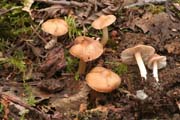 A and O Ceska |
Inocybe lanatodisca has yellow brown to copper brown cap often with patches of whitish fibrils at center, and green corn odor which fades and becomes more sweet and aromatic. CAP 2.5-9cm, yellow-orange to tawny; dry, or lubricous when moist, silky-smooth, often with a thin webby pallid coating of surface fibrils persisting as pallid patches at center. ODOR with three main components: green-corn, spermatic, and fragrant (sweet-aromatic), usually the green-corn component is strongest when the specimen is collected, but fades subsequently, and the fragrant component becomes more evident. GILLS adnexed, close, moderately broad; white becoming grayish olive, the edges white-fringed. STEM 3-12cm x 0.4-1.3cm, with club-shaped or abrupt bulb, stem white becoming pallid yellow, when old flushed with darker yellowish brown or a winy cast; satiny, bald to slightly fibrillose-streaked, sometimes pruinose at top. MICROSTRUCTURES spores 7-11 x 5-6.5 um, elliptic; basidia mostly 4-spored, but occasional 2-spored or 3-spored ones seen; pleurocystidia none, cheilocystidia abundant, in dense cluster along the gill edge, 33-65 x 14-25 um, clavate to subventricose to cylindric; stem apex with clusters of cells much like the cheilocystidia, mostly clavate and 28-50 x 9-25 um, with occasional elongated septate ones 50-90 um long; most septa with clamps. REMARKS Inocybe maculata Boud. differs in having dark brown to chestnut brown cap (with a silky layer in patches), and non-spermatic odor described as pungent aromatic or similar to Lycoperdon, Amanita phalloides, Tuber, or raw potatoes.
Inocybe napipes has a dark grayish brown to chestnut brown silky-fibrillose cap, fibrillose-satiny stem with turnip-like bulb, stem pallid at top and more brown below, strong fruity or rancid or unpleasant odor, and nodulose spores. CAP 1.5-5cm, grayish brown, dull brown, dark brown, or chestnut brown, silky-fibrillose, shining, soapy-feeling when wet. ODOR strong, fruity, rancid, or spermatic. GILLS adnexed, when young whitish. STEM 4-7cm x 0.4-0.8cm, base with a distinct bulb, stem pallid at top, more brown below, fibrillose, satiny. CORTINA present when cap opens. MICROSTRUCTURES spores 7-10 x 5-7.5 um, angular-nodulose, irregularly polyhedral, with 6-10 prominent rather large nodules; pleurocystidia 38-55 x 13-19 um, mostly 45-50 x 18 um, ventricose above a rather slender pedicel, with obtusely rounded apex, the wall thin to moderately and uniformly thickened (1.0-1.6 um), mostly crested, cheilocystidia of two kinds, one like pleurocystidia but shorter and with less of a pedicel, the other of short thin-walled clavate cells like the basidia in size and shape; apex of stem with rare, widely scattered caulocystidia resembling the pleurocystidia, occasional clusters of elongated, thin-walled caulocystidia that are sometimes septate, and some tangled superficial hyphae with abundant clavate to cylindric terminal cells, base with sparse tangled superficial hyphae but no caulocystidia; most septa with clamps. REMARKS I. mixtilis is similar but has a marginate bulb and lacks a cortina, is more lubricous on the honey-colored cap, has a sharper edge to the bulb, and is pruinose the entire length of the stem. For other species with marginate bulb and nodulose spores, see remarks under I. mixtilis.
| Inocybe lacera is common in the Pacific Northwest. It has a dark brown dry cap that is densely fibrillose to fibrillose-scaly and splits readily, stem often dark brown at base, elongate spores, and pleurocystidia often with subacute apices. CAP 1-4cm, dark brown (lighter when weathered), densely fibrillose to fibrillose-scaly, splitting when old. ODOR mild to fungoid or slightly spermatic. GILLS adnate, crowded (when young), moderately broad, whitish at first, may bruise darker brown, edges whitish. STEM 1-4.5cm x 0.2-0.6cm, base may be a little swollen, whitish to brown and colored like cap, darker toward base, rough fibrous, smooth above cortina. CORTINA fibrous, tan, fleeting. MICROSTRUCTURES spores 12-14 x 4.5-5 um, cylindric, long elliptic, smooth, slightly angular, with thick walls; basidia (2-)4-spored; pleurocystidia common, 54-68 x 10-19 um, subfusiform, with fine crystals or none at apex, thick-walled, cheilocystidia similar to pleurocystidia or broader, some subcapitate, paracystidia 25-30 x 10-15 um, thin-walled, typically clavate, but variable; clamp connections present in all tissues, (all for var. lacera), spores extremely variable in size and shape, total range in size 5.5-17 x 4-6.5 um, occurring in approximately four size categories, 5.5-6 x 4-4.5 um, 8-9 x 5 um, 10-11 x 4.5 um and 12-15.5 x 4.5-6.5 um, varying in shape from round to ovate, oval, kidney-shaped, inequilaterally almond-shaped, nearly cylindric, to the usual boletoid outline of the normal spore of I. lacera, (for var. heterosperma) | Inocybe lacera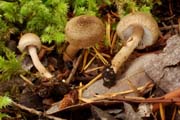 A and O Ceska |
| Inocybe calamistrata, sometimes called the green-foot fibre-head, is fairly common in the Pacific Northwest. It features a scaly convex cap, a greenish stem base, and an odor that ranges from fishy-resinous to flowery-pearlike to green corn or spermatic. CAP 1-4cm, bell-shaped to convex, expanding only slightly when old, margin not typically splitting; dark brown to coffee-brown, surface dry, breaking up into small densely-arranged scales, or sometimes torn-fibrillose toward margin; flesh pallid, becoming somewhat reddish-tinted when cut, bruising reddish to dingy brown, in stem base blue-green. GILLS adnate to adnexed or notched, close, broad, brownish to olive-tinted, the edges whitish-fringed at first. STEM 3-10cm x 0.2-0.8cm, tall, base usually somewhat expanded, stem covered with recurved scales (like cap) which may wear away when old, brown to dark brown (like cap), paler in upper part, the base or lower part (or sometimes the whole stem) dingy greenish-blue to olive-green. MICROSTRUCTURES spores 9-13 x 4.5-6.5 um, elongate elliptic; pleurocystidia lacking, cheilocystidia 33-50(55) x 10-20(22) um, clavate or subcylindric with obtuse apex, thin-walled, colorless, sometimes becoming brown in older specimens; apex of stem with clusters of clavate, thin-walled caulocystidia 27-50 x 10-22 um, base with tangled skeins of superficial hyphae, no caulocystidia; clamps present on most septa. REMARKS I. hirsuta (Lasch) Quél. variety maxima A.H. Sm. may also be green at the base, but has a more reddish brown cap, and flesh turns more strongly reddish when exposed or bruised. | Inocybe calamistrata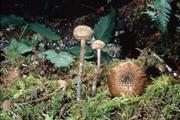 Kit Scates |
| Inocybe lanuginosa group. Three species in the I. lanuginosa group key out here. Inocybe lanuginosa (described below) is indistinguishable in the field from I. leptophylla. I. leptophylla is less restricted to woody substrates than I. lanuginosa but identification must be made microscopically: Inocybe leptophylla has larger spores (8)9-12(12.5) x (6)7-9(9.5) um, with more nodules (9)10-16(18), lacks pleurocystidia, and has somewhat larger basidia (22)24-35(38) um long. The third species, Inocybe stellatospora, is subtly different in the field, with a shaggy-squamulose cap (rather than squarrose to squamulose), is infrequent in the Pacific Northwest, and typically grows on the ground. The thin-walled elongated pleurocystidia of I. stellatospora easily separate it from I. lanuginosa and I. leptophylla. The latter lacks pleurocystidia altogether. | Inocybe lanuginosa group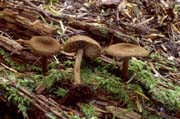 Steve Trudell |
The taxonomy of this group was worked out by Matheny & Kropp (2001). Distinguishing features of the I. lanuginosa group are the brown squarrose to squamulose cap, young gills that are pallid and become brown with age, brown squamulose, floccose to woolly-fibrillose stem, occurrence on soil, among Sphagnum or on rotten wood under members of Pinaceae in the northern hemisphere, and nodulose spores. The following conforms to their description for I. lanuginosa in the strict sense. (Inocybe lanuginosa sensu M.M. Moser, Stangl is not this species, but rather represents I. stellatospora (Peck) Massee.) CAP 1.0-3.5cm, brown with darker center, disc with small crowded hispid squarrae (bristle-like upright to curved-up pointed scales), squamulose (finely scaly) or recurved-squamulose toward the margin, tearing with age but not rimose (not cracking), neither shaggy nor revealing a pallid ground color. ODOR not remarkable. GILLS adnate to notched, close, pallid at first, edges pallid and fringed. STEM 2.0-4.5cm x 0.3-0.7cm, equal to slightly enlarged at base, extreme apex pallid, lower half colored as cap; extreme apex pruinose, lower half woolly-fibrillose or floccose to appressed-(sub)squamulose, less so towards top. CORTINA fleeting. HABITAT In North America I. lanuginosa appears restricted to rotten woody substrates, where conifers are present, but in Europe, it is cited more frequently on the ground and at times under hardwoods. MICROSTRUCTURES spores 8-10.5(11) x (5)5.5-7.5(8) um, distinctly nodulose, outline often subelliptic, typically with (8)9-13(14) nodules; basidia 4-spored, (14)19-30(34) um; pleurocystidia frequent to infrequent, (26)29-46(48) um long, obovate, pyriform to broadly clavate, less often elliptic or utriform, walls thin to slightly thickened, apices crystalliferous, basal pedicel short, cheilocystidia abundant, (17)22-43(56) x (10)11-20(22) um, similar to pleurocystidia though somewhat shorter, also some ventricose to utriform, paracystidia broadly clavate, pyriform to subelliptic, thin-walled, colorless; caulocystidia present at (extreme) apex, generally utriform, obovate to subcylindric, colorless to pale brown, usually thin-walled, apices crystalliferous or not, well-rounded to subcapitate, in dense clusters; clamps frequent. REMARKS Growth on wood is in general unusual behaviour for Inocybe, but has been observed for instance with the similar species I. leptophylla, I. stellatospora, and I. subcarpta. Inocybe subcarpta Kühner & Boursier lacks the squamulose stem, but weathered specimens can be confused.
- END -