Steve Trudell
Dr. Stuntz included in his key the commoner Hygrophorus species from Washington. While it includes the majority of species likely to be encountered in the Pacific Northwest, most interested amateurs will find less common species as well. As this group of mushrooms draws more than its share of interest due to the bright colors or many of the species, a brief account of less common species has been added as an appendix, organized according to Dr. Stuntz's sections. Some of them are recorded by Hesler & Smith from Idaho or Oregon but not from Washington.
The structure and details of the keys have not been altered, lest the wide experience of Dr. Stuntz be accidentally diminished. "NOTES" represent Dr. Stuntz's comments. "REMARKS" were added during the revision. In reformatting, the page references to the Hesler & Smith monograph and to the older field guides have been removed. In the few cases where Pacific Northwest material from the species is not included in the monograph, this is noted in the remarks.
Many of the species included in Hygrophorus by Hesler and Smith have been segregated by various authors into different genera (Hygrocybe, Camarophyllus, Camarophyllopsis, Neohygrophorus, Cuphophyllus, etc.) The renaming process is far from complete: it has been decided for ease of usage here to retain the name Hygrophorus for all the species.
In this key to species of Hygrophorus found in Washington, the species are divided into nine groups, each group characterized by the color of the cap, as follows:
In each of these groups, a further subdivision is made as follows:
It may happen that only two of these subgroups will occur in some of the nine main groups. In any event, if you know the normal color of the cap, and can tell whether or not cap and/or stem are viscid, the combination of a group I through IX plus a subgroup A through C narrows the choice of species to no more than 6 or 7, usually less.
It is well to remember that color can vary considerably with age and with weather. To some extent this has been gotten around by including species with variable color in several places in the key. The perception of viscid surfaces can be difficult in specimens that have developed during dry weather, or that have been subjected to enough rain to wash off most of the slime. The "lip test" is helpful in detecting viscid layers that have dried, but in really dubious cases recourse to the microscope may be the only sure way of settling the question. Dry surfaces of soft-fleshed species (e.g., Hygrophorus flavescens) may seem viscid if much handled, because of sticky cell contents released by the breaking of the delicate cell walls.
A brief description is appended to each key entry that leads to a species in its proper section. In parentheses following each description are given the spore measurements (in microns, taken from the Hesler-Smith monograph) and the type of gill tissue, indicated as follows:
PL = parallel or subparallel
IW = interwoven
DV = divergent
Sometimes these features are the only ones that will really separate two species with essentially the same colors and viscid surfaces.
I. Cap white. (Note: caps that are pure white when in conditions of vigorous growth often will take on a tinge of cream or buff upon aging, or on drying out.)
I A. Cap white, both cap and stem viscid
1a Margin of cap and top of stem bearing many small, golden yellow granules
................................................................................H. chrysodon
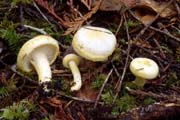
| CAP 1-3 inches broad. ODOR and TASTE mild. GILLS decurrent, white with yellow edges. STEM as long or longer than the width of the cap, 1/4 to 1/2 inch thick, viscid except at the top. MICROSTRUCTURES spores 7-10 x 3.5-5 microns; DV. | Hygrophorus chrysodon Steve Trudell |
1b No yellow granules on cap or stem
................................................................................2
2a Stem 1/2 inch or more thick, usually shorter than the cap width; caps large (usually more than 5 inches wide) and thick-fleshed
................................................................................see H. gliocyclus, in section II.
2b Stem usually less than 1/2 inch thick, and usually longer than the cap width; most caps medium-sized (less than 5 inches wide), with rather thin flesh except at the very center
................................................................................3
3a Gills lemon yellow; cap less than 1/2 inch broad; stem one eighth inch or less thick
................................................................................see H. citrinopallidus, in section IV
3b Gills not lemon yellow; both cap and stem larger than the above choice
................................................................................4
REMARKS If neither choice 3a or 3b fits and there is a fibrillose ring near top of stem, consider H. albiflavus (see Appendix).
4a Gills becoming brownish in old specimens, and turning dark red-brown when dried
................................................................................H. chrysaspis
CAP 1 to 2 1/4 inches broad, convex, drying tawny or with black stains at center. ODOR and TASTE not distinctive. GILLS adnate, white becoming yellow where bruised. STEM as long as width of cap, slender, white, yellow where bruised. MICROSTRUCTURES spores 7-9 x 3.4-4.5 microns; DV.
4b Gills becoming pale yellowish or pale buff in age or when dried
................................................................................H. eburneus
| CAP 1 to 4 inches broad, convex, drying pale buff or yellowish. ODOR and TASTE not distinctive. GILLS decurrent, white, not discoloring markedly in age or when dried. STEM longer than width of cap, slender, white. MICROSTRUCTURES spores 6-9 x 3.5-5 microns; DV. | Hygrophorus eburneus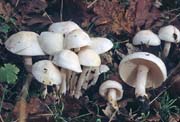 Michael Beug |
I B. Cap white, cap viscid, stem not viscid.
1a Stem slender (less than 1/2 inch thick), usually longer than width of the cap
................................................................................2
1b Stem stout (1/2 inch or more thick), usually shorter than the width of the cap
................................................................................3
2a Cap translucent-striate almost to the center when wet
................................................................................H. niveus
CAP 1 - 2 inches broad; flesh thin, pliant. ODOR and TASTE not special. GILLS decurrent, white, becoming yellowish. STEM white, smooth. MICROSTRUCTURES spores 7-10 x 4-5.5 microns; IW. REMARKS Arnolds 1986 (as quoted in Breitenbach et al.) includes Camarophyllus niveus in Hygrocybe virginea.
2b Cap not translucent-striate when wet
................................................................................H. piceae
| CAP 1 - 2 inches broad, convex; flesh thick at the center. ODOR and TASTE not distinctive. GILLS adnate then somewhat decurrent, white becoming pale buff. STEM white, smooth below, fibrillose at apex. MICROSTRUCTURES spores 6-9 x 4-5.5 microns; DV. | Hygrophorus piceae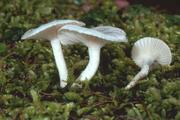 Michael Beug |
REMARKS If cap or gills have a pinkish tinge or habitat is near snowbanks, consider H. albicarneus (see Appendix). If 2a and 2b do not fit, and gills are contrasting creamy yellowish consider H. melizeus forma minor (see Appendix).
3a (1b) Base of stem with a large bulb whose flat upper rim bears a narrow, flaring, membranous, ragged ring in young specimens that have just expanded
................................................................................H. subalpinus
| CAP 2 to 6 or 8 inches broad, sometimes larger, convex then shallowly concave; flesh thick. ODOR and TASTE mild. GILLS decurrent, narrow, white. STEM dry, white, firm, solid. MICROSTRUCTURES spores 8-10 x 4.5-5 microns; DV. | Hygrophorus subalpinus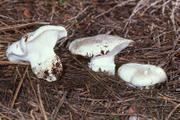 Michael Beug |
3b Base of stem not bulbous (often narrowed or bluntly pointed); no veil, no ring
................................................................................H. sordidus
| CAP 4-8 inches broad, convex; flesh thick. ODOR and TASTE not special. GILLS decurrent, white, becoming slightly yellowish. STEM white, smooth. MICROSTRUCTURES spores 6-8 x 4-5.5 microns; DV. REMARKS H. penarius has slightly darker cap but may be the same species. | Hygrophorus sordidus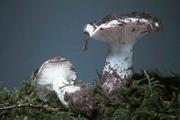 Ben Woo |
I C. Cap white, neither cap nor stem viscid.
1a Cap becoming yellowish at least at the center
................................................................................H. virgineus
| CAP 1 - 2 inches wide; flesh white. ODOR and TASTE not special. GILLS decurrent, white, becoming tinged yellow. STEM smooth, white, rarely tinged salmon pink or pinkish lavender in the lower half. MICROSTRUCTURES spores 8-11 x 5-7 microns; IW. REMARKS Arnolds 1986 (as quoted in Breitenbach et al.) includes Camarophyllus niveus in Hygrocybe virginea. | Hygrocybe virginea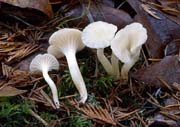 Steve Trudell |
1b Cap remaining white even at the center
................................................................................H. borealis
| CAP 1/2 to 2 inches broad; flesh white. ODOR and TASTE not special. GILLS decurrent, white. STEM smooth, dull, white. MICROSTRUCTURES spores 7-10 x 4.5-6.5 microns; IW. | Hygrophorus borealis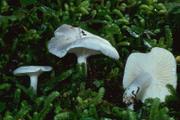 Michael Beug |
REMARKS If there is an odor of cedar or a medicinal taste, consider H. russocoriaceus (see Appendix). If 1a and 1b do not fit, and gills are contrasting creamy yellowish consider H. melizeus forma minor (see Appendix).
II. Cap ivory, pale cream, pale yellow, pale buff or beige, pale salmon flesh color, pale pinkish, vinaceous buff, or pallid cinnamon; usually uniformly colored, but the margin may be somewhat paler than the center.
II A. Cap buff, etc., both cap and stem viscid
1a Margin of cap and top of stem decorated with many small, bright golden yellow granules
................................................................................see H. chrysodon, in section I.
1b Margin of cap and top of stem not covered with bright golden yellow granules
................................................................................2
2a Stem slender for its length, usually 2 or 3 times as long as the width of the cap, and 1/4 inch or less thick
................................................................................3
2b Stem stout, thicker for its length than in the above, usually about as long as the width of the cap (or shorter)
................................................................................4
REMARKS If neither 2a or 2b fits well, or if odor is distinctly aromatic, consider H. cossus (see Appendix.)
3a Gills decurrent, pale pinkish or pale grayish lilac
................................................................................H. laetus
| CAP 1/2 to 1 1/2 inches broad, convex, usually becoming depressed in the center, slimy, very variable in color, usually pale grayish violet, but may be orange, reddish orange, onion-skin pink, or dingy brown. ODOR none, or faintly fishy. GILLS tough, subdistant. STEM 2 to 5 inches long, slimy, same color as the cap. MICROSTRUCTURES spores 5-8 x 3-5 microns; PL. | Hygrocybe laeta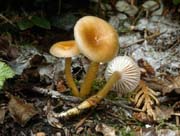 Steve Trudell |
3b Gills not decurrent (adnate), yellow, often retaining a trace of their original green color where they are fastened to the cap
................................................................................see H. psittacinus, in section IX.
4a (2b) Cap pale to bright pinkish buff; lower part of the stem with only a thin layer of slime that breaks into yellowish patches, and does not form a glutinous ring
................................................................................H. vernalis
CAP 1 to 2 inches broad, convex; flesh thick. ODOR not distinctive. GILLS decurrent, whitish. STEM 1 to 2 inches long, whitish. MICROSTRUCTURES spores 11-16 x 5.5-7 microns; DV.
4b Cap pale yellow or nearly white, without any pinkish cast; lower part of the stem with a thick, glutinous sheath that forms a glutinous ring when the cap opens, and does not break into yellowish patches
................................................................................H. gliocyclus
| CAP 3 to 6 inches or more broad, convex, slimy; flesh thick, white. ODOR not special. GILLS adnate or decurrent, subdistant, white then pale yellow. STEM about 1 1/2 to 5 or 6 inches long, white. MICROSTRUCTURES spores 8-11 x 4.5-6 microns; DV. REMARKS the European version has been considered a synonym of Hygrophorus ligatus Fr. | Hygrophorus gliocyclus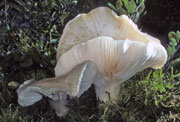 Kit Scates Barnhart |
REMARKS If neither choice fits well, and cap is white with yellow to orange or orange tan disc, or that color over the whole cap, and gills are pink fading to whitish, consider H. flavodiscus. If neither choice fits well and there are watery drops near the top of the stem that dry to reddish dots, consider H. glutinosus. See Appendix for either species.
II B. Cap buff etc., cap viscid, stem not viscid
1a Taste intensely and persistently bitter
................................................................................H. amarus
CAP 1 to 3 inches broad, convex, slimy, flesh color or buff, sometimes yellow tinged with orange in the center. ODOR not distinctive. GILLS adnate or somewhat decurrent, pale yellow becoming spotted with pink. STEM 1 to 2 times as long as the width of the cap, 1/2 inch or more thick, white or flushed with pink. MICROSTRUCTURES spores 7-8.5 x 4.5-6 microns; DV. REMARKS H. erubescens is sometimes described as bitter but has dark reddish brown cap and pinkish gills spotted or stained reddish; H. pudorinus which may also be bitter doesn't have the fibrillose stem sheath of H. amarus.
1b Taste not bitter
................................................................................2
2a Stem slender, 1/4 inch or less thick
................................................................................H. pusillus
| CAP 1/2 to 1 1/2 inches broad, convex then flat, creamy yellow to pale brownish flesh color at the center, pallid at the margin. ODOR slightly fragrant. TASTE mild. GILLS adnate or slightly decurrent, white. STEM 1 to 3 inches long, white. MICROSTRUCTURES spores 7-9 x 4-5 microns; DV. REMARKS If odor is faintly medicinal or gills buff, consider H. burgdorfensis. If odor is faintly aromatic, sweet, fruity, or spicy, stem pruinose, and gills pinkish cinnamon, consider H. subpungens. If odor not distinctive, but cap very pale pinkish and copious white fibrillose veil remnants are present on stem, consider H. velatus. (See Appendix for these 3 species.) | Hygrophorus pusillus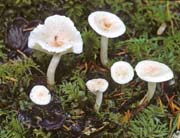 Kit Scates Barnhart |
2b Stem stout, fleshy, more than 1/4 inch thick (up to 1 1/2 or even 2 inches thick in large specimens)
................................................................................3
REMARKS If cap and gills are apricot orange, or if neither 2a or 2b fits well, consider also H. ellenae. If habitat near snowbanks, consider also H. goetzii. (See Appendix for either species.)
3a Gills white or pallid
................................................................................H. penarius
CAP 2 to 3 inches broad, convex, viscid at first but soon becoming dry, and then does not look viscid, pinkish tan to straw color at the center, paler at the margin; flesh white. ODOR and TASTE not special. GILLS slightly decurrent. STEM about as long as the width of the cap, about 1/2 inch thick, white. MICROSTRUCTURES spores 5-7 x 3.5-4 microns; DV. REMARKS H. sordidus has slightly lighter cap but may be the same species.
3b Gills pink, salmon pink, or pale pinkish cinnamon
................................................................................4
4a Gills soon becoming spotted and stained with wine red or dull cherry red
................................................................................see H. erubescens, in section VII
4b Gills not becoming spotted or stained with red
................................................................................5
5a Top of stem dotted with rough white points that quickly turn yellow or orange in 3% potassium hydroxide solution, and turn red-brown when the specimen is dried
................................................................................H. pudorinus var. fragrans
| CAP 2 1/2 to 8 inches broad, pale apricot color or salmon pink at the center, paler pink at the margin; flesh thick, staining yellow then orange where bruised. ODOR faintly fragrant. GILLS adnate, pale pinkish or pinkish cream. STEM 4-8 inches long, 1/2 to 2 inches thick, white or flushed with pink. MICROSTRUCTURES spores 7-9.5 x 4.5-5.5 microns; DV. | Hygrophorus pudorinus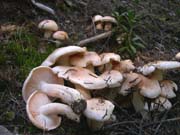 Andrew Parker |
5b Top of stem not dotted with rough white points that turn red-brown when dried
................................................................................H. saxatilis
| CAP 1 1/2 to 4 inches broad, convex or broadly umbonate, slightly viscid but soon becoming dry and then not appearing viscid, pale pinkish buff or pale pinkish cinnamon, margin paler; flesh pale pinkish buff, not staining yellow or orange where bruised. ODOR faint of dried peaches. GILLS decurrent, pale yellowish salmon or pinkish cinnamon. STEM as long as the width of the cap, 1/2 to 1 inches thick, same color as the cap at first, with age becoming same color as the gills. MICROSTRUCTURES spores 7-9.5 x 4-6 microns; DV. | Hygrophorus saxatilis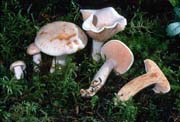 Michael Beug |
II C. Cap buff etc., neither cap nor stem viscid
1a Gills white, becoming tinged pale yellow only with age, or not at all
................................................................................2
1b Gills colored from the first, yellow, buff, salmon buff, etc., and if anything fading with age
................................................................................3
REMARKS If gills are bluish green, see H. caeruleus in Appendix. If cap and gills are white and become apricot orange, consider also H. ellenae (see Appendix).
2a Stem slender, about 10 times as long as it is thick, about 1/4 of an inch thick (or less)
................................................................................see H. virgineus, in section I
2b Stem stout, about 4 times as long as it is thick, about 1/4 to 1/2 inch thick
................................................................................see H. penarius, in subgroup B of this section
3a (1b) Cap less than 1 1/2 inches broad; gills clear yellow
................................................................................H. cremicolor
CAP obtuse, with cottony margin at first, white at first becoming creamy ocher or tinged salmon color; flesh thin, same color as the surface. ODOR and TASTE not special. GILLS decurrent, distant, narrow, retaining their color even when the cap fades to white, as it often does. STEM 2 to 3 inches long, 1/8 to 1/4 inch thick, same color as the cap. MICROSTRUCTURES spores 5-7 x 3.5-4.5 microns; IW.
3b Cap 2 to 4 inches or more broad; gills not yellow
................................................................................4
REMARKS If intermediate in size between 3a and 3b, and has sweetish fragrant odor and pinkish cinnamon colors, consider H. graveolens (see Appendix).
4a Cap hygrophanous, that is, much darker in color when wet, and fading markedly upon losing moisture (turn dry caps upside down in a shallow container of water to test this feature); odor none, or not distinctive
................................................................................see H. pratensis, in section V
4b Cap not hygrophanous, not fading markedly in color upon losing moisture; odor faintly but unmistakable of dried peaches
................................................................................see H. saxatilis, in subgroup B of this section
III. Cap red-brown or tan, or occasionally yellow-brown in the center, pallid to white at the margin ("bicolorous") when mature (very young caps may be more or less evenly red-brown).
III A. Cap bicolorous brown and whitish, both cap and stem viscid.
Only one species
................................................................................H. variicolor
CAP 1 1/2 to 3 inches broad, convex or broadly and shallowly umbonate, slimy, reddish brown to cinnamon brown at the center, whitish at the margin; flesh thick, white. ODOR almond (benzaldehyde). TASTE mild. GILLS short-decurrent, white. STEM 3 to 4 inches long, about 1/2 inch thick, white, the lower half or third slimy, upper part dry. MICROSTRUCTURES spores 7-9 x 4.5-5.5 microns; DV. REMARKS Other almond scented species include H. agathosmus, H. bakerensis, H. monticola, H. odoratus, and H. vinicolor. H. variicolor is similar to H. bakerensis apart from the slimy stem. If odor is mild, gills tinged buff, and fibrillose points on upper stem, consider H. discoideus (see Appendix).
III B. Cap bicolorous brown and whitish, cap viscid, stem not viscid
1a Gills pinkish buff to pinkish cinnamon (yellowish with definite pink cast); stem staining yellow then orange where bruised, its top dotted with rough white points that turn yellow in 3% potassium hydroxide solution, and become red-brown when the specimen is dried
................................................................................see H. pudorinus var. fragrans, in section II.
1b Gills white or yellow, but if yellow, lacking any tinge of pink; stem not becoming yellow or orange when bruised, its top not with rough white points that turn yellow in alkali solutions and dry red-brown
................................................................................2
2a Gills yellow from the first; odor strong and penetrating, aromatic, but not like almond flavoring (benzaldehyde)
................................................................................H. pacificus
| CAP 1 1/2 to 3 inches broad, convex, evenly red-brown at first, then red-brown at the center and pinkish buff at the margin. ODOR strong and penetrating, aromatic. GILLS adnate, broad, distant. STEM about as long as the width of the cap, about 1/2 inch thick, pale yellowish or white. MICROSTRUCTURES spores 10-14 x 5.5-7.5 microns; DV. | Hygrophorus pacificus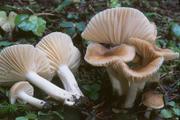 Michael Beug |
2b Gills white at first and remaining so, or becoming creamy white (not truly yellow) in age; odor strong of almond flavoring (benzaldehyde)
................................................................................H. bakerensis
| CAP 1 1/2 to 6 inches broad, convex, slimy, red-brown or cinnamon brown at the center, pallid or almost white at the margin. ODOR almond. GILLS short-decurrent. STEM 3 to 6 to 8 inches long, 1/2 to 1 inch thick, white. MICROSTRUCTURES spores 7-10 x 4.5-6 microns; DV. REMARKS Other almond scented species include H. agathosmus, H. monticola, H. odoratus, H. variicolor, and H. vinicolor. H. variicolor is similar apart from having a slimy stem. If odor is of raw potatoes instead, and taste is bitter, see H. tennesseensis in Appendix. | Hygrophorus bakerensis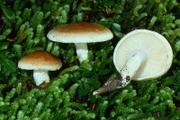 Michael Beug |
IV. Cap some shade of bright yellow, lemon yellow, egg yolk yellow, creamy yellow, chrome yellow, etc.
IV A. Cap yellow, cap viscid, stem viscid.
1a Taste very bitter
................................................................................see H. reai, in section VI.
1b Taste not bitter
................................................................................2
2a Cap 1/2 inch or less in diameter
................................................................................H. citrinopallidus
CAP 1/4 to 1/2 inch broad, convex, lemon yellow fading to white; flesh very thin. ODOR and TASTE not special. GILLS long-decurrent, lemon yellow, remaining so when cap fades. STEM 1/2 to 3/4 inch long, about 1/8 inch thick, lemon yellow fading to white. MICROSTRUCTURES spores 7-10 x 4.5-5 microns; IW.
2b Cap more than 1/2 inch broad
................................................................................3
3a Stem hollow
................................................................................4
3b Stem solid, or sometimes filled with a soft webby pith
................................................................................6
4a Cap very soon becoming depressed in the center, finally deeply concave with shallowly rounded margin; gills decurrent
................................................................................H. nitidus
| CAP 1/2 to 1 1/2 inches broad, yellow fading to white; flesh very thin, yellow fading to white. ODOR and TASTE not special. GILLS long-decurrent, narrow, yellow. STEM 1 1/2 to 3 1/2 inches long, 1/8 to 1/4 inch thick, yellow. MICROSTRUCTURES spores 6.5-9 x 4-5 microns; PL. | Hygrocybe nitida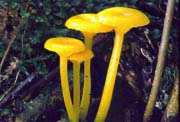 George Barron |
4b Cap not becoming deeply concave, but remaining convex, conical, or bell-shaped, or becoming flat; gills not decurrent
................................................................................5
5a Cap and stem taking on pinkish tinges with age or when dried
................................................................................see H. psittacinus, in section IX.
5b Cap and stem remaining deep lemon yellow when old or upon drying, or sometimes tinged with orange at center of the cap, but not pink
................................................................................H. chlorophanus
| CAP 1 to 2 inches broad, convex then flat, translucent-lined at the margin; flesh thin, fragile, yellow. ODOR and TASTE not special. STEM 1 to 3 inches long, 1/4 to 3/8 inch thick, deep lemon yellow. MICROSTRUCTURES spores 6-8 x 4-5 microns; PL. REMARKS Gills are adnexed, becoming emarginate, rather close, narrow near cap margin; whitish to yellowish, (Hesler & Smith). If gills are broadly adnate to subdecurrent, and cap and stem are only slightly viscid, consider H. ceraceus (see Appendix). | Hygrocybe chlorophana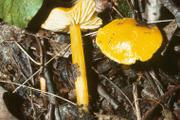 Ben Woo |
6a (3b) Sporocarps associated only with larch; center of cap sometimes tinged orange or red, but not brown
................................................................................see H. speciosus, in section V.
6b Sporocarps associated with conifers other than larch (sometimes also hardwoods), mostly with 2- or 3-needle pines; center of cap retaining a rather dark brown color
................................................................................see H. hypothejus, in section VIII.
IV B. Cap yellow, cap viscid, stem not viscid.
1a Taste intensely and persistently bitter
................................................................................see H. amarus, in section II.
1b Taste not bitter
................................................................................2
2a Cap cone-shaped; flesh red under the surface; cap regaining its original red color when dried
................................................................................see H. cuspidatus, in section VI.
2b Cap convex to flat, never cone-shaped; flesh without any red color under the surface; cap not becoming red when dried
................................................................................H. flavescens
| CAP 1 to 3 inches broad, yellow, but sometimes varying to orange; flesh thin, fragile, yellow. ODOR and TASTE not special. GILLS narrowly attached, yellow. STEM 1 1/2 to 3 inches long, 3/8 to 5/8 inches thick, white at the base, orange in the middle, yellow at the top. MICRO-STRUCTURES spores 7-9 x 4-5 microns; PL. REMARKS H. subceraceus is somewhat similar, with smaller spores (see Appendix). | Hygrocybe flavescens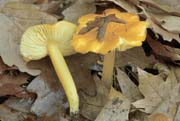 Steve Trudell |
REMARKS If cap has pointed umbo and no red in the cap, consider H. acutoconicus (see Appendix). If cap is obtuse to convex +/- depressed disc, gills are decurrent, and stem tinged red or orangy pink, consider H. parvulus (see Appendix).
IV C. Cap yellow, neither cap nor stem viscid.
1a Cap covered with tiny, scurfy, dull brown to black squamules
................................................................................see H. turundus, in section VI.
1b Cap with fine, bran-like scales, but the scales are yellow, not brown or black
................................................................................2
REMARKS H. turundus var. sphagnophilus has light colored scales which may darken somewhat (see remarks in section VI. If cap is less than 1/2 inch wide and does not have scales, consider also Hygrocybe luteo-omphaloides (see Appendix). If cap is obtuse to convex +/- depressed disc, without scales, gills are decurrent, and stem tinged red or orangy pink, consider H. parvulus (see Appendix).
2a Flesh or cap thick and firm; top of stem sparsely covered with white granular powder
................................................................................see H. squamulosus, in section VI.
2b Flesh of cap thin, soft and brittle; top of stem not covered with sparse white granular powder
................................................................................see H. miniatus, in section VI.
V. Cap orange (may occasionally be bicolorous, with orange or reddish orange in the center, yellow on the margin).
V A. Cap orange, cap viscid, stem viscid.
1a All parts of the mushroom becoming black where bruised, and becoming black spontaneously with age and when dried
................................................................................see H. singeri, in section VI.
1b Not becoming black where bruised, in age, or on drying
................................................................................2
2a Stem stout, 1/2 to 3/4 inch thick, solid or with soft, webby pith; mushrooms associated only with larch
................................................................................H. speciosus
| CAP 1 to 3 inches broad, convex to broadly umbonate, with persistently rounded margin, slimy, scarlet, reddish orange, or orange, fading to yellow, or often red or orange at center and yellow on margin; flesh thick, white to yellowish. ODOR and TASTE mild. GILLS decurrent, white or yellow. STEM 2 to 4 or 6 inches long, lower part slimy, becoming stained dull orange as the slime dries, upper part dry, silky, white or pale tawny or tinged yellow or orange. MICROSTRUCTURES spores 8-10 x 4.5-6 microns; DV. | Hygrophorus speciosus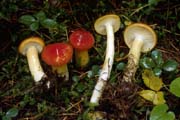 Steve Trudell |
2b Stem slender, 1/8 to 1/4 inch thick, hollow; mushrooms associated with trees other than larch, or sometimes in grassy, open places
................................................................................3
3a Taste very bitter
................................................................................see H. reai, in section VI.
3b Taste not bitter
................................................................................4
4a Gills decurrent, pale pink or pale grayish lilac
................................................................................see H. laetus, in section II.
4b Gills not decurrent, yellow, often retaining a slight trace of their original green color where they are fastened to the flesh of the cap
................................................................................see H. psittacinus, in section IX.
V B. Cap orange, cap viscid, stem not viscid.
1a Taste intensely and persistently bitter
................................................................................see H. amarus, in section II.
1b Taste not bitter
................................................................................2
2a All parts of the mushroom staining black where cut or bruised, and becoming black with age and on drying
................................................................................see H. conicus, in section VI.
2b Not staining black where cut or bruised, with age, or on drying
................................................................................3
3a Stem red, at least at first; gills with a definite red cast
................................................................................see H. coccineus and H. puniceus, in section VI.
3b Stem yellow, gills orange or yellow
................................................................................4
4a Cap cone-shaped; flesh of cap red just below the surface; cap regaining its original red color when dried
................................................................................see H. cuspidatus, in section VI.
4b Cap convex to flat, not cone-shaped; flesh of cap not red below the surface; cap not turning red when dried
................................................................................see H. flavescens, in section IV.
V C. Cap orange, cap not viscid, stem not viscid.
1a All parts of the mushroom becoming black where cut or bruised, and becoming black spontaneously with age and when dried
................................................................................see H. conicus, in section VI.
1b Not staining black where cut or bruised, in age or when dried
................................................................................2
2a Cap covered with tiny, chaffy, gray-brown or black scales, conspicuous against the orange ground color
................................................................................see H. turundus, in section VI.
2b Cap lacking brown or black scales (but may have scales that are the same color as the ground color)
................................................................................3
REMARKS H. turundus var. sphagnophilus which grows in Sphagnum may key to 3 (see section VI).
3a Cap covered with tiny, chaffy scales; cap becoming scarlet when soaked with water
................................................................................see H. miniatus and H. squamulosus, in section VI.
3b Cap smooth, lacking tiny chaffy scales; or if it appears minutely scaly, it does not become scarlet when soaked with water
................................................................................4
4a Stem and gills red, at least at first
................................................................................see H. coccineus, in section VI.
4b Stem and gills never red
................................................................................5
5a Gills a persistent and brilliant chrome orange color; stem hollow
................................................................................H. marginatus var. marginatus
| CAP 1 to 3 inches broad, cone-shaped and remaining so or becoming convex or bellshaped, smooth; flesh thin, very fragile, orange. ODOR and TASTE not special. GILLS deeply rounded at the stem, not decurrent, broad. STEM 3 to 5 inches long, smooth, satiny, pale orange, fragile. MICROSTRUCTURES spores 7-10 x 4-6 microns; PL. | Hygrophorus marginatus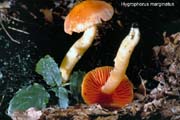 Eleanor Yarrow |
5b Gills apricot color or salmon buff, not brilliant orange, and tending to fade with age; stem solid, or filled with a soft webby pith
................................................................................H. pratensis
| CAP 1 to 3 inches broad, convex, often becoming flat or with upturned margin, smooth or minutely fibrillose (but not scaly), orange or reddish cinnamon fading to buff, or buff from the first; flesh thick, soft. ODOR and TASTE mild. GILLS decurrent. STEM 3 to 4 inches long, up to 1 inch thick, smooth, same color as cap. MICROSTRUCTURES spores 5.5-8 x 2.5-5 microns; IW. REMARKS According to Largent, H. pratensis is sometimes fairly fragrant, and can then be nearly identical with H. graveolens (see Appendix) which is identified by light pinkish cinnamon colors, hoary cap, and slightly larger spores (6-9 x 4-6 microns). | Hygrophorus pratensis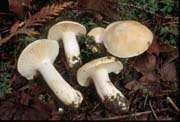 Steve Trudell |
VI. Cap some shade of bright or deep red, such as vermilion, scarlet, blood red, cherry red, etc., but NOT purplish red or wine red or brownish red.
VI A. Cap red, cap viscid, stem viscid.
1a All parts of the mushroom becoming black where bruised or cut, and becoming black spontaneously in age and when dried
................................................................................H. singeri
| CAP 1/2 to 1 1/2 inches broad, cone-shaped, slimy, red, reddish orange, or yellow; flesh greenish yellow, very soft. ODOR and TASTE not special. GILLS narrowly attached to stem (not decurrent), pale orange then greenish yellow. STEM 1 1/2 to 4 inches long, less than 1/4 inch thick, smooth, slimy, hollow, pale orange-yellow then greenish yellow. MICROSTRUCTURES spores 9-12 x 5-6 microns; PL. NOTES Note that the only difference between H. singeri and H. conicus is the slimy stem of H. singeri. | Hygrocybe singeri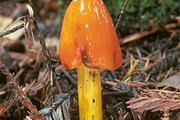 Boleslaw Kuznik |
1b Not becoming black where cut or bruised, in age or when dried
................................................................................2
2a Taste very bitter; small slender mushrooms
................................................................................H. reai
CAP 1/2 to 1 1/2 inches broad, convex, brilliant red, or bright red at center and brilliant orange on the margin (bicolorous), fading to chrome yellow with age or upon losing moisture; flesh thin, brittle, red, fading to yellow. ODOR none. TASTE very bitter. GILLS adnate (not decurrent), pallid at first, becoming yellow. STEM 1 1/2 to 2 1/2 inches long, 1/8 inch or less thick, very fragile, same color as the cap and fading like the cap. MICROSTRUCTURES spores 6.5-9 x 4-5.5 microns; PL.
2b Taste not bitter; medium sized to large, stout mushrooms
................................................................................see H. speciosus, in section V.
REMARKS if very small and not bitter, consider H. minutulus (see Appendix).
VI B. Cap red, cap viscid, stem not viscid.
1a All parts of the mushroom becoming black where bruised or cut, and becoming black spontaneously with age, and when dried
................................................................................H. conicus
| CAP 1/2 to 4 inches broad, cone-shaped, smooth, slightly viscid but soon dry and smooth, silky and then not appearing viscid, scarlet or orange or yellow, sometimes with greenish tinges, soon blackening; flesh thin, fragile, same color as the surface. ODOR and TASTE not special. GILLS very narrowly attached (nearly free), broad, thick, pale yellow-orange or yellow with an olive tinge. STEM 2 to 8 inches long, 1/4 to 1/2 inch thick, fragile, satiny-shining, longitudinally streaked, red, orange, yellow, or with a greenish tinge. MICROSTRUCTURES spores 9-12 x 5.5-6.5 microns; PL. NOTES Note that the only visible difference between H. conicus and H. singeri is the viscid stem of H. singeri. | Hygrocybe conica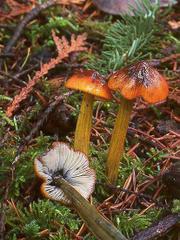 Norman Evans |
1b Not becoming black where cut or bruised, or with age, or when dried
................................................................................2
2a Very small, slender, fragile mushrooms; cap 1/2 inch broad, stem 1/16 to 1/8 inch thick
................................................................................H. subminiatus
CAP 1/2 inch broad, convex to flat, scarlet, smooth. GILLS decurrent, white or tinged yellowish buff. STEM 1 to 1 1/2 inches long, 1/16 to 1/8 inch thick, yellow. MICROSTRUCTURES spores 7-9 x 3-5 microns; PL. REMARKS Other very small red species include H. minutulus and H. subminutulus (see under H. minutulus in Appendix) which have viscid cap and stem.
2b Medium sized to large, stout mushrooms; cap 1-3 inches or more broad, stem 1/4 to 3/4 inch thick
................................................................................3
3a Stem red at least at first, but often fading to orange or yellow; gills with a definite red cast at first; cap bluntly cone-shaped or merely broadly umbonate
................................................................................4
3b Stem yellow from the first, never red; gills orange or yellow, lacking any red color; cap sharply cone-shaped
................................................................................H. cuspidatus
CAP 1 to 3 inches broad, slimy, scarlet, fading to orange or yellow-orange, but regaining the red color when dried; flesh thin, red under the surface, yellow elsewhere. ODOR and TASTE not special. GILLS free or nearly so, orange or yellow. STEM 2 to 7 inches long, 1/8 to 3/8 inch thick, satiny, longitudinally streaked, yellow. MICROSTRUCTURES spores 8-12 x 4-7 microns; PL. REMARKS fruiting is usually May through August; H. acutoconicus is never red and fruits spring through fall (see Appendix).
4a Viscid surface of the cap well-developed, evident, and persistent
................................................................................H. puniceus
| CAP 1 to 3 inches broad, deep blood red, fading to orange in streaks then entirely; flesh thin, fragile, red or orange. ODOR and TASTE not special. GILLS not decurrent, broad, thick, red fading to orange or yellow. STEM as long as, or twice as long as, the width of the cap, stout, satiny, longitudinally streaked, red, fading to orange or yellow. MICROSTRUCTURES spores 8-11 x 4-6 microns; PL. | Hygrocybe punicea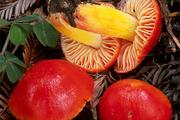 Boleslaw Kuznik |
4b Viscid surface of cap thin, very poorly defined, or more frequently lacking
................................................................................H. coccineus
| CAP 1 to 2 inches broad, smooth, scarlet; flesh fragile, red to orange. ODOR and TASTE not special. GILLS adnate, broad, thick, red or orange-red or yellowish orange. STEM 2 to 3 inches long, stout, smooth, satiny red, soon yellow at the base. MICROSTRUCTURES spores 7-10.5 x 4-5 microns; PL. REMARKS Stem base tends to yellow or orange in H. coccineus (white or sometimes yellow in H. puniceus), although orange base can be covered with white mycelium in moist conditions; H. puniceus also tends to be larger, more robust, and more common, and have a more distinctly striate stem. | Hygrocybe coccinea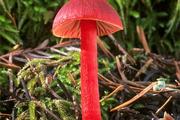 Boleslaw Kuznik |
VI C. Cap red, cap not viscid, stem not viscid.
1a All parts of the mushroom becoming black where cut or bruised, and becoming black spontaneously with age, and when dried
................................................................................see H. conicus, in subgroup B, this section.
1b Not becoming black where cut or bruised, in age, or upon drying
................................................................................2
2a Stem stout, 3/8 to 1/2 inch thick
................................................................................see H. coccineus, in subgroup B, this section.
2b Stem slender, 1/4 inch or less thick
................................................................................3
3a Cap covered with tiny, chaffy, gray-brown to black scales, conspicuous against the red ground color
................................................................................H. turundus
| CAP 3/8 to 1 1/4 inch broad, convex then shallowly concave in the center, scarlet when wet, fading to orange then yellow upon losing moisture, but becoming red again when re-moistened; flesh thin, orange. ODOR and TASTE mild. GILLS decurrent, pale dingy yellow, broad, distant. STEM 1 to 2 1/4 inches long, 1/8 to 3/16 inch thick, orange, satiny, with top and base paler. MICROSTRUCTURES spores 9-14 x 5-8 microns; PL. REMARKS H. turundus var. sphagnophilus has scales that darken slightly if at all, gills vary from red through orange and pale yellow to pallid and may remain adnate or become decurrent, stem is red or yellowish, and grows in Sphagnum; H. miniatus is differentiated from var. sphagnophilus by smaller spores; H. cantharellus (see Appendix) is found in a variety of habitats and has non-darkening scales and orange to yellow decurrent gills. | Hygrocybe turunda var. sphagnophila 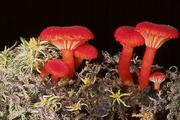 Sara Clark |
3b Cap lacking gray-brown to black squamules (but is covered with tiny scales the same color as the ground color)
................................................................................4
4a Flesh of cap thick and firm; top of stem rather sparsely covered with white, granular powder
................................................................................H. squamulosus
CAP 1/2 to 2 inches broad, convex, bright red when wet, fading to orange then yellow on losing moisture, but regaining the red color when re-moistened, smooth when wet, becoming covered with bran-like scales on drying; flesh red, fading like the cap. ODOR and TASTE not special. GILLS adnate, reddish to pale yellow, broad. STEM 1 1/2 to 2 1/2 inches long, up to 1/4 inch thick, yellow or tinged with red, hollow. MICROSTRUCTURES spores 6-9 x 4-5 microns; PL. NOTES see note following the description of H. miniatus.
4b Flesh of cap thin, soft, and brittle; top of stem lacking white granular powder
................................................................................H. miniatus
| CAP 1/2 to 1 1/2 inches broad, convex, often becoming shallowly concave at center, bright scarlet when moist, fading to orange then yellow, regaining red color when moistened, appearing smooth when wet, but seen to be covered with tiny, chaffy scales when dry; flesh red, fading like the surface. ODOR and TASTE not special. GILLS adnate to subdecurrent, red fading to orange or yellow. STEM 1 to 3 inches long, about 1/8 inch thick, smooth, red, fading like the cap. MICROSTRUCTURES spores 6-8 x 4-5 microns; PL. NOTES This and H. squamulosus are almost impossible to separate; the differences are too slight and subjective. REMARKS Hesler & Smith differentiate on the basis of occasional filamentous cheilocystidia in H. squamulosus and no cheilocystidia in H. miniatus. H. turundus var. sphagnophilus has larger spores than H. miniatus and generally grows on Sphagnum; H. cantharellus compared with H. miniatus has drier cap, longer stem (according to Smith and Hesler (2) 4-9 (12) cm versus 3-5 (7) cm), paler colors, deeply decurrent gills, and usually longer spores (see Appendix). | Hygrocybe miniata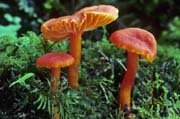 Kit Scates Barnhart |
VII. Cap brownish purple, wine red, purplish red, or streaked or mottled with these colors on a white or pallid ground color.
VII A. Cap purple, cap viscid, stem viscid.
1a Stem less than 1/4 inch thick, slender, about 10 times as long as thick; cap thin-fleshed, becoming concave in the center; gills pink or pale grayish lavender
................................................................................see H. laetus, in section II.
1b Stem 1/4 to 1/2 inch thick, stout, 5-6 times as long as thick; cap thick-fleshed, convex or umbonate; gills white or pallid
................................................................................see H. vernalis, in section II.
VII B. Cap purple, cap viscid, stem not viscid.
1a Odor strong of green corn
................................................................................H. rainierensis
| CAP 3/8 to 1 1/4 inch thick, convex, dull dark purple, fading to ashy gray at the center, and dingy buff on the margin. ODOR strong of green corn. GILLS decurrent, at first pale dull purplish, becoming dingy buff, narrow. STEM about as long as the width of the cap, 1/8 to 1/4 inch thick, smooth, white. MICROSTRUCTURES spores 5-7 x 4-5.5 microns; IW. REMARKS H. nordmanensis (see Appendix) also has green corn odor, but is violaceous brown and has longer spores. | Hygrophorus rainierensis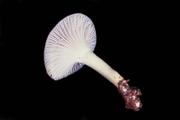 Ben Woo |
1b Odor not of green corn
................................................................................2
2a A fibrillose veil present between stem and margin of cap, visible on unopened caps, leaving a zone of fibrils on the stem for a time after the cap has expanded
................................................................................H. purpurascens
| CAP 2 to 6 inches broad, convex, entirely dull dark reddish purple at first, remaining so at the center, becoming pink at the margin; flesh white. ODOR and TASTE not special. GILLS decurrent, white, becoming shell pink, soon spotted and stained with red. STEM 1 1/2 to 4 inches long, 3/8 to 1 inch thick, pinkish spotted and streaked with reddish purple, usually entirely dark reddish purple at the base. MICROSTRUCTURES spores 5.5-7 x 3-4.5 microns; DV. | Hygrophorus purpurascens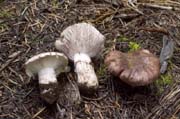 Steve Trudell |
2b Fibrillose veil absent between margin of cap and stem
................................................................................3
3a Gills close
................................................................................H. russula
| CAP 2 to 5 inches broad, convex, with inrolled finely cottony margin (but no veil!) at first, orange-pink, coral pink, or deep wine color, or purplish red at center and pink on the margin; flesh thick, white. ODOR and TASTE not special. GILLS adnate, becoming decurrent, white, soon flushed with pink, then spotted with purplish red, or becoming entirely dingy purplish red. STEM about as long as width of cap, 1/2 to 1 1/2 inch thick, white then streaked or stained pink, finally same color as the cap, often staining yellow where bruised. MICROSTRUCTURES spores 6-8 x 3-4.5 microns; DV. | Hygrophorus russula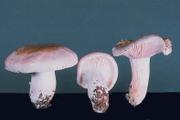 Ben Woo |
3b Gills well spaced (subdistant to distant)
................................................................................4
4a Cap, gills, and stem all uniformly dark reddish purple when the mushroom is mature
................................................................................H. capreolarius
| CAP 1 to 3 inches broad, convex, purplish red from the first, often with darker spots at the center; flesh white to reddish. ODOR and TASTE not special. GILLS adnate then decurrent, at first pallid, becoming pinkish then reddish purple, well spaced. STEM 2-5 inches long, 3/8 to 1/2 inch thick, white, becoming reddish purple like the cap, but the top becoming paler. MICROSTRUCTURES spores 6.5-8 x 4.5-5 microns; DV. | Hygrophorus capreolarius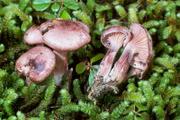 Michael Beug |
4b Cap, gills, and stem not uniformly reddish purple in mature specimens
................................................................................H. erubescens
| CAP 1 to 4 inches broad, convex, dark purplish red to brownish purple at the center, pallid to flesh pink at the margin, frequently streaked and spotted with darker fibrils; flesh thick, white. ODOR and TASTE not special. GILLS adnate then decurrent, pale pink or pinkish cream, soon spotted and stained with red. STEM short and stout, rather rough-fibrous, white at the top, elsewhere brownish wine red, often staining yellow where bruised. MICROSTRUCTURES spores 7-11 x 5-6 microns; DV. | Hygrophorus erubescens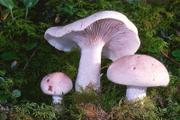 Michael Beug |
NOTE The four preceding species, H. purpurascens, H. russula, H. capreolarius, and H. erubescens, are difficult to distinguish one from another, because of their similarity in size, color, and general appearance. The fibrillose veil is unique to H. purpurascens, and unless it has been obliterated by careless handling, is a sure sign of that species. The close, almost crowded gills and preference from growing under hardwoods distinguish H. russula (which is not as common as the others in Washington); the distinctly larger spores (if one has a microscope) will distinguish H. erubescens from H. capreolarius, or if the spores cannot be measured, the uniform wine red color, especially of the gills, characterizes mature specimens of H. capreolarius. Very young specimens of H. russula, H. capreolarius, and H. erubescens would be difficult to separate, and overmature, weathered, or badly discolored plants of all four species probably would be impossible to tell apart.
VII C. Cap purple, neither cap nor stem viscid.
Only one species
................................................................................see H. cinereus, in section VIII.
VIII. Cap uniformly some shade of brown (rusty brown, umber, cinnamon brown, tobacco brown, olive brown, gray-brown, etc.), or gray. (not bicolorous, as in III, except H. hypothejus which see)
VIII A. Cap brown or gray, cap viscid, stem viscid.
1a Stem slender (1/4 inch or less thick), hollow
................................................................................2
1b Stem stout (more than 1/4 inch thick), solid, or filled with a webby pith
................................................................................3
2a Cap and stem dark gray-brown or slate gray; gills adnate, not decurrent, white, or tinged pale gray
................................................................................H. unguinosus
CAP 3/4 to 2 inches broad, convex, finally nearly flat, slimy; flesh thin, white or grayish. ODOR and TASTE not special. GILLS deeply notched at the stem, rather thick. STEM longer than the width of the cap, slimy, gray, fragile. MICROSTRUCTURES spores 7-10 x 4-5 microns; PL.
2b Cap dull olive brown; gills decurrent, pink or pale grayish lavender (stem usually also the same color)
................................................................................see H. laetus, in section II.
3a (1b) Gills and stem pale yellow to bright yellow
................................................................................H. hypothejus
| CAP 1 to 3 inches broad, convex or slightly umbonate, dark umber to dark olive brown or blackish brown at the center, elsewhere paler brown, ocher, or greenish yellow, often becoming brighter yellow or orange or even red on the margin when older; flesh yellow under the surface, elsewhere white. ODOR and TASTE not special. GILLS decurrent, white at first, becoming yellow, then the same color as the margin of the cap. STEM 1 to 2 times as long as the width of the cap, 1/4 to 1/2 inch thick, silky and yellow at the top, elsewhere glutinous and brown, yellow, olive yellow, orange, or scarlet. MICROSTRUCTURES spores 7-9 x 4-5 microns; DV. REMARKS if stem is not glutinous at all, consider H. siccipes (see Appendix). | Hygrophorus hypothejus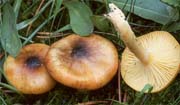 Boleslaw Kuznik |
3b Gills and stem white or pallid, lacking yellow colors
................................................................................4
4a Top of stem (the dry part, above the slimy sheath) covered with conspicuous dark gray dots or granules
................................................................................H. pustulatus
| CAP 3/4 to 2 inches broad, convex, ash gray, with darker brownish gray center, often covered with darker gray dots or granules; flesh soft, white. ODOR and TASTE not special. GILLS adnate or slightly decurrent, white. STEM 2 to 4 inches long, 1/4 to 1/2 inch thick, pallid to pale gray. MICROSTRUCTURES spores 7-9 x 4-5 microns; DV. NOTES This species is often mistaken for H. agathosmus - subgroup B of this section - but differs in its lack of almond odor, and its slimy stem. REMARKS Hesler & Smith give stem as 0.5 to 0.8 cm thick. | Hygrophorus pustulatus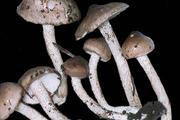 Ben Woo |
4b Top of stem lacking any gray dots or granules
................................................................................5
REMARKS If stem is fuscous dotted or scabrous, but cap 1 1/2 to 4 1/2 inches broad, consider H. fuligineus (see Appendix).
5a Glutinous sheath of the stem underlain by a layer of black or very dark olive gray fibrils that form conspicuous patches and irregular bands as the stem lengthens
................................................................................H. olivaceoalbus
| CAP 1 1/2 to 5 inches broad, convex or flat or slightly concave at the center, slimy, black or very dark smoky olive at the center conspicuously streaked toward the margin with olive gray to black fibrils; flesh thick, white. ODOR and TASTE not special. GILLS adnate to slightly decurrent, white, occasionally tinged with gray. STEM 3 to 5 inches long, 3/8 to 1 1/4 inches thick, smoky olive to blackish below, white and silky at the top. MICROSTRUCTURES spores 9-12 x 5-6 microns; DV. REMARKS Largent comments that Hygrophorus persoonii Arnolds has previously been identified as Hygrophorus olivaceoalbus var. olivaceoalbus in the past (Arnolds established a neotype of Hygrophorus olivaceoalbus having mean spore length 11.5 microns or more, and width 7.4-8.6 microns). Harmaja as quoted by Kernaghan & Currah stated in 1985 that H. olivaceoalbus (Fr.) Fr. sensu Hesler & Smith does not fit the European concept of H. olivaceoalbus, but does fit the description of Hygrophorus korhonenii Harmaja. | Hygrophorus olivaceoalbus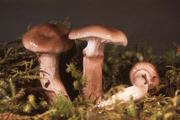 Ben Woo |
5b Lower part of stem, beneath the glutinous sheath, white or pallid, lacking black or olive-gray fibrils
................................................................................6
6a Stem short and stout, 1/2 inch or more thick, scarcely longer than the width of the cap
................................................................................H. fuscoalbus
| CAP 1 to 2 inches broad, convex, dark brownish gray becoming ash gray; flesh grayish white. ODOR and TASTE not special. GILLS adnate or decurrent, white with a slight flush of pinkish cream when mature. STEM white, with a layer or wooly white fibrils underneath the slime sheath. MICROSTRUCTURES spores 9-13 x 5.5-7 microns; DV. REMARKS H. fuscoalboides is a similar species with dry stem (see Appendix). If cap is 1 1/2 to 4 1/2 inches broad and spores 7-9 x 4.5 x 5.5, consider H. fuligineus (see Appendix). | Hygrophorus fuscoalbus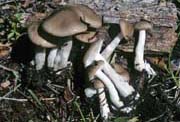 Kit Scates Barnhart |
6b Stem long and slender, less than 1/2 inch thick, and twice as long or more than twice as long as the width of the cap
................................................................................H. megasporus
CAP 1 to 2 inches broad, convex, dark olive-gray-brown, becoming paler at the margin; flesh thin, white. ODOR and TASTE not special. GILLS adnate or slightly decurrent, white. STEM white, lacking a sheath of fibrils beneath the slime sheath. MICROSTRUCTURES spores 12-20 x 7-9 microns; DV. NOTES The only sure way to separate H. fuscoalbus and H. megasporus is by the size of the spores, since the dimensions of the mushrooms as given in the key lead may well overlap.
REMARKS If stem less than 1/2 inch thick, but stem not twice as long as cap, and cap +/- stem gray, consider H. occidentalis (see Appendix).
VIII B. Cap brown or gray, cap viscid, stem not viscid.
1a Gills shell pink or rose pink (from the first)
................................................................................H. calophyllus
| CAP 2 to 5 inches broad, convex or shallowly umbonate, uniformly dark umber or dark smoky olive brown; flesh white, thick. ODOR faintly fragrant. TASTE mild. GILLS decurrent, narrow. STEM as long as the width of the cap, 1/2 to 3/4 inch thick, same color as the cap or somewhat paler. MICROSTRUCTURES spores 5.5-8 x 4-5 microns; DV. | Hygrophorus calophyllus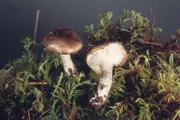 Ben Woo |
1b Gills not pink (may be white, gray, pale buff, or pale dingy grayish lilac)
................................................................................2
2a Odor strong and characteristic
................................................................................3
2b Odor none, or faint but not special or distinctive
................................................................................5
3a Odor of green corn
................................................................................see H. ranierensis, in section VII.
3b Odor not of green corn
................................................................................4
4a Odor of almond (i.e. almond flavoring, benzaldehyde)
................................................................................H. agathosmus
| CAP 1 1/2 to 5 inches broad, convex, slimy, ash gray or pale gray-brown; flesh soft, white. ODOR almond. TASTE mild. GILLS adnate, sometimes becoming slightly decurrent, white, becoming tinged grayish in age. STEM as long as the width of the cap or half again as long, up to an inch thick in large specimens, white, often tinged with gray in age. MICROSTRUCTURES spores 8-10.5 x 4.5-5.5 microns; DV. NOTES see the note under H. pustulatus, subgroup A, this section. REMARKS Other almond scented species include H. bakerensis, H. monticola, H. odoratus, H. variicolor, and H. vinicolor. | Hygrophorus agathosmus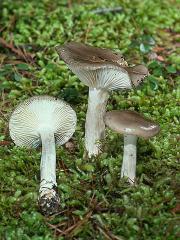 Michael Beug |
4b Odor penetrating and aromatic, but not of almond
................................................................................see H. pacificus, in section III.
5a (2b) Mature cap cinnamon brown or reddish brown with slight purplish cast; gills pale dingy grayish lilac
................................................................................H. colemannianus
| CAP 1/2 to 2 inches broad, convex or shallowly umbonate, marked on the margin with translucent lines when wet; flesh brown. ODOR and TASTE not special. GILLS decurrent. STEM 1 1/4 to 3 inches long, about 1/4 inch thick, white. MICROSTRUCTURES spores 6-8 x 4.5-6 microns; IW. | Hygrocybe colemanniana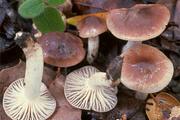 Boleslaw Kuznik |
5b Mature cap gray, olive gray, or dark grayish olive brown
................................................................................6
REMARKS If 5a and 5b do not fit, cap is dark yellowish brown, gills grayish brown, and stem grayish pallid, consider H. avellaneifolius (see Appendix). If 5a and 5b do not fit, cap is dingy yellowish brown with buff margin, appearing fibrillose streaked, gills and stem are whitish, and stem has median fibrillose zone, consider H. siccipes (see Appendix). If 5a and 5b do not fit, cap is hygrophanous violet-gray-brown, gills decurrent and violet-gray, and stem white or tinged cap color, consider H. subviolaceus (see Appendix).
6a Cap, stem, and gills white at first, soon becoming ash gray, dark slate gray, or dark gray with olive tones; growing only in early spring, usually close to melting snow
................................................................................H. marzuolus
| CAP 2 to 5 or 6 inches broad, convex, slightly viscid but soon becoming dry; flesh pallid. ODOR and TASTE not special. GILLS adnate, broad, thick. STEM as long as the width of the cap, 1/2 to 1 inch thick, surface dull. MICROSTRUCTURES spores 7-8.5 x 4.5-5 microns; DV. | Hygrophorus marzuolus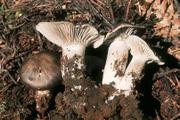 Ben Woo |
6b Cap and stem colored from the first; gills white and remaining so
................................................................................H. camarophyllus
| CAP 2 to 6 inches broad, convex, slightly viscid but soon becoming dry, dark smoky olive brown or blackish olive, often with darker and lighter streaks; flesh thick, white. ODOR and TASTE mild. GILLS adnate to decurrent, may be tinged gray in age. STEM about as long as cap width, up to 1 inch thick, same color as cap or paler. MICROSTRUCTURES spores 7-9 x 4-5 microns; DV. REMARKS If stem 1/3 to 2/5 of an inch wide instead of 2/5 to 4/5 of an inch, and cap and lower stem are gray, consider H. fuscoalboides (see Appendix). | Hygrophorus camarophyllus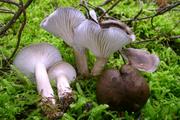 Andrew Parker |
REMARKS If cap is 1 to 2 inches broad, cap and stem dark gray brown, with violaceous to vinaceous brown gills, and often snowbank habitat, see H. angelesianus (also known as Neohygrophorus angelesianus) in Appendix. If cap is 1 1/2 to 2 inches broad with acute umbo, cap and flesh grayish, gills white to pale gray, stem white, consider H. acutus (see Appendix). If cap is 1/2 to 2 inches broad, cap pallid to grayish brown or dark brown, stem white to brownish and furfuraceous-flocculent, consider H. morrisii (see Appendix.). If cap is 1/2 to 1 inch broad, cap +/- stem olive brown, and especially if cap is circumferentially cracked, consider H. recurvatus (see Appendix).
VIII C. Cap brown or gray, neither cap nor stem viscid.
1a Gills bright orange; margin of mature cap orange
................................................................................see H. marginatus var. olivaceus, in section IX.
1b Gills not orange; margin of cap never becoming orange
................................................................................2
2a Cap 3/8 to 1 1/4 inches broad
................................................................................3
2b Cap 2 to 5 or 6 inches broad
................................................................................4
REMARKS If cap 1 1/4 to 2 1/4 inches broad with streaky dark grayish brown fibrils over cap and lower stem, and cap fringed with marginal remnants, see H. inocybiformis in Appendix. If cap 1 to 2 1/4 inches broad with hygrophanous violet-gray-brown, decurrent violet-gray gills, and stem white or tinged cap color, consider H. subviolaceus (see Appendix). If cap 1 to 2 inches broad with gray brown disc and vinaceous buff toward margin, gills are pale pinkish cinnamon, stem white, and odor almond, consider H. vinicolor (see Appendix).
3a Cap smooth; gills dark grayish lilac; stem white or pallid
................................................................................H. cinereus
CAP convex, dark purplish brown, fading to pale grayish lilac; flesh white. ODOR and TASTE not special. GILLS decurrent, distant. STEM about as long as the width of the cap, 1/8 to 1/4 inch thick, pallid. MICROSTRUCTURES spores 7-9 x 4.5-5.5 microns; IW.
3b Cap scaly; gills pale gray with or without a slight violet tinge; stem grayish brown
................................................................................H. atro-olivaceus
CAP convex, very dark blackish brown; flesh brittle, watery. ODOR and TASTE not special. GILLS somewhat decurrent, well spaced, thick. STEM 1 to 2 inches long, up to 3/8 inch thick, same color as the cap, but paler. MICROSTRUCTURES spores 5-6 x 3-4.5 microns; PL.
REMARKS If 3a and 3b do not fit because odor is strong of mothballs, consider H. foetens (see Appendix).
4a (2b) Cap, stem, and gills white at first, soon becoming ash gray, dark slate gray, or dark gray with olive tones; growing only in early spring, usually close to melting snow
................................................................................see H. marzuolus, subgroup B, this section
4b Cap and stem colored from the first; gills white and remaining so, or occasionally tinged slightly gray in age; growing in the fall, rarely in the spring
................................................................................see H. camarophyllus, subgroup B, this section
IX. Cap grass-green or olive-green.
As there are only two species in this section, the usual division into subgroups A, B, and C is not necessary.
1a Stem slimy
................................................................................H. psittacinus
| CAP 1/2 to 1 1/4 inches broad, cone-shaped, bell-shaped, or convex, slimy, at first grass green or more bluish green, soon fading to buff, tawny, flesh color, yellow, ochre, or olive-orange, usually becoming pinkish cream color when dried; flesh thin, same color as the surface of the cap. ODOR and TASTE not special. GILLS adnate, green, soon becoming yellow to orange yellow, but sometimes retaining a trace of the green color where they fasten to the flesh of the cap. STEM twice as long as the width of the cap or longer, 1/8 to 1/4 inch thick, often hollow, green becoming yellow or orange, finally pinkish cream. MICROSTRUCTURES spores 6.5-9 x 4-5 microns; PL. | Hygrocybe psittacina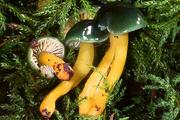 Sara Clark |
1b Stem smooth and moist, but not viscid
................................................................................H. marginatus var. olivaceus
CAP 1 to 2 inches broad, moist or soapy-feeling, but not viscid, dark grayish olive green or dark brownish olive, remaining so at the center, the margin becoming orange; flesh thin and fragile, grayish olive. ODOR and TASTE not special. GILLS adnate, broad, bright orange, not fading or changing color with age. STEM 1 1/2 to 2 1/2 inches long, 1/8 to 1/4 inch thick, fragile, satiny, bright yellow-green, becoming pallid yellow tinged with green. MICROSTRUCTURES spores 6.5-8 x 4-5 microns; PL.
REMARKS The greenish blue H. caeruleus with unpleasant odor might key out here (see Appendix).
I. Cap white.
CAP 0.8-1.2 cm, viscid, convex becoming shallowly depressed, white to pinkish, drying pallid to pinkish buff; flesh whitish. ODOR and TASTE not distinctive. GILLS decurrent to adnate-decurrent, white becoming pale pink. STEM 2-3 x 0.2-0.3 cm, dry, pallid to dingy, bald or with appressed fibrils. MICROSTRUCTURES spores 11-16 x 8-12 microns; PL. REMARKS features include small size, white to pinkish viscid cap, snowbank habitat, and large spores: see H. goetzii for other snowbank species.
CAP 3 cm, viscid, convex, white, becoming warm buff to ochraceous buff on drying; flesh white. ODOR and TASTE not distinctive. GILLS adnate-decurrent, pallid. STEM 5 x 0.7 cm, viscid, pallid, bald up to fibrillose ring near top. MICROSTRUCTURES spores 10-14 x 6.5-7.5 microns. DV. REMARKS H. velatus also has veil but H. velatus has smaller spores; H. flavodiscus has smaller spores (6-8 x 3.5-5 microns) and lacks the fibrillose ring.
Hygrophorus cossus - see section II
Hygrophorus flavodiscus - see section II
Hygrophorus melizeus forma minor
(Hesler & Smith call it Hygrophorus karstenii Sacc. & Cub. forma minor Bres.)
CAP 3-5 cm, somewhat viscid but soon dry, broadly convex to nearly flat with inrolled margin, creamy white; flesh thick, soft, white. ODOR and TASTE not distinctive. GILLS decurrent, creamy yellowish. STEM 3-5 x 0.6-1.2 cm, dry, whitish. MICROSTRUCTURES spores 7-9 x 4.5-5 microns; DV. REMARKS features include somewhat viscid chalk white cap, contrasting decurrent creamy yellowish gills, and dry whitish stem; H. saxatilis similar but has salmon to pinkish cinnamon gills and peach odor.
Hygrophorus russocoriaceus
(Hygrophorus lawrencei Hesler & A.H. Sm. is a synonym)
| CAP 1-3 cm, dry, broadly convex to uplifted, at first with conic umbo, white or with tinge of pale tan or yellowish, striate; flesh fragile, whitish. ODOR cedar (arborvitae). TASTE medicinal or almost like cedar. GILLS decurrent, distant, broad, white, interveined. STEM 3-6 x 0.5-0.8 cm, dry, narrowing downward or more or less equal, white, may be twisted or curved. MICROSTRUCTURES spores 7-10 x 4.5-6 microns; IW. REMARKS cedarlike odor is main distinctive feature: at times so faint as to be almost indistinct, but in these specimens medicinal taste can be used to identify species. | Hygrophorus russocoriaceus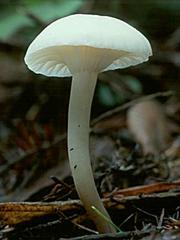 Boleslaw Kuznik |
Hygrophorus subpungens - see section II
II. Cap ivory, pale cream, pale buff or beige, pale salmon or flesh color, pale yellowish or vinaceous buff or pallid cinnamon; usually uniformly colored, but the margin may be somewhat lighter than the center.
Hygrophorus albicarneus see section I
CAP 1-3.5 cm, viscid, convex becoming flat, hygrophanous, when young and fresh pale yellow fading to pinkish buff, striate when moist and mature; flesh thin but firm. ODOR faintly medicinal. TASTE mild. GILLS decurrent, distant, broad, buff, unchanging when bruised but gradually becoming more yellow in age. STEM 5-7 x 0.25-0.4 cm, dull white, twisted-striate in some specimens. MICROSTRUCTURES spores 7-9(10) x 4-5 microns, IW.
| CAP 5-9 cm, broadly convex, cream to dingy cream with a tint of blue, especially over margin, felty, moist to touch but not viscid, bald, coarsely cracked with areolate areas, older caps may develop fibrillose scales; flesh dingy cream color tinted bluish green, bruising bluish-gray to blue-green but soon fading. ODOR strong disagreeable odor of rancid meal. TASTE mild at first but soon unpleasant. GILLS broadly adnate to short decurrent, close to subdistant or in age distant, bluish green. STEM 2.5-5 x 1.5-2.5 cm, narrowing abruptly at base; bluish-green to dingy light brown, nearly cream at top; dry, pruinose at top, the rest with appressed fibrils, usually twisted somewhat, base with numerous white rhizomorphs. MICROSTRUCTURES spores (6.5)7-9 x 4-5 microns, inamyloid; IW. REMARKS This species was not included in the Hesler and Smith monograph as it was not described until 1984: it is distinctive by its color supported by its robust stature and rancid farinaceous odor. | Hygrophorus caeruleus.jpg) Boleslaw Kuznik (MykoWeb) |
CAP 3-7 cm, slimy, obtuse expanding to nearly flat, whitish or "pale pinkish-buff", at maturity becoming slightly more ochraceous or flushed salmon color and retaining either tint in drying; flesh soft, white. ODOR distinctly aromatic. TASTE not distinctive. GILLS adnate to decurrent, white becoming salmon-buff. STEM 4-9 x (0.3)0.8-1.2 cm, slimy gluten covers lower part, white becoming yellowish, lower part salmon-buff to cinnamon-buff in age, fibrillose-punctate to scabrous at top, lower part covered by slimy gluten; thin inner white fibrillose veil, covered with slimy glutinous layer. MICROSTRUCTURES spores 7-9 x 4-4.5 microns; DV.
| CAP 2.5-6 cm, slightly viscid soon dry, convex-depressed, white becoming apricot-orange; flesh soft, white. ODOR and TASTE not distinctive. GILLS decurrent, white becoming tinged apricot, when dried pallid to ochraceous buff. STEM 5-9 x 0.4-1.2 cm, dry, white drying pallid to grayish, twisted fibrillose-striate, top silky to slightly pruinose. MICROSTRUCTURES spores 7-9.5 x 4-4.5 microns; DV. REMARKS H. saxatilis and H melizeus forma minor are similar but differ in gill color: both have yellow gills at first. | Hygrophorus ellenae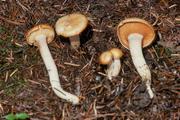 Michael Beug |
| CAP 2-7 cm, slimy, convex to flat; white with disc that is yellow to orange or orange tan, the color eventually spreading over the whole cap, or if covered by leaves the cap may remain white; flesh firm, thick, white. ODOR and TASTE mild. GILLS adnate or decurrent, pinkish becoming whitish, sometimes interveined. STEM 3-7.5 x 0.6-1.4 cm, slimy nearly to top, white or somewhat stained with yellow, fibrillose or dotted at top, slimy universal veil, ring gelatinous. MICROSTRUCTURES spores 6-8 x 3.5-5 microns; DV. REMARKS differentiated from H. gliocyclus by having gills pinkish fading to whitish, usually more slender stem, cap white when fresh with yellow to orange disc, and smaller spores (6-8 x 3.5-5 microns), but both species have been considered synonyms of Hygrophorus ligatus Fr.; H. albiflavus has a fibrillose ring and larger spores. | Hygrophorus flavodiscus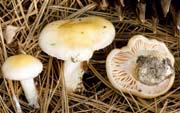 John Plischke |
CAP 4-5(10) cm, glutinous, convex, broad umbo; disc "cream buff", rest of cap "ivory-yellow" drying bright "primuline yellow"; flesh white. ODOR and TASTE none. GILLS adnate to rounded-adnate, broad near stem, abruptly narrowed near margin, white then "ivory-yellow". STEM 4-9 x 0.8-1.5 cm, glutinous-viscid and floccose-tomentose up to collar near top, white, slime leaving yellowish-brown stains or spots (simulating reticulations), watery drops near top dry to form reddish dots. MICROSTRUCTURES spores 8-10 x 5-6 microns; DV. REMARKS H. flavodiscus does not have pronounced red dots near top of stem, and has smaller spores (6-8 x 3.5-5 microns).
| CAP 2-5 cm, slimy-viscid, obtuse to broadly convex, at times slightly depressed, rosy-pink fading to cream and drying grayish pinkish-buff; flesh thin, pallid to cream. ODOR and TASTE mild. GILLS broadly adnate, subdistant to distant, pallid to cream drying grayish pinkish-buff. STEM 3-6 x 0.3-0.8 cm, dry, cream drying grayish pinkish-buff, silky smooth top, hairy base. HABITAT in mountainous areas, often near snowbanks. MICROSTRUCTURES spores 12-15 x 7-9 microns; DV. REMARKS Other snowbank species include according to Largent H. albicarneus with white to pinkish cap, decurrent gills, inamyloid spores 11-16 x 8-12 microns, and parallel gill trama, H. subalpinus with fleshy fruiting body, white cap and stem, decurrent gills, fibrillose partial veil, inamyloid spores 8-10 x 4.6-6.1 microns, and divergent gill trama, H. vernalis with vinaceous viscid cap, decurrent sordid whitish gills, inamyloid spores 11-15 x 8-10.2 microns, and divergent gill trama, and Hygrophorus angelesianus with scalloped-pleated cap margin, purplish drab adnate to decurrent gills, amyloid spores 7-10 x 4.6-6.6 microns, and interwoven gill trama. | Hygrophorus goetzii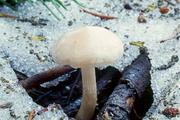 Boleslaw Kuznik |
CAP 3-6.5 cm, dry or moist, not hygrophanous, convex, orange-white to pale pinkish cinnamon beneath pale cinnamon hoary coating, becoming paler toward margin; flesh pinkish cinnamon. ODOR sweetish and sickening according to Hesler and Smith, but according to Largent decidedly fragrant at first, becoming faint with age but always detectable. TASTE mild. GILLS adnate to short decurrent, subdistant to distant, colored as cap or slightly darker, interveined. STEM 4-7 x 0.5-1.4 cm, narrowing downward, solid, colored as cap but generally lighter; silky-striate, somewhat hoary at first. MICROSTRUCTURES spores 7-9 x 4.5-5.5 microns; IW. REMARKS similar to H. pratensis but light pinkish cinnamon with fragrant odor: according to Largent, when H. pratensis is fairly fragrant, nearly identical and H. graveolens is identified by light pinkish cinnamon colors, hoary cap, and slightly larger spores (6-9 x 4-6 microns instead of 5-8 x 4-5.5 microns).
Hygrophorus melizeus forma minor - see section I.
Hygrophorus russocoriaceus - see section I.
CAP 1.5-3(4)cm, viscid, obtusely conical when young becoming flat or with slight umbo; dull whitish at first, developing a yellowish or more often pinkish brown to salmon brown to light yellowish brown discoloration on the disc, which may spread over the whole cap; flesh thin, soft, dull white, then sometimes browner. ODOR faint spicy fragrant (Hesler & Smith), faintly aromatic, sweet or fruity, fades quickly with maturity, (Largent). TASTE mild. GILLS adnate becoming short-decurrent, whitish at first then quickly pale pinkish cinnamon to almost cinnamon. STEM 2.5-4 x 0.3-0.7 cm, dry, whitish, becoming dingy where handled; pruinose all over becoming bald. MICROSTRUCTURES spores 7-8 x 4.5-5 microns (Hesler & Smith), 6.6-10.2 x 4.1-6.1 microns, (Largent); DV. REMARKS H. discoideus has a glutinous veil with remnants on stem, darker colors and larger spores.
III. Cap some shade of tan or brown, usually bright, in the center, pallid or almost white on the margin. (this color pattern is called "bicolorous")
CAP 2-5 cm, slimy to viscid, convex or with slight umbo, hazel to chestnut on disc, buff near margin, bald or slightly downy near margin; flesh thin, close to brick-color. ODOR and TASTE not distinctive. GILLS decurrent, narrow, whitish or tinged buff (yellowish in var. californicus). STEM 4-9 x 0.3-0.5 cm, (0.4-1.0 cm wide in var. californicus), slightly viscid in lower part, white, upper part with white fibrillose points, occasionally staining pale yellow at base. MICROSTRUCTURES spores 5.5-7 x 3.5-4.5 microns, (6-9 microns long in some European descriptions, and var. californicus 7-10 x 4-6 microns); DV. REMARKS H. hypothejus can look similar but H. discoideus differs in having a more yellow-brown to orange-brown cap with a darker center; like H. bakerensis in color, but H. discoideus has viscid stem and mild odor; like H. variicolor somewhat in color but H. variicolor is larger, with white gills that dry reddish brown, and an aromatic odor.
Hygrophorus flavodiscus - see section II
Hygrophorus glutinosus - see section II
Hygrophorus subpungens - see section II
| CAP 4-12 cm, viscid or glutinous, convex becoming depressed, whitish soon becoming dull yellowish brown over disc with whitish to pale orange-yellow margin, cap skin separable to disc, margin may be striate and floccose-fibrillose; flesh firm, white. ODOR distinct when young and fresh of raw potatoes. TASTE bitter. GILLS adnate becoming short-decurrent, venose at cap; white. STEM 6-10 x 0.8-1.8 cm, dry, narrowing downwards or nearly equal, solid, whitish or dingy; fibrillose-striate, upper part with tiny cottony scales. MICROSTRUCTURES spores (6)7-9 x 4.5-6 microns; DV. REMARKS This species is listed by Hesler & Smith for California and other states, but not the Pacific Northwest; however, Michael Beug has a photograph of a fruitbody from the Pacific Northwest identified by Daniel Stuntz as this species: it is distinctive by the combination of color pattern, potato odor, and bitter taste. | Hygrophorus tennesseensis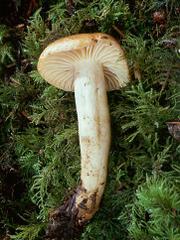 Michael Beug |
CAP 1.5-3 cm, viscid, convex, expanding, very pale pinkish, bald; flesh medium thin, whitish. ODOR and TASTE not distinctive. GILLS decurrent, rather close to subdistant, medium broad, pale buff. STEM 3-5 x 0.4-0.6 cm, dry, equal, pallid to pale buff, white-fibrillose above veil remnants; veil copious, white-fibrillose. MICROSTRUCTURES spores 5.5-6(8) x 3.5-4 microns, DV.
IV. Cap definitely yellow, some bright shade such as lemon yellow, egg yolk yellow, deep yellow tinged with orange, etc.
| CAP 2-7 cm, viscid or slimy, conical at first and usually retaining pointed umbo, bright yellow to orange, the orange usually toward the center; flesh yellow. ODOR and TASTE mild. GILLS adnexed to free, yellow. STEM 5-8 x 0.3-0.6 cm, moist or lubricous but not truly viscid, yellow to yellow orange, base may blacken. MICROSTRUCTURES spores 9-15 x 5-9 microns; PL. REMARKS H. conicus blackens all over, has white or yellow-tinged gills, and cap may be red. H. cuspidatus fruits May through August, and is red initially fading to orange or yellow; red color generally returns with drying. | Hygrocybe acutoconica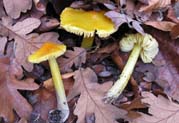 Michael Beug |
Hygrophorus cantharellus see section VI.
| CAP 1-4 cm, slightly viscid, convex, disc may be depressed; hygrophanous, golden yellow fading to straw yellow; flesh yellowish. ODOR and TASTE not distinctive. GILLS broadly adnate to subdecurrent, broadest near stem, pale yellow to near white. STEM 2-5 x 0.2-0.4 cm, slightly viscid but soon dry, colored as cap, hollow. MICROSTRUCTURES spores 5.5-8 x 4-5 microns; PL. | Hygrocybe ceracea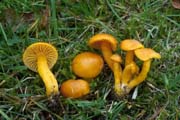 Steve Trudell |
Hygrophorus flavodiscus - see section II.
Hygrophorus hondurensis - see section VI.
CAP 0.3-0.8 cm, moist, convex to broadly conic, hygrophanous, lemon yellow when young, more ochraceous in age, pale yellowish when faded; bald, not striate; flesh thin, fragile, colored as cap. ODOR and TASTE mild. GILLS decurrent, distant, broad, yellow. STEM 1-1.5 x 0.05-0.1 cm, moist, solid or hollow; yellow, in age paler than cap or white below; bald. MICROSTRUCTURES spores 6.5-9.5 x 4-5 microns. REMARKS rare; formerly Omphalina occidentalis, it was not treated by Hesler & Smith and consequently has never been a Hygrophorus; distinguished from omphalinoid species by combination of yellow colors throughout, small size, growth on moss and presence of clamp connections, and separated from small brightly colored Mycenas growing on moss or needles by absence of cystidia.
| CAP 1-3 cm, moist, at times subviscid, broadly obtuse to convex, sometimes with a depressed disc, hygrophanous, amber or apricot yellow or orange, sometimes fading to paler yellow, striate; flesh thin, same color as cap. ODOR and TASTE mild. GILLS decurrent, interveined, whitish or pale yellowish to "wax yellow". STEM 3-6 x 0.2-0.3 cm, dry or moist, not viscid, lemon to amber yellow, often tinged red or orangy pink or rufous on the lower half. MICROSTRUCTURES spores 5-7.7 x 3.5-5 microns; PL. REMARKS the stem is often more highly colored (pinkish red) than the cap. | Hygrocybe parvula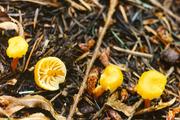 Buck McAdoo |
| CAP 1-3 cm viscid, convex, may have broad umbo, hygrophanous, yellow, may be striate; flesh thin, yellow. ODOR and TASTE mild. GILLS short-decurrent to adnate, fairly broad, pale yellow. STEM 2-4 x 0.2-0.4 cm, dry, colored as cap or paler, base may be orange. MICROSTRUCTURES spores 5-7.5 x 2.5-3.5 microns; PL. | Hygrocybe subceracea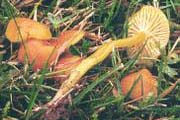 Buck McAdoo |
V. Cap orange.
Hygrophorus acutoconicus - see section IV.
Hygrophorus cantharellus - see section VI.
Hygrophorus hondurensis - see section VI.
Hygrophorus minutulus - see section VI.
Hygrophorus subceraceus - see section IV.
VI. Cap some shade of bright or deep red, such as vermilion, scarlet, blood red, cherry red, etc. but not purplish red or wine red or brownish red.
| CAP 1-3.5 cm, dry, convex, disc often becoming depressed; scarlet becoming vermilion, when old ocher or yellowish; flesh colored as cap, thin. ODOR and TASTE mild. GILLS deeply decurrent, often triangular; orange to yellow (usually paler than cap). STEM 4-9(12) x 0.15-0.4 cm, dry, colored as cap or paler, base whitish or pallid yellowish. MICROSTRUCTURES spores 7-13 x 4-8 microns. PL. REMARKS H. miniatus has drier cap, longer stem, paler colors, arcuate-decurrent gills, and usually longer spores; H. turundus var. sphagnophilus usually found on Sphagnum, may have slightly darkening scales, and may have red or adnate gills. | Hygrocybe cantharellus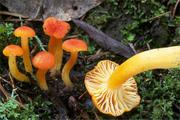 Boleslaw Kuznik |
CAP 1-1.5 cm, very viscid, convex to slightly depressed; red to yellow; striate; flesh thin, deep yellow. GILLS short-decurrent, "ivory yellow". STEM 3-4 x 0.1-0.2 cm, very viscid, yellow. MICROSTRUCTURES spores 5-7 x 3-4.5 microns. PL. REMARKS rare, and Hesler & Smith identification for WA qualified by "in all probability".
| CAP 0.5-1.5 cm, viscid to lubricous, convex, disc not depressed; hygrophanous, bright red when young, with age remaining bright red on disc and becoming yellowish on margin, eventually fading to reddish orange on disc and orangish to orangish yellow on margin; bald; flesh colored as cap surface. ODOR and TASTE mild. GILLS adnate to adnexed or with decurrent tooth, close to subdistant, broad and somewhat broader in middle, yellowish when young, becoming orangish from the cap downward. STEM 1.5-5 x 0.1-0.3 cm, glutinous or viscid, stuffed becoming hollow, at first red in upper part, yellowish or whitish in lower part, fading to yellow over all in age. MICROSTRUCTURES spores 7-10.3 x 4-5(6) microns, (Hesler & Smith), 7-8.5 x 3-4 microns, (Largent), PL. REMARKS like H. subminiatus (in size) which is only slightly viscid, has white gills tinged yellow-buff; like H. subminutulus (recorded once from Florida, once from California) which has smaller spores (5-7 x 3-4 microns) but is otherwise identical according to Largent. | Hygrocybe minutula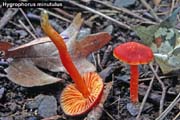 Peter Katsaros |
VII. Cap brownish purple, wine red, purplish red, or streaked or mottled with these colors on a white or pallid ground color.
Hygrophorus nordmanensis - see Section VIII.
Hygrophorus subviolaceus - see Section VIII.
VIII. Cap uniformly some shade of brown (rusty brown, umber, cinnamon brown, tobacco brown, olive brown, gray-brown, etc.) or gray. (not bicolorous, as in III)
CAP 3-4.5 cm, slightly viscid to viscid, conic with acute umbo, gray over umbo, browner toward margin; flesh grayish. ODOR and TASTE mild. GILLS adnexed to slightly decurrent, close to subdistant, whitish to pale gray; interveined. STEM 7-9 x 0.6-0.8 cm, white, sometimes small scales upper part. MICROSTRUCTURES spores 6-7(8) x 4-5.5 microns, PL.
Hygrophorus angelesianus
(also called Neohygrophorus angelesianus (A.H. Sm. & Hesler) Singer; Camarophyllus angelesianus and Clitocybe mutabilis are synonyms)
| CAP 2-5 cm, viscid (Hesler & Sm.), moist but not viscid (Bessette), convex, disc becoming slightly depressed; brownish gray to dark gray brown, margin scalloped-pleated; flesh thin, firm, dark gray. ODOR and TASTE mild. GILLS decurrent, distant, violaceous when young to violaceous-brown or vinaceous-brown in age. STEM 4-5 x 0.3-0.45 cm, narrowing slightly downwards, inside stuffed, colored as cap, may have tint of violet at base with white or pale lilac-tinted mycelium, top fibrillose-furfuraceous, base whitish with appressed fibrils and scant white rhizomorphs, the rest bald. HABITAT on soil and needles, in or near melting snowbanks at high elevations in spring, but also in other situations. MICROSTRUCTURES spores 7-9 x 4-5.5 microns, smooth, amyloid; IW. REMARKS red reaction in 3% KOH of gill and stem tissue. H. subviolaceus similar but fades differently and spores inamyloid. For other snowbank species see H. goetzii. | Hygrophorus angelesianus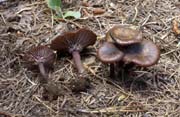 Steve Trudell |
CAP 3-5 cm, viscid, convex to obtuse becoming more or less flat; dark yellowish brown, sometimes zoned in age; flesh brownish near cap skin, grayish toward stem. ODOR and TASTE mild. GILLS broadly adnate to decurrent, "avellaneous" or nearly so. STEM 4-6 x 0.9-1.8 cm, dry, grayish pallid, solid. MICROSTRUCTURES spores 7-9 x 3.5-4.5 microns; DV.
Hygrophorus discoideus - see section III
| CAP 1-4 cm, convex, hygrophanous, moist, cinnamon brown to brown on disc and paler between striations, fading to gray brown, may be slightly scaly in age, may appear granular; flesh brittle, firm, cinnamon brown to brown. ODOR unpleasant, of mothballs, naphthalene flakes or chloride of lime. TASTE mild. GILLS decurrent, distant, light gray to darker gray brown. STEM 2-4 x 0.2-0.3 cm, narrowing downward, cinnamon brown to brown, may be darker lower stem, bald, dots or small scales at first, may appear hoary over base. MICROSTRUCTURES spores 4.5-6 x 4.5-5 microns; IW. REMARKS The mothball odor makes this easy to identify. | Hygrophorus foetens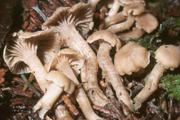 Sharon Godkin |
| CAP 4-12 cm, glutinous, convex becoming obtuse or flat, at first blackish brown to dark olive brown, slightly paler toward the margin, somewhat radially streaked after the colorless gluten dries, cap cuticle (cap skin) separable, margin even; flesh thick, white. ODOR and TASTE not distinctive. GILLS adnate or subdecurrent, whitish to creamy white. STEM 4-10 x 1.0-2.5 cm, slimy, equal or narrowing downward, sometimes wider at base, solid, white, slightly silky or bald in upper part, but at times scabrous. MICROSTRUCTURES spores 7-9 x 4.5-5.5 microns; DV. REMARKS somewhat like H. hypothejus but does not develop yellow colors. | Hygrophorus fuligineus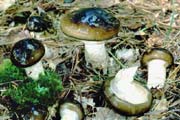 George Barron |
CAP 5-7 cm, viscid, conic becoming flat; gray; streaked; flesh medium thick on disc, thin on margin. ODOR and TASTE mild. GILLS subdecurrent, broad, white. STEM 3.5-5 x 0.8-1.0 cm dry, equal, or club-shaped widening downward to 2.0 cm; gray, white above, with a thin coating of gray fibrils below the line where the veil breaks. MICROSTRUCTURES spores 9-13 x 5.5-7 microns, DV. REMARKS like H. fuscoalbus but has dry stem.
| CAP 3-6 cm, dry, convex to broadly umbonate, dark grayish brown from dark grayish brown fibrils over pallid background, innately fibrillose to fibrillose-squamulose, fringed with marginal remnants of fibrillose veil.; flesh, soft, whitish. ODOR and TASTE mild. GILLS short-decurrent to adnate, broad, whitish tinted gray to grayish buff. STEM 3-6 x 0.5-1.2 cm, dry, solid, white and bald to appressed-silky near top, streaked with dark gray-brown fibrils below ring zone. MICRO-STRUCTURES spores 9-14 x (5)6-8 microns; DV. REMARKS like Inocybe or Tricholoma terreum group in general appearance; like H. pustulatus but has fibrillose veil and larger spores. | Hygrophorus inocybiformis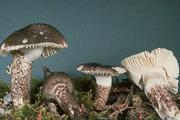 Ben Woo |
| CAP 2-5 cm, viscid but soon dry, convex, may become slightly depressed; buff to brownish and flushed vinaceous, in age with salmon to wine-colored tones extending to margin; fibrillose-streaked in age; flesh thick, firm, white. ODOR of cherry pits or bitter almonds. GILLS decurrent, distant, broad, whitish but in age becoming flushed with cap color but paler; interveined. STEM 3-6 x 0.3-2.5 cm, dry, equal or narrowing downward, white at first, may be flushed with color of cap in age, not darkening to more than pale salmon-buff around wormholes. MICROSTRUCTURES spores 10-14 x 5.5-7.5 microns; DV. REMARKS H. vinicolor has gills colored when young and powder on stem which becomes pink. | Hygrophorus monticola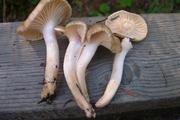 Andrew Parker |
CAP 1.5-4(5) cm, viscid to slimy, convex, obtusely conic, becoming flat with conic umbo; at first pallid or gray brown or dark brown, developing an obscure yellowish tone in places, skin separable; flesh whitish then gray at least under cap skin. ODOR and TASTE not distinctive. GILLS adnate then short-decurrent; white but may be grayish or yellowish near cap skin. STEM 3-9 x 0.3-0.9 cm, equal or narrowing downward, solid, white, pallid or brownish, in age with dingy-yellow stains; furfuraceous-flocculent. MICROSTRUCTURES spores 8-11 x 5-7 microns; DV. REMARKS similar to H. pustulatus but evenly colored cap with no pustules, and stem that may be scurfy but is not rough and scabrous with black points.
| CAP about 2 cm, viscid, convex expanding, "benzo brown" (violaceous brown), bald, with striate margin; flesh medium thin. ODOR of green corn. GILLS decurrent, distant, pale drab, becoming dingy buff with age. STEM about 2 cm long, dry, pallid. MICROSTRUCTURES spores 7-11 x 4.5-5.5 microns; IW. REMARKS Spores of H. ranierensis (which also has green corn odor) and H. subviolaceus are shorter. | Hygrophorus nordmanensis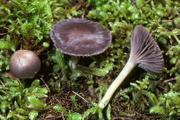 Michael Beug |
CAP 2-8 cm, glutinous, convex becoming uplifted; disc gray, margin whitish to pale gray; somewhat streaked-fibrillose; flesh thin, white. ODOR not distinctive to somewhat sweet to slightly almondlike. TASTE not distinctive. GILLS adnate to decurrent, white to cream. STEM 2-7 x 0.3-1.0 cm, slimy in lower part, equal but narrowing at base, solid, pallid or colored as cap, or whitish apart from pale gray top and pale yellow; with appressed white fibrils underneath slime, top white-dotted or pruinose. MICROSTRUCTURES spores 6-8 x 3.5-5 microns; DV. REMARKS can be described when mature as a gray H. eburneus, scarcely distinguishable when young before colors develop; somewhat like H. agathosmus which has stronger almond odor, lighter gray cap, and white dry stem; somewhat like H. fuscoalbus which has larger spores (9-13 x 5.5-7 microns).
CAP 2-4 cm, viscid, obtuse to broadly convex, becoming flat or disc slightly depressed and margin arched; dark ashy gray over disc, paler gray to pallid along margin, when old with faint ochraceous tinge throughout; fibrillose-streaked to matted-fibrillose under viscidity; flesh soft, pallid. ODOR strongly aromatic, of bitter almonds. TASTE mild. GILLS decurrent, distant, broad, whitish becoming creamy. STEM 4-8 x 0.3-0.6 cm, dry, equal or narrowing downward, pallid at first, unchanging with bruising but yellows on handling and dries with faint ochraceous tinge, faintly silky at top. MICROSTRUCTURES spores 11-14 x 6.5-8 microns; DV. REMARKS H. agathosmus somewhat similar but H. odoratus has yellowish tinged cap, more slender stem that yellows on handling, and larger spores.
| CAP 1-2.5 cm, lubricous to subviscid when wet, obtuse to convex at first, in age flat, sometimes with a recurved margin, sometimes with a depressed disc, with or without a papilla; dark or pale olive brown, margin paler in age; surface may crack circumferentially, disc make be finely wrinkled, at times margin faintly striate or wavy or pleated; flesh thin, dark olive-brown. ODOR and TASTE not distinctive. GILLS decurrent, distant to subdistant, broad, grayish white. STEM 2-4 x 0.3-0.6 cm, moist, whitish to cap colored, occasionally longitudinally striate; flesh of stem grayish. MICROSTRUCTURES spores 7-12 x 4-6 microns; IW. REMARKS H. acutus is acutely conical; H. atro-olivaceus has a finely scaly cap which is dark at least at center. | Hygrophorus recurvatus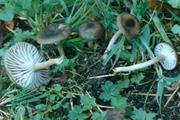 Buck McAdoo |
CAP 2-3 cm, slimy, convex, pale tan to dingy yellowish brown with buff margin ("Isabella color" with a "warm buff" margin, disc becoming cinnamon-tinged and then more or less "sayal brown"), appearing fibrillose-streaked under slime. ODOR and TASTE not distinctive. GILLS decurrent, distant, narrow, whitish becoming buff ("ivory yellow" becoming "warm buff"). STEM 4-6 x 0.3-0.6 cm, dry, whitish becoming buff ("ivory yellow" becoming "warm buff"), partial veil leaves a median fibrillose zone. MICROSTRUCTURES spores 8-10 x 4-5 microns; DV. REMARKS according to Hesler & Smith like H. hypothejus in all other characters but without gelatinous veil on stem.
| CAP 2-6 cm, slightly viscid when moist, broadly convex to flat or uplifted; hygrophanous, violet-gray to violet-brown at least at margin when moist, center often paler, fading as it dries to gray or pallid; margin striate when fresh and moist, cap skin separable; flesh colored like cap or paler. ODOR mild or earthy. TASTE mild to bitter or subnauseous or slightly peppery. GILLS decurrent, subdistant to distant, whitish soon becoming smoky violet or gray with a violet tinge, interveined. STEM 3-7 x 0.4-1.1(1.7) cm, dry, equal or narrowing downward, often curved at base; white or tinged cap color, solid becoming hollow, appressed-fibrillose. MICROSTRUCTURES spores 6-9 x 4-7 microns: IW. REMARKS Violet-tinged gills are unusual in Hygrophorus. H. angelesianus (Neohygrophorus angelesianus) has amyloid spores, non-fading cap, most often at high elevations spring and summer. H. ranierensis has strong green corn odor. H. cinereus has dry cap, mild taste, and larger spores. H. colemannianus has viscid, brown to pinkish-gray to buff cap. | Hygrophorus subviolaceus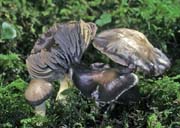 Kit Scates Barnhart |
CAP 2.5-5 cm, slightly viscid soon dry, obtuse with inrolled margin, "wood brown" on disc and "vinaceous-buff" toward margin, margin may be pink in age; flesh white, or wine-colored near cuticle (cap skin), unchanging. ODOR aromatic, almond, like H. agathosmus. TASTE disagreeable. GILLS decurrent, distant, broad, near "pale pinkish cinnamon" (almost the color of H. saxatilis). STEM 3-5 x 1-2 cm, dry, solid, white, minutely pruinose at first with powder developing a pinkish tone. MICROSTRUCTURES spores 10-14 x 6-8 microns; DV. REMARKS like H. monticola (and could possibly be a variant according to Hesler and Smith who described both species) but H. vinicolor has pale pinkish-cinnamon gills, disagreeable taste and pink powder on stem.
IX. Cap grass-green or olive-green.
Hygrophorus caeruleus - see section II: unusual greenish blue color might cause it to key out here, especially as it does not fit earlier sections well.
areolate - surface cracked into plaques or blocks, like the cracking that occurs when mud dries in the sun
divergent - of gill hyphae, projecting outward and downward away from cap as seen in cross-section
drab - a dull medium or brownish gray, dark gray with shades of yellow; gray with violet overtones; in Ridgway 1912, a gray-brown
dry - surface not sticky or slimy or hygrophanous, feeling as if there is no moisture on surface
emarginate - of gills, with a notch near stem, may be equated with abruptly adnexed, or sinuate, or a deeper notch of the sinuate type
equal - of a stem, the same diameter throughout its length
farinaceous - of odor, with the smell of fresh ground meal from whole grain, especially wheat
flocculent - with fine, easily removed cottony or woolly tufts; finely woolly or cottony
furfuraceous - scurfy, surface covered with branlike particles resembling scales, coarser than granular
gelatinous - jelly-like in consistency or appearance
gluten - the dissolved gelatinous hyphae of certain tissues
glutinous - slimy, having a highly viscid gelatinous layer, more than viscid
hazel - light to moderate yellowish brown; the color of the shell of the ripe hazelnut
hygrophanous - cap surface changing color markedly as it dries, usually having a water-soaked appearance when wet and turning a lighter opaque color on drying
interveined - of gills, connected by "veins" (ridges) that run between gills
interwoven - hyphae entwined or tangled, not forming a regular pattern
Isabella color - color of unbleached linen, dingy yellowish brown to pale tan
lubricous - greasy or slippery or oily but not viscid (sticky) or slimy
moist - having a slightly wet appearance or feel, not dry, lubricous, or viscid
neotype - specimen or other material designated as nomenclatural type when all the original material is missing
obtuse - blunt, not pointed; greater than a right angle
omphalinoid - of general form of the genus Omphalina, with broadly convex to depressed cap, decurrent or subdecurrent gills, cartilaginous stem, and no ring or volva; or loosely applied to indicate agarics with decurrent gills and small fruitbodies
parallel - of hyphae, arranged more or less parallel to each other
pliant - being pliable without breaking, flexible, not rigid or firm
pruinose - looking finely powdered or finely granular
recurved - curved back: when used of cap margin or scales means curved back
reticulations - markings that form a network
rhizomorph - cordlike strand of twisted hyphae present around base of stem
sayal - close to cinnamon in color, dark to dull cinnamon; between a moderate orange and a moderate yellowish-brown
scabrous - roughened by short projecting rigid scales
scurfy - surface covered with branlike particles resembling scales, same as furfuraceous
sensu - in the sense of
slimy - having a thick layer of slime, more than viscid or glutinous
sordid - dingy-looking
squamule - fine scale
stature - characteristic shape
striate - marked with lines or fine grooves, generally longitudinal on stem and radiating on cap
subdecurrent - of gills, meaning short decurrent or nearly decurrent or somewhat decurrent (i.e. intermediate between adnate and decurrent, when attachment extends slightly further down stem than when adnate)
subviscid - slightly sticky, thinly viscid
trama - the tissue under the surface cell layers of cap, stem, or gills
umbo - a raised knob or mound at the center of the cap
umbonate - having a raised knob or mound at the center of the cap
viscid - sticky but not slimy or lubricous: the mushroom usually feels somewhat slimy or slippery when wet but when dry may need to be wetted slightly to feel sticky; sometimes used to include slimy
| GENUS SPECIES | DESCRIPTION |
| HYGROCYBE (Fr.) P. Kumm. | |
| H. luteo-omphaloides Norvell, Redhead & Ammirati. | Appendix |
| HYGROPHORUS Fr. | |
| H. acutoconicus (Clem.) A.H. Sm. | Appendix |
| H. acutus A.H. Sm. & Hesler | Appendix |
| H. agathosmus Fr. | VIII B 4a |
| H. albicarneus Hesler & A.H. Sm. | Appendix |
| H. albiflavus Hesler & A.H. Sm. | Appendix |
| H. amarus A.H. Sm. & Hesler | II B 1a |
| H. angelesianus A. H. Sm. & Hesler | Appendix |
| H. atro-olivaceus A.H. Sm. & Hesler | VIII C 3b |
| H. avellaneifolius Hesler & A.H. Sm. | Appendix |
| H. bakerensis A.H. Sm. & Hesler | III B 2b |
| H. borealis Peck | I C 1b |
| H. burgdorfensis Hesler & A.H. Sm. | Appendix |
| H. caeruleus O.K.Mill. | Appendix |
| H. calophyllus Karsten | VIII B 1a |
| H. camarophyllus (Fr.) Dumée et al. | VIII B 6b |
| H. cantharellus (Schw.) Fr. | Appendix |
| H. capreolarius (Kalchbr.) Sacc. | VII B 4a |
| H. ceraceus (Fr.) Fr. | Appendix |
| H. chlorophanus (Fr.) Fr. | IV A 5b |
| H. chrysaspis Metrod | I A 4a |
| H. chrysodon (Fr.) Fr. | I A 1a |
| H. cinereus Fr. | VIII C 3a |
| H. citrinopallidus A.H. Sm. & Hesler | IV A 2a |
| H. coccineus (Fr.) Fr. sensu Hesler & A.H. Sm. | VI B 4b |
| H. colemannianus Blox. apud Berk. | VIII B 5a |
| H. conicus (Fr.) Fr. | VI B 1a |
| H. cossus Fr. | Appendix |
| H. cremicolor (Murrill) Murrill | II C 3a |
| H. cuspidatus Peck | VI B 3b |
| H. discoideus (Fr.) Fr. | Appendix |
| H. eburneus (Fr.) Fr. | I A 4b |
| H. ellenae Hesler & A.H. Sm. | Appendix |
| H. erubescens (Fr.) Fr. | VII B 4b |
| H. flavescens (Kauffman) A.H. Sm. & Hesler | IV B 2b |
| H. flavodiscus Frost apud Peck | Appendix |
| H. foetens Phillips apud Berk. & Broome | Appendix |
| H. fuligineus Frost apud Peck | Appendix |
| H. fuscoalboides Hesler & A.H. Sm. | Appendix |
| H. fuscoalbus (Lasch) Fr. | VIII A 6a |
| H. gliocyclus Fr. | II A 4b |
| H. glutinosus Peck | Appendix |
| H. goetzii Hesler & A.H. Sm. | Appendix |
| H. graveolens A.H. Sm. & Hesler | Appendix |
| H. hondurensis (Murrill) Murrill | Appendix |
| H. hypothejus (Fr.) Fr. | VIII A 3a |
| H. inocybiformis A.H. Sm. | Appendix |
| H. karstenii Sacc. & Cub. forma minor Bres. | Appendix |
| H. lawrencei Hesler & A.H. Sm. | Appendix |
| H. laetus (Fr.) Fr. | II A 3a |
| H. marginatus Peck var. marginatus | V C 5a |
| H. marginatus Peck var. olivacea A.H. Sm. & Hesler | IX 1b |
| H. marzuolus (Fr.) Bres. | VIII B 6a |
| H. megasporus A.H. Sm. & Hesler | VIII A 6b |
| H. melizeus (Fr.:Fr.) Fr. forma minor | Appendix |
| H. miniatus (Fr.) Fr. | VI C 4b |
| H. minutulus Peck | Appendix |
| H. monticola Hesler and A.H. Sm. | Appendix |
| H. morrisii Peck | Appendix |
| H. nitidus Berk. & Curt. | IV A 4a |
| H. niveus Fr. | I B 2a |
| H. nordmanensis Hesler & A.H. Sm. | Appendix |
| H. occidentalis A.H. Sm. & Hesler | Appendix |
| H. odoratus A.H. Sm. & Hesler | Appendix |
| H. olivaceoalbus (Fr.) Fr. var. olivaceoalbus sensu Hesler & A.H. Sm. | VIII A 5a |
| H. pacificus A.H. Sm. & Hesler | III B 2a |
| H. parvulus Peck | Appendix |
| H. penarius Fr. | II B 3a |
| H. piceae Kühner & Romagn. | I B 2b |
| H. pratensis (Fr.) Fr. | V C 5b |
| H. psittacinus (Fr.) Fr. | IX 1a |
| H. pudorinus (Fr.) Fr. | II B 5a |
| H. puniceus (Fr.) Fr. | VI B 4a |
| H. purpurascens (Fr.) Fr. | VII B 2a |
| H. pusillus Peck | II B 2a |
| H. pustulatus (Fr.) Fr. | VIII A 4a |
| H. ranierensis Hesler & A.H. Sm. | VII B 1a |
| H. reai Maire | VI A 2a |
| H. recurvatus Peck | Appendix |
| H. russocoriaceus Berk. & Miller apud Berk. & Broome | Appendix |
| H. saxatilis A.H. Sm. & Hesler | II B 5b |
| H. siccipes A.H. Sm. & Hesler | Appendix |
| H. singeri A.H. Sm. & Hesler | VI A 1a |
| H. sordidus Peck | I B 3b |
| H. speciosus Peck | V A 2a |
| H. squamulosus Ellis & Ev. | VI C 4a |
| H. subalpinus A.H. Sm. | I B 3a |
| H. subceraceus (Murrill) Murrill | Appendix |
| H. subminiatus (Murrill) Murrill | VI B 2a |
| H. subpungens A.H. Sm. & Hesler | Appendix |
| H. subviolaceus Peck | Appendix |
| H. tennesseensis A.H. Sm. & Hesler | Appendix |
| H. turundus (Fr.) Fr. var. turundus | VI C 3a |
| H. turundus (Fr.) Fr. var. sphagnophilus (Peck) Hesler | VI C 3a |
| H. unguinosus (Fr.) Fr. | VIII A 2a |
| H. variicolor Murrill | III A |
| H. velatus Hesler & A.H. Sm. | Appendix |
| H. vernalis A.H. Sm. | II A 4a |
| H. vinicolor Hesler & A.H. Sm. | Appendix |
| H. virgineus (Fr.) Fr. | I C 1a |
- END -