Ben Woo
Key when Peridioles (Eggs) are present
Key when Only Cups are present
The family Nidulariaceae, as used here, consists of twelve species in six genera (and we include Sphaerobolus, for convenience). Fruiting bodies are small, usually less than 15 mm high and 10 mm wide. Shapes range from globose to cushion (pulvinate) to obovoid, subcylindric, cup-shaped or vase-shaped. In keeping with the common name, "Bird's Nest Fungi", some are seen to resemble an avian nursery when the lid (epiphragm) falls away and the peridioles appear as "eggs" which usually have a covering called a tunica. Within the peridiole, the spores are smooth and no capillitium is present as in the Lycoperdaceae. The fruiting bodies may appear singly but will usually be found in groups of few to many on wood, woody debris, dung or soil.
All fruiting bodies contain peridioles, from one in Sphaerobolus to many in Cyathus. Some of these are embedded in a gelatinous substance while others are not. Some are fastened to the interior of the cup by a slender cord called a funiculus. Some peridia fracture and drop the peridioles on the substrate; others depend on wind, rain or insects to disperse them. Eventually these small packages disintegrate and release the spores.
Most of the information herein was derived from The Bird's Nest Fungi by Harold J. Brodie and the photo slides and personal experience of Kit Scates.
Information added in 2007 about Sphaerobolus iowensis was taken from the first two references below, and the original description is in the third. The title of the key was changed from Nidulariaceae to reflect the fact that Sphaerobolus is presently considered a member of Geastraceae. The spore distribution mechanism is remarkable in that the fungus can project its peridioles up to 6 meters, normally toward the brightest light in its environment, hence acquiring the common names “artillery fungus” and “cannonball fungus”. Basidiospores are stimulated to germinate in the digestive system of mammals that have ingested them with plant material. If they are not ingested, the asexual spores can germinate directly on wood or plant debris. The dispersal mechanism of other bird’s nest fungi is no less remarkable in that they are adapted so that falling drops of water splash the periodoles out of the “nest” to land a distance away.
1a Only one egg per cup; fruit body globose, splitting into star-like rays
................................................................................Sphaerobolus stellatus or Sphaerobolus iowensis
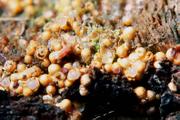
| FRUIT BODY globose, up to 3 mm diameter, white to cream; opening from top with star-like rays to expose one red-brown peridiole which is forcefully expelled. HABITAT on wood in mossy areas.REMARKS Sphaerobolus iowensis L.B. Walker was found in 2005 to be as common as or more common than S. stellatus in North America (Geml et al. 2005b). They record Sphaerobolus iowensis from Washington and Sphaerobolus stellatus from Oregon (Geml et al. 2005b). The two species must be differentiated microscopically. “Early gleba development in young basidiocarps of S. stellatus is marked by the formation of globular knots of binucleate hyphae. These later become centers around which new basidia are formed, eventually producing four (occasionally eight) basidiospores per basidium. The basidia entirely break down and disappear as soon as the spores are mature, making room for the enlargement and maturation of other basidia. In S. iowensis, the development of young basidia is followed by the formation of characteristic cavities or chambers in which the spores are produced (Walker, 1927). In addition, the glebal covering (peridium) consists of a three-layered endoperidium and three-layered exoperidium in S. stellatus, whereas in S. iowensis a gelatinous layer in the outer peridium is absent (Walker, 1927).” (Geml et al. 2005a). The third species of Sphaerobolus, Sphaerobolus ingoldii J. Geml, D.D. Davis & D.M. Geiser, has smaller fruitbodies (rarely exceeding 1-1.5 mm) and peridioles (0.6-1.3 mm), slightly larger spores (8.0-9.5 x 5.3-6.5 um from cultures), no gemmae (asexual spores), and other differences in cultural characteristics, and lacks basidial cavities. It has been recorded so far from the USA (GA, MI, OH, PA) and Japan. (Geml et al. 2005b). | Sphaerobolus stellatus Ben Woo |
1b Few to many eggs per cup
................................................................................2
2a Eggs embedded in a gelatinous substance, not attached to side of cup
................................................................................3
2b Eggs not embedded in a gelatinous substance, attached to side of cup by a minute cord
................................................................................7
3a Fruit body globose, less than 1.5 mm diameter, often confluent
................................................................................Mycocalia denudata
FRUIT BODY thin-walled, smooth, white to pale buff. EGGS numerous chestnut-brown 0.3-0.4 mm, with a double cortex. HABITAT mainly on old wood and on stems of rushes. Recorded in Northern Europe and British Columbia.
3b Fruit body either pulvinate (cushion-shaped) or shaped as a mug, flower pot, cup, vase or bird's nest
................................................................................4
4a Fruit body pulvinate, thin-walled, breaking down to release numerous eggs; without epiphragm
................................................................................5
4b Fruit body shaped as a mug, flower pot, cup, vase or bird's nest; structure persistent; epiphragm functional
................................................................................6
5a Eggs reddish brown, lens-shaped, wrinkled when dry
................................................................................Nidularia deformis
FRUIT BODY subglobose, 5 mm diameter, yellow-brown, with epiphragm breaking apart to expose shiny red-brown lenticular (lens-shaped) eggs which fall to substrate. EGGS wrinkled when dry, cortex with thin wall of separable hyphae which is sparingly branched. HABITAT on partially rotted wood.
5b Eggs grayish brown, irregular in shape, rarely wrinkled when dry
................................................................................Nidularia pulvinata
FRUIT BODY pulvinate to subglobose, 2-10 mm diameter; golden brown to red-brown, floccose at first, inner surface shiny brown and often bumpy from pressure of many eggs. EGGS grayish-brown, irregular in shape. HABITAT found on old wood, especially driftwood.
6a (4b) Cup like a slender mug, 4-6 mm high, covered with whitish velvety hairs
................................................................................Nidula niveotomentosa
| CUP with a slight flare at the top, 5.5 mm high, 5 mm across the mouth, white to pale buff, finely tomentose outside; shiny gold to gold-brown inside. EGGS 0.5-1 mm across, reddish brown, embedded in shiny gelatinous material; circular, wrinkled when dry, smooth when wet. HABITAT on old wood, bracken, berry canes. Common. | Nidula niveotomentosa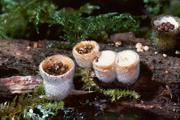 Michael Beug |
6b Cup like a flower pot, 10-15 mm high, covered by gray or gray-brown shaggy tomentum
................................................................................Nidula candida
| CUP large (for a bird's nest fungus), white-buff to yellow-buff to gray-brown, finely tomentose to shaggy outside, sometimes tufted; 10 mm high, 7.6 mm across mouth. Epiphragm tufted, yellow-brown. Inside silver-beige with flaring mouth. EGGS 1.5-2 mm diameter, gray-brown to red-brown on top, black underneath, smooth, thin tunica. HABITAT rotting wood, berry canes, on ground, may grow out of old cups. Common. | Nidula candida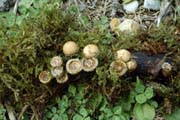 Steve Trudell |
7a (2b) Eggs white to light buff, each with a small nipple-like protuberance
................................................................................8
7b Eggs dark (gray, brown, blackish)
................................................................................9
8a Cup widely obconic (like a pointed ice cream cone); 2-4 mm high; white, gray or pale buff; from desert areas only
................................................................................Crucibulum parvulum
CUP very small, 2-4 mm high, 1.5-3 mm across mouth; wide flaring; white to gray with delicate tomentum; inside smooth, shiny white to gray. EGGS 0.5-2.5 mm, with a white tunica, attached to inner well by funiculus. HABITAT found in desert lands of Idaho on dead juniper.
8b Cup 4-8 mm high, about as wide; sides almost cylindric, short; tawny yellow when young, variable habitat, usually not desert
................................................................................Crucibulum crucibuliforme
| CUP subglobose to short cylindric; thin-walled, single layered; tawny yellow when young to white in age. Exterior velvety and epiphragm coarsely tomentose. Inside shiny white glaze; 5-8 mm across mouth, slightly narrower at base. EGGS 1.5-2 mm across, silvery beige to white, round, wrinkled when dry; attached by funiculus. HABITAT fruits on twigs, old nut shells, chips, old matting, manure, never on soil or large logs. | Crucibulum crucibuliforme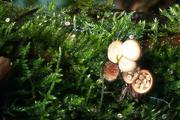 Norman Evans |
9a (7b) Cup plicate
................................................................................10
9b Cups not plicate
................................................................................11
10a Wall of cup thick; external surface with hairs distinctly tufted; gray, rarely light fawn; in alpine and desert regions
................................................................................Cyathus helenae
CUP obconic; inner surface faintly but distinctly plicate (grooved or pleated), external surface with hairs in distinct tufts; 5-6 mm wide at mouth, 7 mm high; wall thick; outer surface gray, rarely light fawn; inner surface gray, shiny, silvery; solid to touch. Lip dark brown. Epiphragm white, thin. EGGS dark, attached to side of cup by complex yellow-white funiculus with purse connections, not embedded in gelatinous substance.
10b Wall of cup thin; external surface with hairs not in tufts; brown
................................................................................Cyathus striatus
| CUP obconic; 7-10 mm high and 6-8 mm across mouth; gray-brown to dark brown; outside shaggy to hairy but not tufted. Inside strongly striate, silvery gray. Epiphragm prominent, white to buff. EGGS subglobose, 3 to many, blackish, vaguely triangular, attached to cup by complex yellow-white funiculus with purse connections. HABITAT on wood debris, dead willow, berry canes and manure. | Cyathus striatus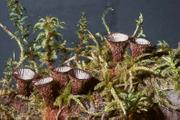 Ben Woo |
11a (9b) Outside of cup shaggy, including additional long and conspicuous hairs. Eggs large and shiny black
................................................................................Cyathus stercoreus
| CUP obconic; 5-10 mm high and 4-8 mm wide; with large, red-brown basal emplacement; exterior gold-brown to russet brown; outer surface covered with tufted, shaggy tomentum, becoming smooth in age at times. Inside lead-gray to blue-black. EGGS black, 1.5-2 mm with hard wall (lacks tunica); occasionally without funiculus or difficult to see. HABITAT on dung or manured soil. REMARKS often misidentified as Nidula. | Cyathus stercoreus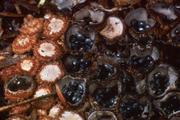 Michael Beug |
11b Outside of cup with fine matted hairs but very few or no long, conspicuous hairs; eggs variable in color
................................................................................12
12a Cup 4-4.5 mm high and 3.5 mm across mouth; inside surface very dark; eggs 1 mm across
................................................................................Cyathus pygmaeus
CUP small with strongly flaring rim; gray-brown; rigid; with appressed hairs over outer surface. Inner surface very dark, smooth. Epiphragm unusually strong. EGGS small, to 1 mm with thin silvery tunica, dark underneath; angular with flat side; funiculus white, translucent. HABITAT on dead stems, shrubs of arid areas, cow dung. REMARKS smallest Cyathus, common in Washington in the right habitat.
12b Cup 10-15 mm high and 8-10 mm across; inside surface considerably lighter than C. pygmaeus; eggs to 3.5 mm
................................................................................Cyathus olla
CUP elongated bell-shape, thick-walled; gray to gray-brown, finely tomentose outside; lip of cup seldom circular; flaring and wavy. Basal emplacement large. Inside smooth, shiny, lead color with gray and black mottling. EGGS large, to 3.5 mm, brown-black or black, flat, irregular, attached by funiculus. HABITAT on cedar chips, manure, twigs, sometimes growing with Crucibulum crucibuliforme.
1a Fruit body 2-3 mm wide, globose, opening star-like
................................................................................Sphaerobolus stellatus or Sphaerobolus iowensis
1b Fruit body like a cushion or bird's nest, pot, vase, mug, etc.
................................................................................2
2a Fruit body +/- like a cushion, thin-walled, breaking down to release numerous small eggs
................................................................................3
2b Fruit body +/- like a bird's nest, cup, mug, goblet, etc.
................................................................................4
3a Eggs reddish brown, lenticular, wrinkled when dry
................................................................................Nidularia deformis
3b Eggs grayish brown, irregular in shape, rarely wrinkled when dry
................................................................................Nidularia pulvinata
Since the peridium of this genus breaks down to release the peridioles, it is questionable if any recognizable portions of the cup would be found. A definite identification clearly could not be made without the presence of the peridioles.
4a (2b) Cup plicate (pleated)
................................................................................5
4b Cup not plicate
................................................................................6
5a Wall of cup thick, with external hairs distinctly aggregated into tufts; emplacement large, solid; cups gray-colored, rarely light fawn
................................................................................Cyathus helenae
5b Wall of cup not thick; external hairs not in tufts; cups brown
................................................................................Cyathus striatus
6a (4b) Cups usually under 4.5 mm tall, from dry deserts
................................................................................7
6b Cups usually 5-15 mm tall, usually not in deserts
................................................................................8
7a Cups 2-4 mm tall x 1.5-3 mm wide, inside white to buff
................................................................................Crucibulum parvulum
7b Cups 4-4.5 mm tall x 3.5 mm wide, inside very dark
................................................................................Cyathus pygmaeus
8a (6b) Cups with sides almost vertical, +/- like a mug
................................................................................9
8b Cups with sides tapering downward, (obconic, as ice cream cone)
................................................................................11
9a Height of cup about equal to width at mouth; exterior in age almost smooth, color yellowish or orangish brown
................................................................................Crucibulum crucibuliforme
9b Height of cup usually greater than width at mouth, exterior retaining hairiness, velvety to shaggy; color white, buff, or gray-brown
................................................................................10
10aa Cup like a slender mug, 5-7 mm high, covered by whitish velvety hairs
................................................................................Nidula niveotomentosa
10b Cup like a flower pot, 10-15 mm high, covered by shaggy gray or gray-brown tomentum
................................................................................Nidula candida
11a (8b) Outside of cup woolly, with conspicuous long hairs
................................................................................Cyathus stercoreus
11b Outside of cup covered by fine matted hairs but very few or no long conspicuous hairs
................................................................................Cyathus olla
basal emplacement - the solid rounded mass of hyphae at the lower and narrow end of the fruit body.
epiphragm - the membrane of hyphae covering the mouth of the fruit body.
funiculus - the cord attaching peridioles (eggs) of some Nidulariaceae to the fruit body.
globose - rounded, spherical.
obconic - vase-shaped, like ice cream cone (point down).
peridiole - egg.
peridium - cup.
pulvinate - cushion-shaped.
purse connection - where the uppermost part of the funiculus is connected to the peridiole (egg).
striate - ridged, scored, or with lines.
subglobose - somewhat spherical.
tomentum - densely matted woolly hairs.
| SPECIES | B.C. | WASHINGTON | OREGON | CALIFORNIA | IDAHO | MONTANA |
|---|---|---|---|---|---|---|
| Crucibulum crucibuliforme | Common 1 | Common 2, 23 | Common 2 | Common 3 | Found 4 | Found 5 |
| Crucibulum parvulum | Found 6 | |||||
| Cyathus helenae | Found 6 | |||||
| Cyathus olla | Reported 7 | Found 8, 20, 23 | Found 9 | Found 5 | Found 4 | |
| Cyathus pygmaeus | Found 6 | Found 6 | Found 6 | Found 6 | ||
| Cyathus stercoreus | Found 20, 23 | Found 10 | Found 11 | Found 4 | ||
| Cyathus striatus | Found 6 | Found 5, 23 | Found 12 | Included 13 | Found 4 | Found 5, 22 |
| Mycocalia denudata | Found 6 | |||||
| Nidula candida | Common 1 | Found 6, 23 | Common 6 | Common 11 | ||
| Nidula niveotomentosa | Common 6 | Common 14, 23 | Common 15 | Common 11 | Found 4 | |
| Nidularia deformis | Found 16, 23 | Found 4 | ||||
| Nidularia pulvinata | Found 17 | Found 23 | ||||
| Sphaerobolus sp. | Found 18 | Found 21, 23 | Found 10, 21 | Included 13 | Found 19 | Found 22 |
(Key entry refers to the "Key when Eggs (Peridioles) are Present.")
| GENUS AND SPECIES | KEY ENTRIES |
| CRUCIBULUM Tul. & C. Tul. | |
| C. crucibuliforme V.S. White Bull. (= Crucibulum laeve) | 8b |
| C. parvulum H.J. Brodie | 8a |
| CYATHUS Haller | |
| C. helenae H.J. Brodie | 10a |
| C. olla (Batsch) ex Pers. | 12b |
| C. pygmaeus Lloyd | 12a |
| C. stercoreus (Schw.) de Toni | 11a |
| C. striatus (Huds.) ex Pers. | 10b |
| MYCOCALIA J.T. Palmer | |
| M. denudata (Fr.) J.T. Palmer | 3a |
| NIDULA V.S. White | |
| N. candida (Peck) V.S. White | 6b |
| N. niveotomentosa (Henn.) Lloyd | 6a |
| NIDULARIA Fr. | |
| N. deformis (Willd.) Fr. (= Nidularia farcta) | 5a |
| N. pulvinata (Schw.) Fr. | 5b |
| SPHAEROBOLUS Tode | |
| S. stellatus (Tode) Pers. | 1a |
| S. iowensis L.B. Walker | 1a |
- END -