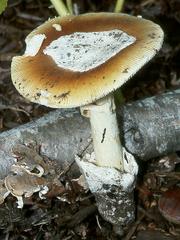
Janet Lindgren
In 1792 C.H. Persoon reintroduced the name Amanita to a group of species, from the Linnaean genus Agaricus that had a distinct membranous or friable universal veil. This universal veil is also known as a volva. Remnants of the volva can often be seen on the surface of the cap and around the base of the stipe. The presence of a distinct volva was, and still is, the main macroscopic character of the genus.
FRUIT BODIES agaricoid, fleshy, stipe central, small to large, solitary to subgregarious; primordium enveloped in a membranous or friable universal veil which, upon expansion of fruit body, ruptures, leaving a membranous sac at base of stipe on some species or breaks up into warts, patches, rings, scales, or powder adhering to cap and/or stipe. CAP ovoid, convex to plane, surface smooth or with remnants of universal veil, if margin smooth then spores usually amyloid, if striate/sulcate then spores usually inamyloid, dry to slightly viscid, colors range from pure white through shades of gray, brown, yellow, red, orange, and green. GILLS white or whitish; free from stipe at maturity. SPORES white to cream. UNIVERSAL VEIL white, cream, shades of gray, brown, or yellow; some with reddish to brown stains. PARTIAL VEIL or ANNULUS persistent on the stipe if membranous, or absent if friable or not developed. STIPE solid, hollow, or stuffed; shape of base unique for each species and is important for correct identification.
THE KEY IS BASED MAINLY ON CAP COLOR, PRESENCE OR ABSENCE OF AN ANNULUS, AND FEATURES SEEN AT THE BASE OF THE STIPE, INCLUDING COLOR, TEXTURE AND SHAPE OF THE VOLVA.
This is an easy, but not a foolproof method, for identifying an Amanita. If you have several complete specimens, at different stages of development, it is often possible to determine the species listed below. There are more than 30 species of Amanita in the Pacific Northwest. Some are not described or known well enough to be included here. Others are listed as a "group" because several species may actually have similar macroscopic features and key out together. Additional species found in old literature but not seen in recent years cannot be confirmed; therefore they are not included. All species of Amanita in this key are mycorrhizal except for Amanita pruittii, A. armillariiformis, and A. prairiicola that are saprotrophic (Wolfe 2012).
The color of the cap should not be confused with the color of the universal veil (volva), that may cover the top surface, and be of a different color. This veil usually breaks into one or more pieces, referred to as a patch or warts. Remaining pieces which did not adhere to the cap surface will form a cup, sac, or rings, or leave loose remnants on or near the base of the stipe. These remnants of the universal veil found around the base are called a volva. Many amanitas also have a partial veil that covers immature gills and then breaks away during development, leaving a ring or annulus around the stipe. Weather conditions, exposure, and state of maturity can influence the colors and features you see on a mushroom. Bruising, lack of moisture or excess moisture, and insect damage may also alter the colors. The more specimens you collect, the more variations you will see within the same species.
Do not consider this key as a guide to the edibility of any Amanita, as none in this genus should be eaten without positive identification by someone who knows the species well.
Sincere appreciation is given to Dr. Rodham E. Tulloss for his guidance, support, and sharing of information on the genus Amanita. With his detailed microscopy and study of type collections we have been able to determine the status of some Pacific Northwest species. Kit Scates-Barnhart brought to my attention the interesting story about A. pruittii and gave encouragement to write the original version of this key. Ian Gibson edited and fine-tuned the format and Sallie Jones made suggestions for which I am most grateful.
1a Stipe ± equal with no bulb at the base (cut mushroom longitudinally to view); cap margin usually striate; volva a large membranous cup or sac
................................................................................2
1b Stipe usually tapers up from base or bulb; cap margin usually striate for species 3a to 17a, and not striate for 17b to 26b; volva membranous, friable, farinaceous, or evanescent
................................................................................8
2a (1a) Annulus and volva thick and membranous, well developed; cap a shade of yellow, usually with a large patch
................................................................................3
2b Annulus not formed; cap gray, gray brown, brown, white or pinkish beige
................................................................................4
3a (2a) Cap a shade of pale yellow with short striations on margin; annulus superior, often fragile and collapsing; volva as an open cup; fruits in spring
................................................................................Amanita vernicoccora Bojantchev & T. M Davis
CAP 6–18 cm broad, hemispheric to convex to plano-convex, sometimes depressed in age; pale yellow to almost white; surface viscid or tacky when moist, smooth, shiny and with a large, white or brownish stained patch; margin with short striations; flesh white, shading yellowish just under surface, may darken when cut or bruised. GILLS crowded; white to cream; edge white, ± fimbriate or floccose; not bruising. STIPE 5–14 cm long, 1.5–3 cm thick, equal or tapering upward from the midpoint; white to cream; surface smooth or fibrillose below annulus; flesh white to yellowish; hollow to stuffed. VOLVA open, saccate, membranous, friable, sometimes collapsing around stipe; white. ANNULUS superior; white to yellowish; membranous, thin, often evanescent. HABIT and HABITAT gregarious in areas with Douglas fir; not common; fruits in the spring. ODOR mild when young, like old fish, unpleasant in age. TASTE reportedly good, if fresh. EDIBILITY not known to be toxic. SPORES (8.5–)9.2–11.8(12.5) × (5.7–)6.2 –7.1(–7.5) µm, broadly ellipsoid to elongate, rarely cylindrical; inamyloid. REMARKS previously incorrectly known as A. calyptroderma or A. lanei.
3b Cap dark yellow to yellow brown, margin striate; annulus skirt-like; volva often lobed; fruits in the fall
................................................................................Amanita calyptroderma G. F. Atk. & V. G. Ballen
| CAP 8-25 cm (or more) broad; subglobose to convex, then plane; color may shade from yellow at the margin to orange-brown over the center or be completely yellow-brown; surface viscid when moist, smooth except for a large, thick patch of white universal veil tissue; margin striate; flesh thick, solid, white to yellow near the top surface. GILLS broad, close, white to pale creamy-yellow; fimbriate. STIPE 7-25 cm long, 2-4 cm thick; equal; creamy or pale yellow, staining brownish where handled; smooth but powdery below the annulus; center hollow. ANNULUS superior, cream colored like the stipe, skirt-like, membranous and fragile. VOLVA large, thick, white, uneven margin. HABIT and HABITAT gregarious; grows in PNW with Douglas fir and more commonly with madrone and hardwoods in southern Oregon and California. It can be huge! ODOR and TASTE mild. EDIBILITY good, but be sure of your identification. SPORES 8-11 x 5-6 µm, inamyloid. REMARKS This is listed incorrectly as A. calyptrata or A. lanei in some field guides. | Amanita calyptroderma Janet Lindgren |
4a (2b) Cap pinkish beige to pale pinkish orange, rarely white, with one or several thick patches, margin striate; upper portion of stipe rough, lower portion smooth; volva membranous, white, like a loose cup or sheathing base and often buried
................................................................................Amanita velosa (Peck) Lloyd
CAP 3-12(-15) cm broad, oval to convex and finally plane; color fades from light orange to salmon, pale pinkish-buff, orange-buff or rarely white; viscid when moist; smooth; usually with a white patch or several large thick pieces of universal veil; margin striate; flesh thick, white. GILLS close; white turning dull pinkish; lamellulae subtruncate to truncate. STIPE 5-15 cm long, 0.5-2.5 cm thick; equal or tapering upward; white or tinged with cap color; upper portion powdery, lower end smooth. VOLVA membranous, thick, saccate, white and pale pinkish inside, usually buried or obscure. ANNULUS absent or just a fibrous zone on the stipe. HABIT and HABITAT scattered to gregarious with various species of oak in southwestern Oregon and northern California; usually fruits in the spring. It grows out beyond the drip line of trees. ODOR pungent when old. TASTE when cooked is sweet and excellent. EDIBILITY While this is an excellent edible mushroom, it is not one for beginners because of the similarities it has to A. ocreata and other toxic species. SPORES 8.5-12.5 x 6-10 µm, inamyloid.
4b Cap a shade of gray, gray brown, brown, or white, smooth or with patches, often with a slight umbo; volva membranous, sac-like or constricted around lower stipe, white, buff, gray, or with rust colored stains
................................................................................5
5a (4b) Cap brown, darker when young, with a darker band of brown at inner edge of prominent striations; volva large, membranous, sac-like, often split and attached only at base of stipe
................................................................................Amanita pachycolea Stuntz in Thiers & Ammirati
| CAP 7-12(-20) cm broad, at first oval, then convex and finally plane with an umbo, and with an upturned margin; dark brown, shading lighter toward the margin and with a darker band at inner edge of striations; surface smooth, viscid when moist, usually without a patch or warts of universal veil; margin deeply striate; context white, soft. GILLS broad, close, white, discoloring orangish in age; edges fimbriate and often dark brown. STIPE 12-30 cm or more long, 1-3 cm thick, equal or tapering upward; covered with gray-brown to brown fibrillose scales on a pale background; hollow in age. VOLVA membranous, thick, saccate, tall, white with rust colored stains. ANNULUS none. HABIT and HABITAT solitary to scattered in mixed woods with conifers; common. ODOR and TASTE mild. EDIBILITY edible, not choice. SPORES 11-14.5 x 10-12.5 µm, broadly ellipsoid to globose; inamyloid. REMARKS often large in size and can be rust colored like A. fulva which is not confirmed to be in the PNW. | Amanita pachycolea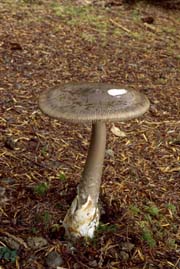 Steve Trudell |
5b Cap a shade of gray, to gray brown, brown, or white, smooth with or without flat patches; striations without a band of brown; volva sac-like, constricted sac, or as patches at base of stipe
................................................................................6
6a (5b) Cap gray, gray brown, or light brown; volva attached only at bottom of stipe
................................................................................ Amanita vaginata group sensu auct. PNW
| CAP 3-10 cm broad; convex to obtusely conic to subglobose, becoming plane with an umbo; color gray to gray-brown or light brown; smooth or with a patch of universal veil tissue; margin with deep striations. GILLS close to subdistant, white to grayish; edges may be fimbriate. STIPE 7-15 cm long, 0.5-2 cm wide, equal or tapering upwards; surface striate near top, white to grayish; not bulbous. VOLVA membranous, saccate, white to whitish, often with rust colored stains. ANNULUS none. HABIT and HABITAT solitary to scattered with hardwoods and conifers; usually fruits in fall throughout the PNW. ODOR and TASTE mild. EDIBILITY not known to be toxic in PNW. SPORES size varies by different authorities, 7–12.0 x 6.0–9.0 µm, globose to broadly ovoid; inamyloid. REMARKS This European name is used because the local species in this section have not been well studied. We have several undescribed species that macroscopically match this description, so therefore we use the name Amanita vaginata group. | Amanita vaginata.jpg) Fred Stevens (MykoWeb) |
6b Cap a shade of gray, gray brown, or white; volva as a constricted sac around base of stipe, or as patches and not distinct
................................................................................7
7a (6b) Cap white, usually with whitish patch; volva large, sac-like, attached only at bottom of stipe
................................................................................Amanita "alba" sensu auct. PNW
CAP 5-15 cm broad; convex to subglobose, in age broadly convex to umbonate; white to whitish with pinkish buff stains or spots; surface moist to subviscid, glabrous or with a patch of whitish universal veil; margin incurved to plane or uplifted, with striations; context white. GILLS close to subdistant; white, rarely pinkish in age; edge fimbriate when young. STIPE 7-13 cm long, 1.0-2.5 cm wide, equal or tapering upwards, no bulb; white, often with buff stains; surface smooth or slightly granular. VOLVA membranous, saccate, sheathing, attached only at the base, white or with rust to brown stains. ANNULUS none. HABIT and HABITAT solitary to gregarious in mixed woods; rare. ODOR and TASTE mild. EDIBILITY unknown. SPORES 9.5-12 x 9.5-11.5 µm, globose to subovoid; inamyloid. REMARKS This is not a valid name. It has been applied to several white vaginate mushrooms that are unnamed. Some consider this mushroom to be A. vaginata var. alba, but that has not been published.
7b Cap gray brown to brown with buff or grayish patch; volva constricted with the top flaring out, inner surface often tan or gray
................................................................................Amanita constricta Thiers and Ammirati
| CAP 5-13 cm broad; convex to plane in age with an umbo; gray to brownish-gray, some with inconspicuous radial streaks; viscid when moist; patch or patches of universal veil often left on surface; margin deeply striate; context next to surface gray to drab, white below. GILLS close to crowded; white becoming grayish; edge usually gray, fimbriate; lamellulae in several lengths, truncate. STIPE 10-16(-20) cm long, 0.7-1.7 cm broad; equal or tapering downward, no bulb; fine gray scales cover a white surface which darkens when bruised. VOLVA membranous, but fragile, adhering to lower section of stipe and flaring out above constricted area, white to pale buff, bruising reddish (rust), interior gray. ANNULUS none. HABIT and HABITAT singly to scattered in mixed forests, fruits in the fall. ODOR and TASTE not distinctive. EDIBILITY unknown. SPORES 9.6-12.8 x 8-10.4 µm, globose to ovoid; inamyloid. REMARKS This name has also been used for several undescribed species in section Vaginatae that have a constricted volva. | Amanita constricta group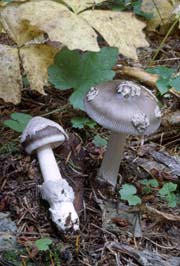 Steve Trudell |
8a (1b) Cap yellowish brown becoming dark brown in age, covered with dark gray to brownish volva remnants; volva at base as patches or crust or not distinct; annulus absent
................................................................................Amanita ceciliae sensu auct. PNW
CAP tannish brown to yellow brown, losing the yellow tone in age and with a darker disc, 5-12 cm across, subellipsoid to plane, slightly viscid when moist and decorated with dark gray to brownish gray volva remnants; margin striate. GILLS crowded, white to dingy white with numerous truncated lamellulae. STIPE 7-16 cm narrowing upward, white with remnants of the dark volva material hanging on. VOLVA floccose to floccose-membranous patches or crusts on base and may extend up the stipe, detersile, gray to brown. ANNULUS none. HABIT and HABITAT usually single in coniferous and deciduous forests in late summer and fall. ODOR and TASTE lacks odor and has a sweet taste. EDIBILITY not considered edible. SPORES (9.5-)10.3-14.9(-25) x (8.6-)9.5-14.3(-25) µm, globose to subglobose; inamyloid. REMARKS This is a European name for a species previously named A. inaurata. Here in the PNW there may be several species that come close to matching this description.
8b Cap a shade of gray, brown, white, yellow, orange, red, or green, with or without patches or warts; volva membranous, floccose, friable, farinaceous, powdery, or obscure; annulus present or absent
................................................................................9
9a (8b) Cap white shading to light tan, darker on disc, with or without patches or warts; volva a white, thin, membranous, thimble-like cup; annulus absent; grows with aspen and cottonwood
................................................................................Amanita populiphila Tulloss & E. Moses
CAP 3-12 cm across, white to off white, yellowish, or light tan, margin lighter and striate, rimose in dry weather. GILLS free to adnexed, close to crowded, off white to pale pinkish cream, white flocculose edges, lamellulae truncate. STIPE 6.3-17.5(-22) x (0.5-)0.7-2 cm, white, pale, orangish white flocculence on upper half. ANNULUS none. HABIT and HABITAT gregarious in grass after soaking rains and associated with aspen and cottonwood trees in late spring and summer. ODOR and TASTE mild or pleasant odor, good taste. EDIBILITY Be positive of your identification before eating. SPORES (7.0-)9.2-12.5(-21) x (6.0-)8.2-11.2(-15.8) µm, subglobose, inamyloid. REMARKS Known from Idaho and sites further east.
9b Cap a shade of gray, brown, white, yellow, orange, red, or green, with or without patches or warts; volva prominent or broken up; annulus present or absent
................................................................................10
10a (9b) Cap and basal bulb covered with gray to gray brown, powdery (farinaceous) universal veil remnants; no annulus
................................................................................Amanita farinosa sensu auct. PNW
| CAP 2.5-6.5 cm broad; convex to plane or depressed; gray to gray-brown and covered with granular or farinose universal veil remnants; margin striate; flesh whitish. GILLS close to subdistant; white; edges fimbriate; lamellulae truncate. STIPE 3-8 cm long, 0.4-0.8 cm broad; whitish to gray; granular, to smooth in age. VOLVA seen as farinose granules on a bulbous base. ANNULUS none. HABIT and HABITAT grows solitary with conifers; fall; uncommon. ODOR not distinct. TASTE mild. EDIBILITY unknown. SPORES 6.3-9.4 x 4.5-7.9 µm, globose to subglobose; inamyloid. REMARKS Pacific Northwest specimens of A. farinosa are larger than those from other parts of the country and usually found early in fall. | Amanita farinosa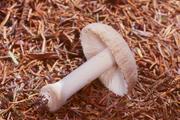 Michael Beug |
10b Cap color a shade of gray, brown, tan, white, yellow, red, orange or green, with or without warts or patches; volva membranous, friable, or obscure; annulus formed, but may be evanescent
................................................................................11
11a Cap a shade of red, orange, yellow, white, or tan; stipe base bulbose; annulus persistent; volva as concentric rings around the enlarged base
................................................................................Amanita muscaria group
................................................................................A. muscaria subsp. flavivolvata Singer
| CAP 5-17(-30) cm broad, convex to plane, often depressed in age; red to orange; subviscid when moist, glabrous under numerous, pale yellowish-tan, floccose warts; margin striate, at least in age; flesh white with yellow to reddish color just under the cap surface. GILLS white to pale cream, crowded, broad; lamellulae numerous, truncate. STIPE 5-13.5(-20) cm long, 1-3(-4) cm thick; tapering upward from a bulbous base; white to cream, becoming tannish when handled; surface smooth above annulus, ragged to scaly below; flesh white to cream, center stuffed. VOLVA seen as concentric rings or patches of creamy to yellowish-tan tissue. ANNULUS median to superior; white with yellowish edge; membranous; often falling away. HABIT and HABITAT solitary to densely gregarious; in mixed forests, and gardens from sea level to over 4,000’; fruits late summer to fall and is easy to recognize with its red cap, common. ODOR and TASTE mild. EDIBILITY toxic, unless prepared in a special way. SPORES (7.5-)9.1–12.8(-19.0) x (5.5-)6.6–8.6(-11.5) µm, broadly ellipsoid to ellipsoid; inamyloid. REMARKS A. muscaria var. muscaria is described as having a white universal veil and white warts; PNW species have cream to yellowish universal veil tissue. We do have a yellow capped A. muscaria known as Amanita muscaria var. formosa Thiers. The description for this variety is very similar to the above, except for the color of the cap. Molecular studies on Amanita muscaria var. formosa by Dr. Jozsef Geml have confirmed that it is a color variant of the true A. muscaria. The status of the white specimens and the tan ones has not been determined. | A. muscaria var. flavivolvata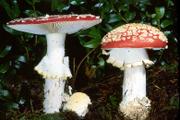 Catherine Ardrey |
11b Cap a shade of gray, brown, white, yellow, orange, or green: stipe enlarged at base, tapered, or root-like; volva shape variable; annulus formed but may be evanescent
................................................................................12
12a (11b) Cap light to dark brown, or brown with a yellowish margin, numerous white warts; volva short, close fitting, whitish, cup shaped with free margin
................................................................................Amanita pantherina group
| CAP 5-15 cm broad, convex to plane or slightly depressed; color is variable, usually dark brown, but may be light brown, yellow-brown, or brown with a yellowish margin, often darker near the center; viscid when moist, surface covered by white warts that may be in concentric rings or washed away by rain; margin striate; flesh firm and white. GILLS close; white to off-white; lamellulae truncate, numerous. STIPE 5-15(-20) cm long, 1-3 cm thick, equal or tapering upward from a basal bulb; white to creamy; surface smooth above the annulus and fibrous or scaly below; context white, stuffed to hollow. VOLVA short, with an abrupt margin, flat collar, or rolled edge; white to pallid. ANNULUS superior, skirt-like and with a ragged edge, white. HABIT and HABITAT gregarious with conifers and in mixed woods; can be found spring throughout the year. ODOR and TASTE not distinct. EDIBILITY toxic and the cause of many poisonings in the PNW. SPORES 9-13 x 6.5-9 µm, ellipsoid; inamyloid. REMARKS There are a number of similar looking mushrooms in this group. Check out the descriptions for A. gemmata and A. pantherinoides. | Amanita pantherina group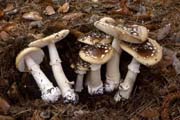 Steve Trudell |
12b Cap a shade of gray, brown, white, yellow, orange, or green; volva shape variable
................................................................................13
13a (12b) Cap predominately a shade of yellow to orange
................................................................................14
13b Cap not yellow, but may have yellow on the annulus, stipe, or volva; cap color a shade of light to dark brown, gray, white, or green
................................................................................17
14a (13a) Cap a shade of pale yellow, yellow, or orange with either a thinly stretched, white universal veil covering the cap, or small white warts; volva as patches or a short, close fitting cup with a free margin
................................................................................15
14b Cap creamy white to pale yellow, or honey yellow with a darker disc; volva short and close fitting around an oval basal bulb
................................................................................16
15a (14a) Cap bright yellow to orange, usually covered with a firmly attached, thin, white universal veil; annulus membranous; volva close around base; fruits in spring to early summer
................................................................................Amanita aprica J. Lindg. & Tulloss
| CAP 5-15 cm broad, globose, then convex to plane; bright yellow to yellow-orange, occasionally orange; surface usually covered with thin, stretched universal veil, tacky when moist; margin inrolled at first, sometimes appendiculate and with faint striations. GILLS close to subdistant; white to creamy white; fimbriate; lamellulae truncate and numerous. STIPE 3.5-9 cm long, 1.5-3.5 cm thick; usually equal; white to cream, bruising brownish where handled; surface pruinose to scurfy below annulus; context white to yellowish, stuffed to hollow in age. VOLVA low, close fitting, margin free, seldom rolled; white to cream; sometimes with additional rings of tissue near the base. ANNULUS superior to median; white to cream; membranous yet fragile; skirt-like or collapsing on stipe; may be evanescent. HABIT and HABITAT solitary to gregarious; most often with Douglas fir in exposed areas; fruits just after morels; common throughout PNW. ODOR and TASTE not distinctive. EDIBILITY toxic. SPORES (8.0-)9.5–13.0(-21) x (5.0-)6.5–8.5(-12.5) µm, ellipsoid; inamyloid. REMARKS This species contains ~ 650 ng. muscimol and ~175 ng. ibotenic acid per mg. of A. aprica cap, see Colby J.M. et al., 2013. | Amanita aprica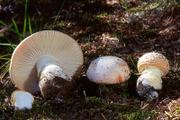 Michael Beug |
15b Cap light yellow to yellow with small, white warts or patches; volva short, white, with a free margin
................................................................................Amanita gemmata group sensu auct. PNW
| CAP 3 - 10 cm broad, convex to plane; creamy to pale yellow, golden yellow to almost buff, slightly darker at the center; surface viscid to tacky when moist, with thin to floccose white or dirty white patches or warts; margin striate, flesh white. GILLS close; white; narrowing towards the stipe; edges often floccose; lamellulae truncate. STIPE 4 - 13 cm long, 0.05 - 2 cm thick, tapering upward from an enlarged base, apex often expanded; white to pale cream; smooth above the annulus, floccose-scaly towards the base; flesh white, center hollow to stuffed. VOLVA short, close fitting with a collar-like or free rim, may also break up into loose patches around the subglobose basal bulb; white. ANNULUS if present, superior to median; membranous, fragile, skirt-like, edge thicker; often evanescent. HABIT and HABITAT solitary to scattered in conifer or mixed woods; late summer through fall; common. SPORES 8 - 13 x 6 - 9 µm, ellipsoid; inamyloid. ODOR not distinct. TASTE not noted. EDIBILITY toxic. REMARKS This is probably another misused name. It actually covers a group of similar, but often variable, yellow capped, often small to medium sized summer to fall fruiting amanitas. If the specimen does not have an annulus, it is called A. gemmata var. exannulata. If the specimen has a double, nearly basal, annulus and a short, tapered, rooting base, it may be A. breckonii. Recent sequencing of the nrlTIS locus from one WA specimen, which closely matches the description for A. breckonii, has shown it not to be A. breckonii and Dr. Rod Tulloss refers to it as C-19. This entire group is considered toxic. Some specimens also appear to merge with A. pantherina, as a whole color range from yellow to brown can be found in one group. The description combines features described by Western authors who know this group. (See A. pantherina group 12a.) | Amanita gemmata group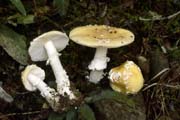 Steve Trudell |
Note: The two species in leads 15b and 16a cannot be accurately separated by macroscopic features or by what is written in the literature and in personal notes. There are close similarities in their descriptions and cap color may not be sufficient to differentiate between Amanita gemmata and A. pantherinoides. Amanita pantherinoides was originally described from a collection found near Seattle, so we know it grows in Washington. Another specimen of A. pantherinoides, found in Washington and described by Dr. Rod Tulloss, is illustrated with a photo in Mushrooms of North America by Roger Phillips. There is agreement that the cap color is honey yellow, but that appears to be the only consistent macroscopic characteristic to separate it from the paler yellow Amanita gemmata. Unfortunately, the type collection, found in Sweden, for Amanita gemmata no longer exists. A good photograph of what is locally called A. gemmata is shown in Mushrooms of the Pacific Northwest by Drs. Steve Trudell and Joe Ammirati. Genetic analysis of these two entities appears to be the only solution to the problem.
16a (14b) Cap honey yellow, darker on disc, with whitish warts or patches; volva close fitting, floccose, or with a free margin
................................................................................Amanita pantherinoides Murrill(Murrill)
CAP 3-10 cm broad; globose to hemispherical to plane; margin faintly striate; center often darker or brown; viscid when wet; volva remnants as soft, small, floccose warts or patches that may fall away; flesh is thin. GILLS white; adnexed to free, crowded; lamellulae truncate. STIPE 2-11 cm long, tapering upward from an ovoid basal bulb; white or whitish; glabrous. ANNULUS relatively large, white; persistent. VOLVA submembranous or floccose; short, thin margin, white. HABIT and HABITAT single or scattered in mixed conifer and hardwood forests. ODOR and TASTE not recorded. EDIBILITY probably toxic. SPORES (8.1-)8.5-11.2(-12.2) x (6.0-)6.3-7.7(-8.5) µm, mostly ellipsoid, inamyloid. REMARKS Some authors rank this species as a variety of A. pantherina; others may want to place it in the A. gemmata group. It was described by Murrill from collections found in WA and sequencing must be done on specimens of what we think are A. pantherinoides to better understand this group of yellow amanitas.
16b Cap very pale yellow to creamy white with thin white to tan floccose warts; annulus evanescent on many, or as thin, ragged tissue; volva short, around a pointed basal bulb
................................................................................Amanita alpinicola nom. prov. Cripps and J. Lindgren
CAP 3–9 cm broad, convex expanding to plane; whitish, cream to pale yellow, not bruising; surface slightly viscid with thin to floccose warts; margin with short striations only in extreme age; flesh white. GILLS broad, close to crowded, white to creamy, not staining. STIPE 3-9 cm long, 1-2.5 cm wide at apex; white, surface powdery; with a rounded bulb at base that often tapers to a point. VOLVA short, free margin, not inrolled. ANNULUS evanescent on many, others with partial rings or ragged tissue. HABIT and HABITAT scattered, growing with Pinus albicaulis or P. monticola at higher elevations, known only from a few sites in Idaho, Washington, Montana, and British Columbia; fruits in summer; specimens hardly break through the surface, and shed their spores in the duff. ODOR not distinctive. EDIBILITY unknown. SPORES 9–12 × 6–7.5 µm, ellipsoid; inamyloid.
17a (13b) Cap dull, light tan to tannish orange with floccose or membranous patches that often stain yellowish brown; white to pale orange scales on stipe; volva often breaks apart
................................................................................Amanita aurantisquamosa Trueblood, Miller & Jenkins
CAP 3.5-7 cm broad, convex to plane; light tan to pale tannish-orange, fading toward margin; glabrous, moderately viscid when moist; margin striate; flesh white, not staining. GILLS crowded; off-white to orange-white, white in age; lamellulae truncate to rounded truncate. STIPE 4-11(-13.5) cm long, 8-2.2 cm wide, tapering upward with a slight flare at apex; white floccose scales near apex, white to pale orange scales near middle and base of stipe; context pale pinkish-white; basal bulb ovoid. VOLVA seen as floccose, membranous patches on an enlarged base, ± saccate at first, soon breaking apart; white with yellowish to yellowish-brown stains. ANNULUS median to low, thin, delicate, evanescent in age; white. HABIT and HABITAT solitary to scattered under Douglas fir, aspen or juniper; only the cap shows above the duff when it fruits in late spring to early summer. ODOR and TASTE not distinct. EDIBILITY not known. SPORES 10.5-12.5 x 9.4-10.9 µm, subglobose to broadly ellipsoid; inamyloid. REMARKS This species is not mycorrhizal but will grow near Douglas fir and aspen. Known only from southern Idaho.
17b Cap a shade of light to dark brown, gray, white, or green; stipe often with a white or colored, floccose surface; volva variable
................................................................................18
18a (17b) Cap a dark shade of gray to brown, grayish warts or patches, no striations; abrupt bulb with low rim at base of stipe
................................................................................Amanita porphyria Alb. & Schw.
| CAP 5-12 cm; convex to plano-convex or subumbonate at maturity; gray to brownish-gray, often entire mushroom has a violet cast; thin warts or a patch of gray universal veil on surface; no striations on margin; flesh white, except gray to olive beneath surface. GILLS close to subdistant; white to grayish, staining gray when bruised; lamellulae numerous, short, attenuate. STIPE 5-12 cm long, 0.6-1.6 cm broad at apex, tapers slightly upwards; gray chevron pattern on surface; basal bulb rounded, marginate. VOLVA when present seen as thin, gray patches on margin of bulb. ANNULUS superior to median, gray, membranous, thin, often adhering to stipe. HABIT and HABITAT solitary with conifers or mixed forest, common, fall. ODOR like raw potatoes. TASTE not recorded. EDIBILITY unknown, may be toxic. SPORES 7.2-10.3 x 6.7-10.1 µm, globose; amyloid. | Amanita porphyria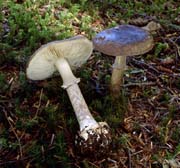 Steve Trudell |
18b Cap a shade of brown, green, white, or with a pale tint of color; volva shape variable
................................................................................19
19a (18b) Cap light green to brownish olive, rarely white, usually without a patch or patches; skirt-like annulus; volva membranous, thin, lobed, often broken
................................................................................Amanita phalloides (Fr.: Fr.) Link
| CAP 4-16 cm broad, convex to plane; green to brownish olive, rarely white; smooth and shiny when dry, tacky when moist with the appearance of innate, radiating fibers, occasionally with a thin patch or patches of white universal veil; margin usually not striate; flesh white. GILLS close, white to faintly greenish; lamellulae numerous, attenuate. STIPE 5-18 cm long, 1-3 cm thick, tapering upward, or equal with a globose to subglobose base, white with fibrous or scaly ornamentation that is white or colored like the cap. VOLVA white, membranous, saccate, lobed, not thick. ANNULUS superior, white, membranous, skirt-like, fragile, and may disappear in age. HABIT and HABITAT scattered or in groups, often growing with filbert or chestnut trees in the Pacific Northwest; fruits summer to fall. ODOR sickening sweet or like raw potatoes. TASTE probably good, as people have eaten it, but IT CAN BE DEADLY - DON’T TRY IT! EDIBILITY TOXIC. SPORES 9-14 x 7-10 µm, broadly ellipsoid to nearly round, amyloid. REMARKS It is thought that this species came into the area on the roots of nut trees brought from Europe in the 1800’s and early 1900’s. | Amanita phalloides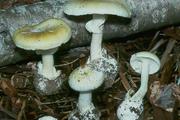 Janet Lindgren |
19b Cap predominately brown, white, or with a pale tint, smooth or floccose; volva variable; bruising and/or aging may cause color change
................................................................................20
20a (19b) Cap dark brown to yellow brown covered with remnants of yellow to grayish universal veil; stipe usually yellow; bulbose base with scaly to powdery, yellowish patches
................................................................................Amanita augusta Bojantchev & R. M. Davis
| CAP 3-15 cm broad; globose to convex, then plane; dark brown to gray-brown, or yellow brown; viscid when moist, and covered with mealy, yellow warts which become flattened and grayish in age; margin usually not striate, often yellow on the very edge; flesh white to yellow and soft. GILLS close; white to creamy-yellow; edges often fimbriate and darker. STIPE 4-15 cm long, 1-3 cm thick, equal or tapering upward from an enlarged base; white to yellowish, fibrillose or scaly towards the base, smooth when old. VOLVA mealy pieces of yellow tissue may form rings at the base or be left in the soil. ANNULUS membranous, skirt-like, white on the upper surface and yellow below and on the edge. HABIT and HABITAT solitary to scattered with both hardwoods and conifers; fruits late summer to fall. ODOR and TASTE not distinct. EDIBILITY not considered edible. SPORES 8-12 x 6-8 µm, ellipsoid; amyloid. REMARKS Names applied to this species include A. aspera and A. franchetii. | Amanita augusta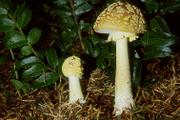 Catherine Ardrey |
20b Cap white or pale colored, smooth and silky, or floccose, powdery, or areolate; volva either large or not clearly defined, broken and ragged
................................................................................21
21a (20b) Cap white and smooth; volva membranous, white, large
................................................................................Amanita ocreata Peck
| CAP 5-12 cm broad, hemispheric to plano-convex; white to occasionally pale pinkish-buff; surface shiny when dry, viscid when moist, infrequently with a patch; margin incurved to slightly flaring in age, usually without striations; context white. GILLS attached when young by a slight decurrent tooth; broad; close to subdistant; white; edges not floccose; no staining; lamellulae subtruncate to attenuate. STIPE 6-20 cm long, 1-3 cm thick at apex; equal to tapering slightly upwards; white, sometimes brownish stains; fine powder or scaly near apex, flesh white, center solid to stuffed; abruptly bulbous to subglobose bulb. VOLVA white, large, thin, limbate and often buried in the soil. ANNULUS superior, membranous, fragile, often disappearing; white. HABIT and HABITAT solitary to gregarious; found mainly near water in sandy soil with deciduous oak, filbert, and possibly coniferous trees; known from only a few areas; fruits in the spring, just after the lowland morel season and in the same habitat. ODOR unpleasant when old. TASTE DO NOT TASTE. EDIBILITY DEADLY POISONOUS. In the past identified as A. verna or A. virosa. SPORES 9-14 x 7-10 µm, broadly ellipsoid to nearly round; amyloid. REMARKS Flesh of cap turns bright yellow in KOH. | Amanita ocreata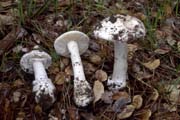 Steve Trudell |
21b Cap white or pale colored, smooth, floccose, powdery, or areolate; volva not clearly defined or broken and ragged
................................................................................22
22a (21b) Cap white when young, floccose, cap diameter about the same as stipe length, margin appendiculate; stipe base pointed; whole mushroom bruises pink or reddish brown
................................................................................Amanita novinupta Tulloss & Lindgren
| CAP 3-15 cm broad, hemispheric at first, then convex to plane; white with a pink or rosy tint beneath the surface, may become brownish in dry weather; surface chalky or powdery becoming smoother or cracked in age; margin without striations, sometimes appendiculate; context white, worm holes become reddish-brown. GILLS close to crowded, white to off-white, becoming pinkish when bruised; lamellulae truncate to attenuate, plentiful. STIPE 2-15(-18) long, 1-3.5(-5) cm wide; white, bruising pink, rose, or brown; surface powdery, often with scales and cracking. VOLVA often not well defined, some with rings or patches on a slightly enlarged base, often staining similarly to stipe. ANNULUS superior, usually with reddish tints; membranous, skirt-like, persistent. HABIT and HABITATgregarious under Oregon white oak (Quercus garryana) in landscaped areas and probably with other trees; uncommon in the Pacific Northwest; fruits in April. ODOR faintly fungoid. TASTE not distinctive. EDIBILITY unknown. SPORES (6.2-)8.2-10.8(-14.8) x (4.2-)5.5-7.2(-8.8) µm, ellipsoid; amyloid. | Amanita novinupta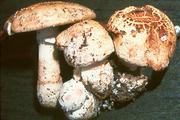 Janet Lindgren |
22b Cap white or pale colored, smooth, floccose, powdery, or areolate; base marginate, tapered, rooting, or enlarged
................................................................................23
23a (22b) Cap and stipe white and floccose; cap diameter usually larger than the stipe length; stipe base marginate
................................................................................Amanita silvicola Kauffman
| CAP 5-12 cm broad, convex to plane; white; surface usually cottony to powdery; margin incurved and appendiculate when young, not striate; flesh white. GILLS close; white; edges floccose. STIPE 5-10 cm long, 1-2.5 cm thick, usually rather stout, tapers upward; surface powdery or with cottony scales; flesh white. VOLVA white and cottony, leaving only a slight rim of tissue on a distinct bulb which is marginate to clavate in age. ANNULUS evanescent or as white floccose zone on stipe. HABIT and HABITAT solitary to small groups; usually in conifer forests; common in the fall. ODOR fishy when old. TASTE not distinctive. EDIBILITY While no poisoning cases have been recorded in the PNW for A. silvicola, it should not be eaten because of its close resemblance to A. smithiana which is toxic. SPORES 8-12 x 4.5-6 µm, ellipsoid; amyloid. REMARKS The chalk white, floccose tissue rubs off easily. | Amanita silvicola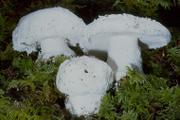 Catherine Ardrey |
23b Cap smooth, floccose, powdery, or areolate; volva not clearly defined, may be broken or ragged; base tapered or enlarged
................................................................................24
24a (23b) Cap diameter often smaller than stipe length, white, smooth beneath floccose to felted patches, margin appendiculate; stipe fusiform and rooting
................................................................................Amanita smithiana Bas
| CAP 5-17 cm broad, hemispherical to plano-convex, sometimes almost subumbonate; white, sometimes universal veil remnants darken in hot, dry weather; subviscid to tacky when moist; margin appendiculate, not striate, incurved at first, then flaring upward; context white. GILLS close to crowded; white to ivory or pale pinkish-buff; edges white, fimbriate and/or floccose; lamellulae truncate to attenuate. STIPE 6-16 cm long, 1-3.5 cm wide, tapers upward from a large spindle shaped (fusiform) base; white, bruising slightly where handled; surface decorated with floccose fibrils that come off in handling or in rain; flesh white. VOLVA evanescent or as patches of tissue near top of bulb on stipe. ANNULUS superior; white; floccose, ragged and sometimes evanescent. HABIT and HABITAT solitary to gregarious; grows with conifers in or near rotten wood; fruits in fall throughout Pacific Northwest. ODOR many specimens have no odor while others have one that is strong and unpleasant. TASTE mild to somewhat sweet. EDIBILITY TOXIC, causes kidney failure. SPORES 11-12.5 x 7.5-9.5 µm, broadly ellipsoid to subovoid; amyloid. REMARKS This amanita gives a positive red-violet reaction with syringaldazine indicating the presence of laccase, an enzyme that breaks down lignin. A. smithiana also has a long, radicating "root" which is seldom collected. | Amanita smithiana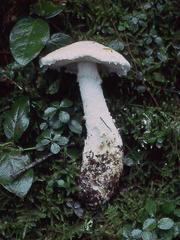 Dick Bishop |
24b Cap smooth to areolate, white or pale colored, some with pale colored warts or patches; volva may not be clearly defined
................................................................................25
25a (24b) Cap dull white to pale pinkish buff, sometimes areolate, margin inrolled; universal veil often absent or only as thin white patches with a pale salmon tint
................................................................................Amanita armillariiformis Trueblood and Jenkins
CAP 4-16 cm broad, convex to plane at maturity; dull white to dull pinkish-buff; slightly viscid to dry, glabrous or with thin patches of universal veil tissue that have a pale salmon tint and form irregular areolae; margin incurved when young, appendiculate; context white. GILLS subdistant, broad, white to pale tan; two tiers of lamellulae. STIPE 3.5-9 cm long, 1.7-2.4 cm wide; equal or expanding towards the base; white and very firm; fine tufts of fibrils and scales over lower surface. VOLVA seen as white to pale salmon remnants, concentric rings, partial rings or patches around the base. ANNULUS thin, membranous, white, superior, adhering to margin or falling away completely at maturity. HABIT and HABITAT one to several in dry areas among sagebrush, mustards, cheat grass and usually near aspen, Douglas fir or willow; fruits late March to mid-June. ODOR strong, medicinal, unpleasant. TASTE not tried. EDIBILITY unknown. SPORES 10-13 x 6.2-8.2µm, ellipsoid to somewhat elongate; amyloid. REMARKS Another species, A. prairiicola Peck (also known by an invalid name, A. malheurensis Trueblood, Miller & Jenkins) is found in a similar habitat. Both species are saprotrophic
25b Cap dull white turning yellowish to tannish cream, not pinkish, or off white with gray to tannish universal veil pieces; gills white, becoming yellowish, gray, or orange when dried; volva evanescent or as broken pieces on a tapered stipe
................................................................................26
26a (25b) Cap white at first, then yellowish or tannish cream; universal veil white to light tan, thin; gills off white to gray
................................................................................Amanita prairiicola Peck
CAP 2-11 cm broad, convex to nearly plane at maturity, non-striate, appendiculate, surface sticky when moist, white to tannish, flat, irregular warts or patches; context white, not bruising. GILLS moderately crowded, white to creamy or gray at maturity, drying yellow to orange; edges slightly floccose, lamellulae numerous and attenuate. STIPE 4-8(-15) cm long, 2-3.5 cm wide, tapering toward base, no distinct basal bulb, glabrous above annulus and fibrillose below, white becoming yellowish to pale or reddish brown where bruised or from age, solid. ANNULUS thin, narrow, white to pale tan, superior, membranous, persistent. VOLVA may be absent or as white, detersile squamules or patches. HABIT and HABITAT solitary to subgregarious in hard, dry soil or open grassland. Fruits after heavy, torrential rains. ODOR earth-like, medicinal becoming fetid and unpleasant when cut. TASTE not distinctive. EDIBILITY unknown. SPORES (8.0-)10.0-14.1 x (6.5-)6.6-9.6(-9.7) µm, smooth, thin walled, ellipsoid, some cylindrical or adaxially flattened; amyloid. REMARKS Originally named by Peck in 1897 from specimens collected in KS. In 1990 Trueblood, Miller and Jenkins published what they thought was a new species from Oregon, Amanita malheurensis. It was later determined that these two species were actually the same, so the name A. malheurensis was dropped.
26b Cap whitish, often areolate with pieces of gray to tannish universal veil; volva evanescent or as a ring or rings around a pointed base
................................................................................Amanita pruittii A. H. Sm. ex Tulloss, J. Lindg. & Arora
CAP up to 15 cm broad, white to off-white; surface rough with gray to light brown universal veil pieces of various sizes; margin incurved at first, uplifted in age, no striations, appendiculate; context white. GILLS close; broad; white, becoming yellow in age or in drying; edges irregular and browning when dried; lamellulae numerous, attenuate. STIPE up to 15 x 4 cm, broadest near the midpoint, tapering down to a rounded point; white, sometimes staining brownish; upper portion smooth, “floccose tags” around lower part; flesh white. VOLVA mealy pieces of tissue in the form of grayish scales form obscure rings on the base. ANNULUS evanescent. HABIT and HABITAT single or gregarious, often in arcs or a circle in meadows and grassy areas; fruits in the fall; not mycorrhizal. ODOR and TASTE not distinctive when raw, offensive and bitter when heated. EDIBILITY unknown. SPORES (7.2-)8.2-11.8(-14.0) x (6.2-)6.8-9(11.2) µm, smooth, subglobose to broadly ellipsoid; amyloid. REMARKS This species was fruiting heavily at the Fern Ridge Reservoir in 1975 and most years thereafter. It is the same species as David Arora’s "Anonymous Amanita." The above description was taken from notes written to A. H. Smith by Ben Pruitt, from unpublished correspondence from Rod Tulloss who worked on dried material from the herbarium at Michigan, and from recent material gathered by Janet Lindgren.
abruptly bulbous - top of bulb flattened, sides and bottom rounded
adaxially - toward the axis or central line
adnate - gills which are broadly attached to the stipe
adnexed - gills narrowly attached to the stipe
agaricoid - having exposed gills, mushroom shaped
amyloid - spores which stain bluish in Melzer’s reagent or iodine
annulus - a ring of tissue around the stipe
appendiculate - margin of cap fringed or adorned with fragments of the veil
areolae, areolate - spaces marked out on the surface, separated by cracks
attenuate - gradually narrowed
bulbose - enlarged at the base
clavate - base thickened like a club
convex - regularly rounded, domed
detersile - comes off cleanly
disc - center of the cap
ellipsoid - spores with rounded ends and slightly curved sides
evanescent - slightly developed and soon disappearing
farinaceous - mealy to powdery particles; may also refer to the odor of fresh meal
fimbriate - gill edges finely fringed by cells
floccose - loose cottony or soft tufts of tissue
flocculose - finely floccose
free gills - ones not attached to the stipe
friable - easily crumbled, fragile, breaking into powder or flakes
fusiform - spindle shaped, tapering in both directions from an enlarged part
gills - the knife-blade-like structures on the underside of the cap
globose - spherical, like a globe
habit - the general, external, and characteristic appearance, or manner of growth
habitat - the natural place of growth
inamyloid - not amyloid, spores will not stain bluish or gray in Melzer’s reagent
lamellulae - the short gills that do not span the whole distance from margin to stipe
limbate volva - membranous, attached closely around the bulb and with an open, free margin
macroscopic - large enough to be visible without the aid of the microscope
marginate bulb - with circular ridge around top edge of bulb; in age it may flatten to look like wide shoulders on a rounded bulb
Melzer’s reagent - an iodine solution used to test for an amyloid reaction of the spore wall
membranous - like a membrane or skinlike
nom. prov. - the name is not yet published
obtusely conic - rounded or blunt cone-shaped
plane - having a flat surface
plano-convex - convex but flattened on the disc
PNW - Pacific Northwest, that part of North America comprised of Southern British Columbia, Washington, Oregon, Idaho, and up to the Rocky Mountains in Montana
pruinose - finely powdered
radicating - growing deeply, root-like
saccate volva - one shaped like a sack, cup or sheath
saprotrophic - fungi that obtain nutrients by decomposing dead organic material
sensu. auct. - denotes the local authors’ concept of the species may not agree with the original author
spores - the reproductive units of a fungus
squamules - scale-like tissue
stipe - the correct term for the "stem" of a mushroom
striate, striations - radiating grooves or lines on cap margin
subglobose - almost spherical
subumbonate - center of cap slightly or broadly raised
truncate - appearing chopped off or abruptly ending
umbo, umbonate - having a raised knob or mound at center of cap
universal veil - the enveloping veil that covers an immature amanita and breaks to form a volva at the base. It often leaves remnants on the cap that are referred to as warts or patches.
vaginate: a stipe with a long volva or sheath at the lower end
volva - the remains of the universal veil; usually refers to the structure found at the base of the stipe
| GENUS AND SPECIES | KEY ENTRIES |
| AMANITA Pers. | |
| A."alba" sensu auct. | 7a |
| A. alpinicola Cripps & J. Lindgr. |
16b |
| A. aprica J. Lindgren & Tulloss | 15a |
| A. armillariiformis Trueblood and Jenkins | 25a |
| A. aspera | 20a |
| A. augusta Bojantchev & R. M. Davis | 20a |
| A. aurantisquamosa Trueblood, Miller & Jenkins | 17a |
| A. breckonii Thiers & Ammirati | 15b |
| A. calyptrata Peck | 3b |
| A. calyptroderma Atk. & Ballen | 3a, 3b |
| A. ceciliae sensu auct. PNW | 8a |
| A. constricta Thiers & Ammirati | 7b |
| A. farinosa sensu auct. PNW | 10a |
| A. franchetii sensu Thiers | 20a |
| A. gemmata group | 12a, 15b, 16a |
| A. gemmata var. exannulata Lange | 15b |
| A. inaurata | 8a |
| A. lanei (Murrill) Sacc. & Trott. | 3a, 3b |
| A. malheurensis Trueblood, Miller & Jenkins | 25a, 26a |
| A. muscaria var. flavivolvata (Singer) Jenkins | 11a |
| A. muscaria var. formosa sensu Thiers | 11a |
| A. muscaria (L.: Fr.) Pers. var. muscaria | 11a |
| A. novinupta Tulloss & Lindgren | 22a |
| A. ocreata Peck | 4a, 21a |
| A. pachycolea Stuntz in Thiers & Ammirati | 5a |
| A. pantherina group | 12a, 15b, 16a |
| A. pantherinoides (Murrill) Murrill | 12a, 15b, 16a |
| A. phalloides (Fr.: Fr.) Link | 19a |
| A. populiphila Tulloss & E. Moses | 9a |
| A. porphyria (Alb. & Schw.: Fr.) Alb. & Schw. | 18a |
| A. prairiicola Peck | 25a, 26a |
| A. pruittii A. H. Smith ex Tulloss, J. Lindg. & Arora | 26b |
| A. silvicola Kauffman | 23a |
| A. smithiana Bas | 23a, 24a |
| A. vaginata sensu auct. | 6a, 7a |
| A. velosa (Pk.) Lloyd | 4a |
| A. verna (Bull.: Fr.) Lamarck | 21a |
| A. vernicoccora Bojantchev & R.M. Davis | 3a |
| A. virosa Lamarck | 21a |
| "C-19" | 15b |
- END -